Departure
96%
vs 95% ▲ 1
 MY FS FLIGHTS
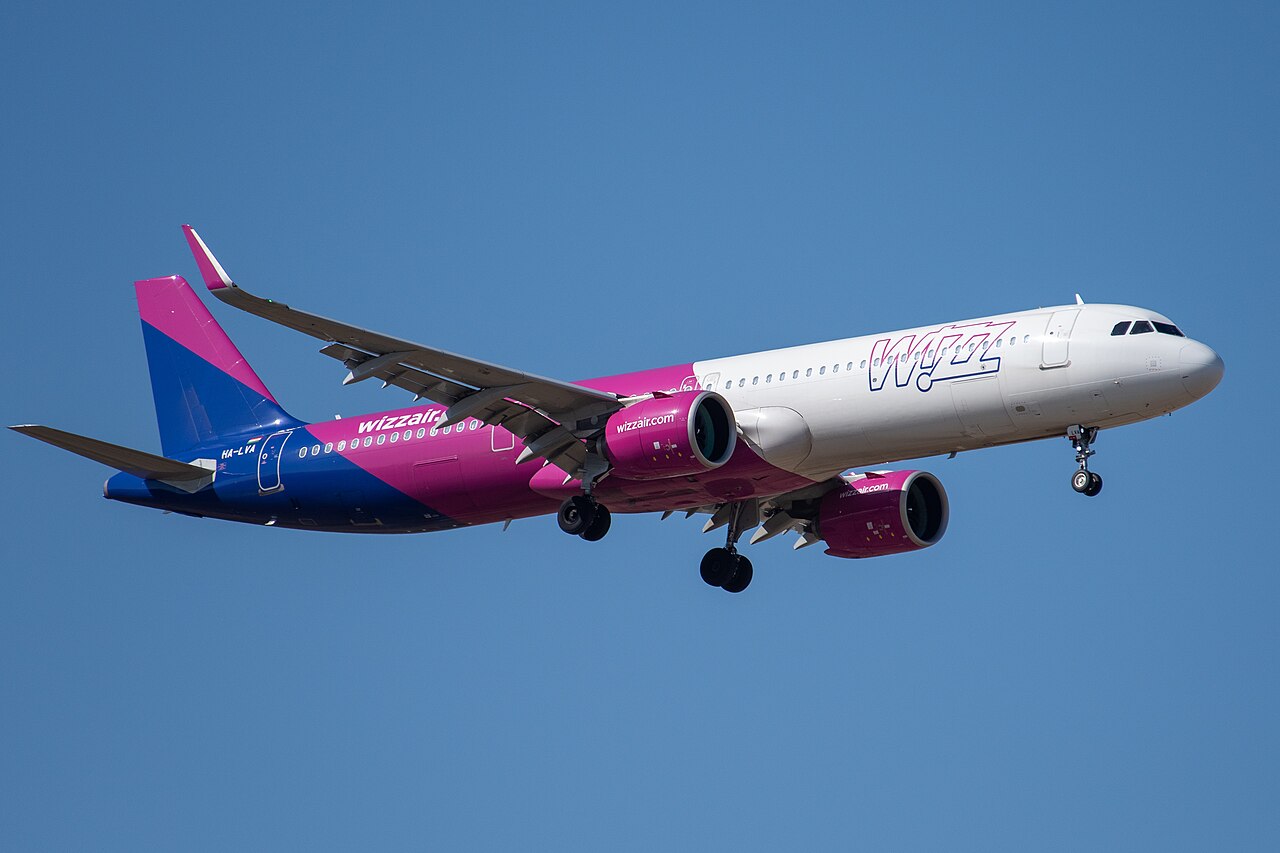
The Airbus A321neo is the largest member of the Airbus A320neo family, a narrow-body single-aisle airliner combining new-generation engines and Sharklet wingtips with the longest fuselage of any Airbus narrow-body in commercial use. Developed from the original A321 and launched in December 2010, it has become the best-selling large single-aisle jet, with primary operators including Wizz Air, IndiGo, American Airlines and Delta Air Lines. For a simulator pilot it represents the high end of the A320 family, offering the same type rating as its smaller siblings while stretching range and payload into territory once reserved for widebodies.
The A321neo is a narrow-body, single-aisle airliner built by Airbus as part of the A320neo family alongside the A319neo and A320neo, and it is the longest of the three. It is a low-wing cantilever monoplane with a conventional tail unit featuring a single vertical stabiliser and rudder, retractable tricycle landing gear, and two wing pylon-mounted turbofan engines. Developed from the Airbus A321, it typically seats 180 to 220 passengers in a two-class layout, with a maximum high-density arrangement of 244 passengers, and it shares a common type rating with every other A320-family variant so that pilots can move between them without further training.
Airbus announced the A321neo's development in December 2010 as an improvement and eventual replacement for the A321ceo, sixteen years after the original A321 had entered service. AerCap became the first customer to order the aircraft on 27 April 2011, and IndiGo became the first airline customer on 22 June 2011, ordering 304 aircraft. The prototype, registered D-AVXB and fitted with CFM International LEAP-1A engines, made its first flight from Hamburg on 9 February 2016, flown by test pilots Martin Scheuermann and Bernardo Saez Benito Hernandez; the flight lasted 29 minutes. Type certification for the Pratt & Whitney-powered version followed on 15 December 2016, with simultaneous EASA and FAA certification for the CFM LEAP-powered variant on 1 March 2017. The aircraft entered commercial service on 31 May 2017 with Virgin America, flying a GECAS-leased example configured with 185 seats and LEAP engines; Virgin America was later absorbed into Alaska Airlines in 2018, which took on its A321neo fleet. Boeing's competing 737 MAX had entered service nine days earlier. Early Pratt & Whitney PW1100G engines suffered reliability issues that delayed retrofits and pushed back deliveries to several airlines, including Cebu Pacific, Air New Zealand and Hawaiian Airlines, into 2018. Production began in 2016 and continues at final assembly lines in Hamburg, Germany; Toulouse, France; Mobile, Alabama, United States; and Tianjin, China. As of June 2025 a total of 7,064 A321neo aircraft had been ordered by 88 disclosed customers, with 1,752 delivered.
The A321neo retains the A321's overall length of 44.51 m but introduces new engines, standard Sharklet wingtip devices, and extended fuselage fuel tanks compared with the ceo. Two engine options are offered: CFM International LEAP-1A or Pratt & Whitney PW1100G-JM, each producing between 109 and 156 kN (24,500 to 35,000 lb) of thrust. Key dimensions are a cabin length of 34.44 m, fuselage width of 3.95 m, maximum cabin width of 3.70 m, wingspan of 35.80 m, height of 11.76 m, wheel track of 7.59 m and wheelbase of 16.90 m. Weights include a maximum take-off weight of 97.00 tonnes, maximum ramp weight of 97.40 tonnes, maximum landing weight of 79.20 tonnes and maximum zero fuel weight of 75.60 tonnes, with a maximum fuel capacity of 32,940 litres. Underfloor cargo capacity is rated at 10 LD3-45W containers or 10 pallets, with a water volume of 59 cubic metres. From 2015 the Aircraft Cabin Flex (ACF) layout became available as an option, replacing the second pair of doors ahead of the wing with two pairs of Type III+ overwing exits fitted with dual-lane slides to accommodate higher-density seating; the first ACF aircraft entered final assembly in Hamburg in October 2017 and made its first flight on 31 January 2018. Inherited from the A321 lineage, the aircraft uses double-slotted flaps and a wing area increased to 128 square metres to maintain performance despite the fuselage stretch.
The A321neo has a maximum operating Mach number of 0.82 and a standard range of 7,400 km (4,000 nm). Airbus states the aircraft delivers a 20 percent reduction in fuel burn and CO2 emissions per seat compared with the previous generation, alongside roughly 500 nautical miles of additional range or two tonnes of extra payload capacity. The long-range A321LR variant extends this to routes of up to 4,000 nm carrying 206 passengers by using up to three Additional Centre Tanks (ACTs), a configuration Airbus positions as well suited to transatlantic operations. Hawaiian Airlines found its 189-seat A321neos well matched to 2,100 to 2,300 nautical mile routes to the US West Coast, reporting per-seat costs slightly lower than its larger 294-seat A330-200s on comparable missions.
The core A321neo is offered with either CFM LEAP-1A or Pratt & Whitney PW1100G-JM engines and in either the original four-door exit configuration or the Aircraft Cabin Flex (ACF) layout, which trades the second forward door pair for overwing Type III+ exits to permit denser seating. The A321LR is the long-range derivative, using additional centre fuel tanks to reach up to 4,000 nm with 206 passengers and opening single-aisle transatlantic routes. The A321XLR extends this further as Airbus's next evolutionary step for the family, offering additional range up to 4,700 nm.
The A321neo entered commercial service on 31 May 2017 with Virgin America, whose fleet passed to Alaska Airlines following their 2018 merger. It has since become widely adopted across airline business models on every continent, with Wizz Air the largest operator and IndiGo, American Airlines and Delta Air Lines listed among its primary users. Turkish Airlines introduced the type to its fleet in 2018, describing it as its first narrow-body