Departure
97%
vs 95% ▲ 2
 MY FS FLIGHTS
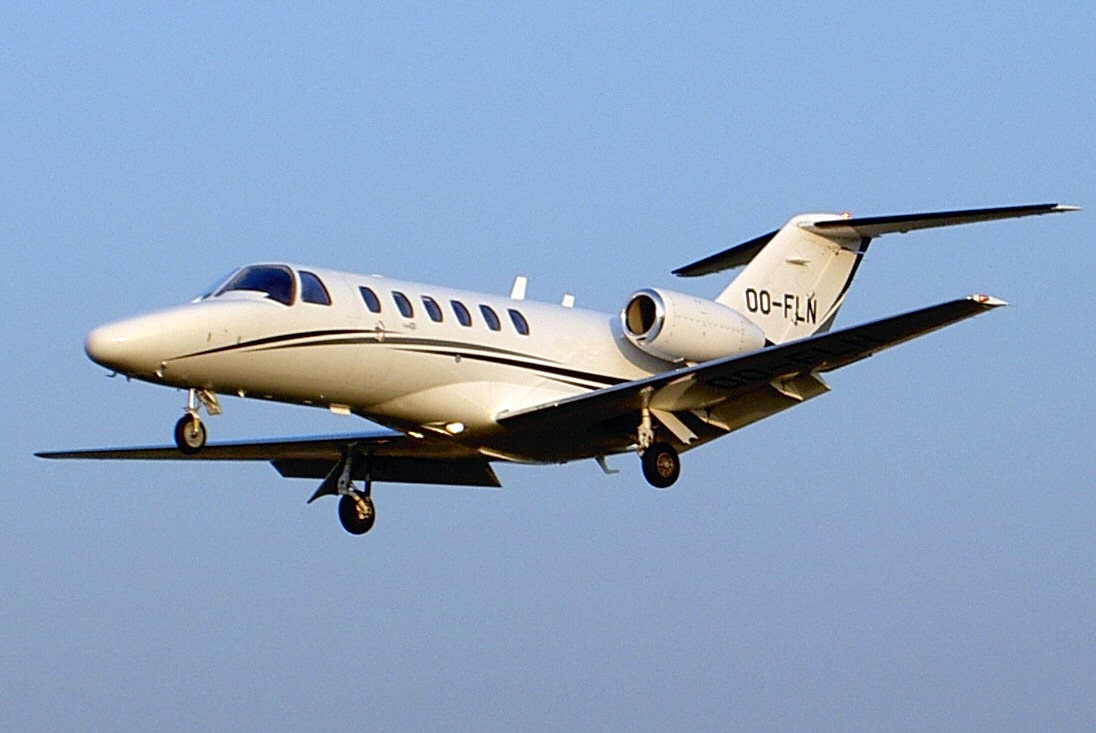
The Cessna Citation CJ3, known internally as the Model 525B, is a light business jet in Cessna's long-running CitationJet family, built by Cessna (now Textron Aviation) as a further fuselage stretch of the CJ2. Certified for single-pilot operation and powered by twin Williams FJ44-series turbofans, it sits toward the upper end of the light-jet category, offering business operators speed and short-field capability with the operating economics that made the original CitationJet line so popular. For a simulator pilot it represents a fast, modern, single-pilot-capable twinjet with a pedigree stretching back to the Citation I.
The Citation CJ3 is a twin-turbofan light business jet built by Cessna as part of the CitationJet/CJ family, a lineage that also includes the CJ1/M2, CJ2 and CJ4. Carrying the manufacturer's designation Model 525B and the ICAO type designator C25B, the CJ3 is a further fuselage stretch of the CJ2, itself a stretch of the original CitationJet. Like its stablemates it is certified for single-pilot operation, placing it in the owner-flown and light-charter segment of the business jet market.
The origins of the CJ series lie in the 1985 discontinuation of the Citation I, brought about by the rising cost of its Pratt & Whitney JT15D-1 engines, which had made it uncompetitive with its larger straight-wing Citation stablemates. Cessna judged that a market still existed for a light four-to-five passenger jet with low operating costs, docile handling and short-runway capability, but recognised that a new, lighter airframe using less expensive, lower-thrust engines would be needed to improve on the Citation I's cruise speed shortfall. The resulting Model 525 CitationJet was launched at the October 1989 NBAA convention in Atlanta at a price of $2.4 million, with Cessna estimating demand for 1,000 aircraft over ten years. It first flew on 29 April 1991, received FAA type certification on 16 October 1992, and was first delivered on 30 March 1993, meeting its design goal of a cruise speed 29 knots faster than the Citation I despite having 600 lbf less total engine thrust. The CJ1 was subsequently stretched into the CJ2/CJ2+, built between 2000 and 2016, and two further fuselage stretches produced the CJ3/CJ3+, built from December 2004 to the present. An upgraded CJ3+ variant received FAA certification in 2014, introducing Garmin G3000 avionics and M2-style cabin seating with foldable armrests. In 2021 Cessna announced updated Citation Gen2 versions of the M2, CJ3 and CJ4, adding more advanced avionics, autothrottles and cabin and cockpit upgrades; the CJ3 Gen2 received its FAA type certificate in October 2025, featuring improved avionics, a fully customisable cabin, an additional 4.5 inches of cockpit legroom, and a Garmin autothrottle. In 2024 Cessna announced plans for a further Citation Gen3 generation across the CJ/M2 line, intended to introduce the Garmin G3000 PRIME avionics suite and Garmin emergency autoland, with entry into service expected in 2026; existing Gen3 marketing material for the CJ3 already cites single-pilot operation and a 2,040-nautical-mile range.
The CJ family shares a common design philosophy across its variants: a monoplane with a cantilever, natural-laminar-flow supercritical wing developed in conjunction with NASA and Boeing, a T-tail with the engines mounted high on the rear fuselage, retractable tricycle landing gear with trailing-link main units for smooth touchdowns, and a pressurised, semi-monocoque fuselage of conventional riveted and bonded aluminium alloy construction. The forward fuselage and 58-inch-diameter circular cross-section are inherited from the Citation II, while composite materials are used in non-load-bearing fairings and the nose radome to save weight. The cockpit uses electronic flight instrument avionics, evolving through the Rockwell Collins Pro Line and later Garmin G3000 suites across the CJ3 and CJ3+ variants. Twin Williams FJ44-family turbofans power the series, with the CJ3 using higher-thrust FJ44-3A engines compared with the original CitationJet's 1,900 lbf FJ44s, reflecting the type's stretched fuselage and increased weights.
The original CitationJet on which the CJ3 is based was designed to cruise at up to 437 knots with a range of 1,500 nautical miles carrying four passengers, comfortably outperforming the Citation I it replaced in every significant respect except maximum payload and approach noise. The CJ3 carries this performance heritage forward with a larger, more powerful airframe; current Gen3 marketing for the type cites a range of 2,040 nautical miles with single-pilot operation, reflecting the cumulative aerodynamic and engine improvements made across the CJ3 and CJ3+ upgrades.
The CJ3 (Model 525B) is one link in a chain of progressive fuselage stretches within the CitationJet family: the original Model 525 CitationJet was updated into the CJ1/CJ1+, later rebranded the Citation M2; the CJ1 was stretched into the CJ2/CJ2+, produced between 2000 and 2016; two further fuselage stretches produced the CJ3/CJ3+, in production from December 2004; and the CJ4, with a moderately swept wing, has been built since 2010. The CJ3+ upgrade, certified in 2014, introduced Garmin G3000 avionics and M2-style cabin seating. In 2021 Cessna introduced Citation Gen2 versions of the CJ3 with more advanced avionics and autothrottles, with the CJ3 Gen2 receiving FAA type certification in October 2025 and adding a fully customisable cabin, extra cockpit legroom and a Garmin autothrottle. A Citation Gen3 CJ3, planned for service entry in 2026, is intended to introduce the Garmin G3000 PRIME avionics suite and Garmin emergency autoland capability.
The CJ3 continues the role established by the original CitationJet: a light, single-pilot-certified business jet intended for owner-flown and light-charter operations requiring good short-field performance combined with reasonable speed and operating economy. Across the whole CJ/CitationJet/M2 family, more than 2,000 aircraft had been delivered by June 2017, having accumulated some five million flight hours, underlining the series' broad and enduring popularity in the light business jet market.
The CJ3 inherits the docile, forgiving handling qualities that have characterised the CitationJet family since its Citation I-derived origins, combined with a trailing-link undercarriage intended to smooth out landings. Its single-pilot certification and modern glass cockpit avionics, evolving from Pro Line through to Garmin G3000 and later G3000 PRIME suites across its Gen2 and planned Gen3 updates, make it a natural fit for simulator pilots interested in single-pilot business jet operations, offering a manageable workload alongside genuine twinjet speed and short-runway capability.