Departure
89%
vs 95% ▼ 6
 MY FS FLIGHTS
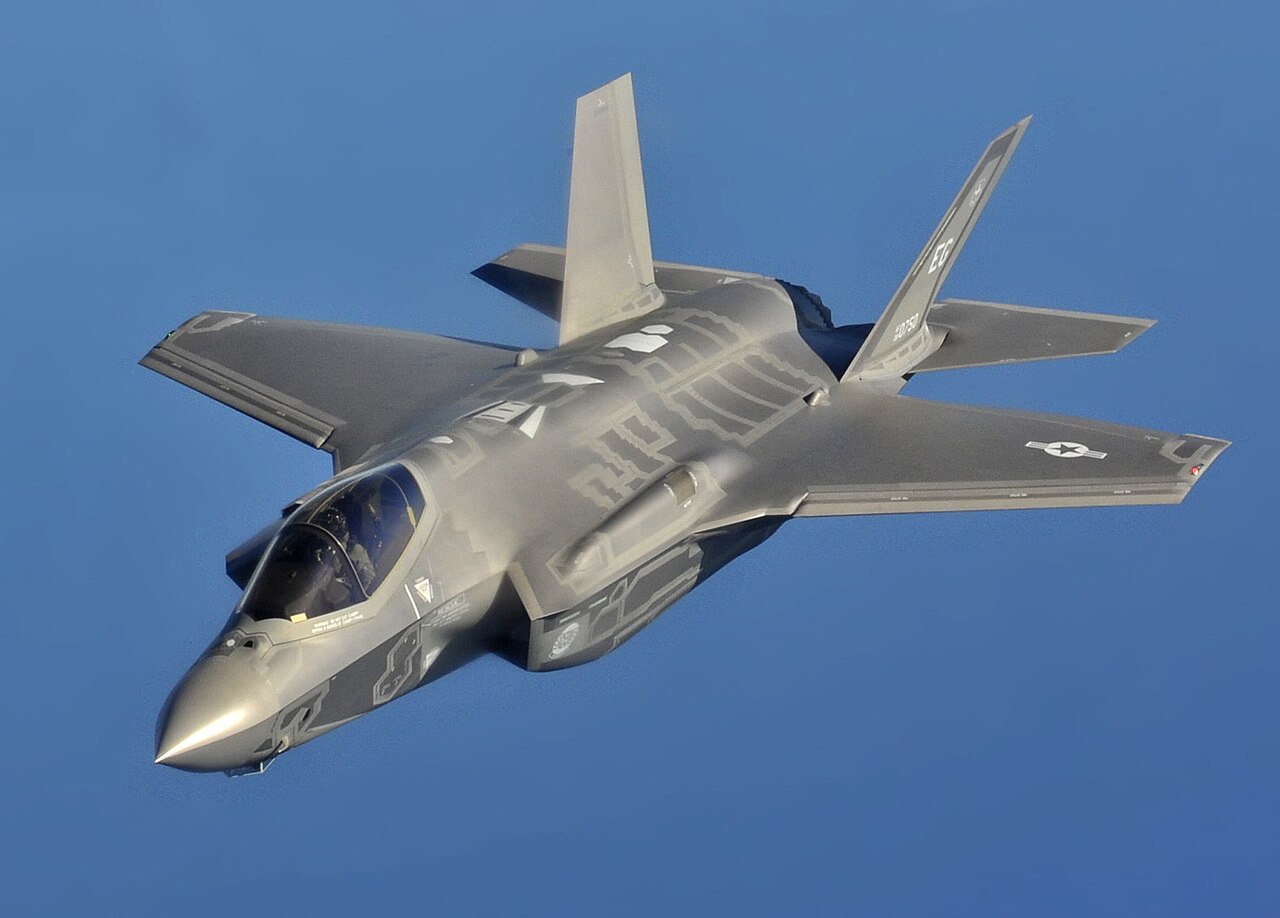
The Lockheed Martin F-35 Lightning II is an American single-seat, single-engine, supersonic stealth multirole fighter developed for the US armed forces and a wide coalition of allied air arms. Built in three variants for conventional, short take-off/vertical-landing and carrier operations, it descends from the X-35 that won the Joint Strike Fighter competition and now forms the backbone of Western fifth-generation fighter fleets. For a sim pilot it represents the most numerous and most data-fused stealth aircraft flying today, combining sensor fusion, networked warfare and, in the B model, vertical landing.
The F-35 Lightning II is a family of single-seat, single-engine, supersonic stealth strike fighters built by Lockheed Martin, with Northrop Grumman and BAE Systems as principal partners. It is a multirole combat aircraft designed primarily for air superiority and strike missions, and also carries electronic warfare and intelligence, surveillance and reconnaissance capabilities. Three main variants exist: the conventional take-off and landing F-35A, the short take-off and vertical-landing F-35B, and the catapult-launched, arrested-recovery carrier variant, the F-35C. With more than 1,340 aircraft built and 883 in service as of 2025, it is the world's fourth-most-numerous military aircraft and the most numerous stealth aircraft in service, intended to replace the F-16 Fighting Falcon, F/A-18 Hornet and AV-8B Harrier II across the US services and a large number of allied air forces.
The F-35 emerged from the Joint Strike Fighter (JSF) program, itself a merger of several combat-aircraft efforts from the 1980s and 1990s. DARPA's Advanced Short Take-Off/Vertical Landing (ASTOVL) program, running from 1983 to 1994, sought a Harrier replacement for the US Marine Corps and the UK Royal Navy; under its classified Supersonic STOVL Fighter effort, Lockheed's Skunk Works researched a stealthy supersonic STOVL fighter using a shaft-driven lift fan, initially envisaged as a single-engine canard delta weighing about 24,000 lb empty. ASTOVL became the Common Affordable Lightweight Fighter (CALF) in 1993, involving Lockheed, McDonnell Douglas and Boeing, before merging into the Joint Advanced Strike Technology (JAST) program that also absorbed the cancelled US Air Force Multi-Role Fighter and US Navy Advanced Attack/Fighter programs. The JSF development contract was signed on 16 November 1996, and the System Development and Demonstration contract was awarded on 26 October 2001 to Lockheed Martin, whose X-35 beat the Boeing X-32; the X-35 had first flown on 24 October 2000. Lockheed Martin enlarged the X-35 design into the F-35 following wind tunnel testing, lengthening the forward fuselage by 5 inches, moving the horizontal stabilators 2 inches rearward, raising the fuselage top surface by 1 inch along the centreline, and enlarging the F-35B's weapons bay to match the other variants; the addition of internal weapons bays, absent on the X-35, drove later weight problems. In 2004 the F-35B was found to be roughly 2,200 lb (8%) overweight and at risk of missing STOVL performance requirements, prompting Lockheed Martin to add engine thrust, thin airframe members, shrink the common weapons bay and vertical stabilizers, reroute thrust from the roll-post outlets to the main nozzle, and redesign the wing-mate joint and other structures. The first F-35A, AA-1, was rolled out at Fort Worth on 19 February 2006 and first flew on 15 December 2006 with chief test pilot Jon S. Beesley at the controls; the name Lightning II was announced on 7 July 2006, honouring the Lockheed P-38 Lightning and the English Electric Lightning. Unusually for a fighter program, no two-seat trainer version was built for any variant, advanced flight simulators being judged sufficient, with F-16s used as bridge trainers between the T-38 and the F-35. Commonality between the three variants, intended to cut costs, had fallen to just 20% of parts by 2017. The program drew heavy criticism for cost overruns and schedule delays, partly caused by low-rate initial production during development; by 2017 the lifetime program cost through 2070 was projected at $406.5 billion for acquisition and $1.1 trillion for operations and maintenance, and by 2024 the total program cost through 2088 was expected to reach roughly $2 trillion including inflation. The F-35B entered US service on 31 July 2015 with the Marine Corps, the F-35A on 2 August 2016 with the Air Force, and the F-35C on 28 February 2019 with the Navy, with full-rate production beginning in 2021 following completion of operational testing.
The F-35 is a single-seat, single-engine stealth fighter powered by the F135 engine, priced at around $20.4 million per unit as of 2025 and supplied to Lockheed Martin under a separate contract from the airframe. Internal weapons bays, absent on the X-35 demonstrator, were added to all three production variants and were a major driver of airframe weight growth during development. The design shares only around 20% of parts across the F-35A, F-35B and F-35C, far below the original commonality goals set to reduce production and logistics costs. The F-35 carries an Electro-Optical Targeting System (EOTS), developed with Northrop Grumman Electronic Systems, giving the pilot the ability to detect and track targets at long range with high accuracy, alongside broader sensor fusion intended to give pilots a networked, shared picture of the battlespace. Design deficiencies alleged during development and testing included a comparatively small internal weapons payload, vulnerability of the fuel tank to fire, and a propensity for transonic roll-off, or