Departure
92%
vs 95% ▼ 3
 MY FS FLIGHTS
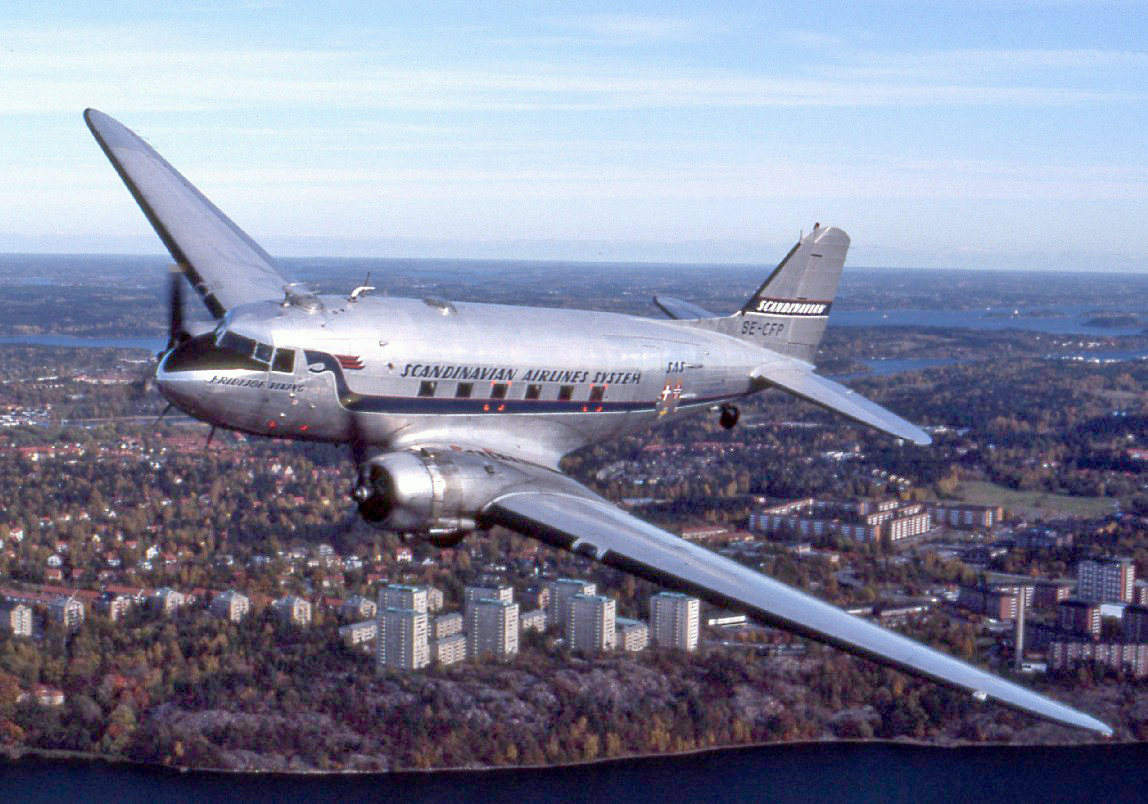
The Douglas DC-3 is a twin-engine, low-wing airliner developed by the Douglas Aircraft Company in the mid-1930s that transformed civil aviation and went on to serve as the backbone of Allied airlift in the Second World War as the C-47/Dakota. Renowned for its rugged simplicity, adaptability and short-field capability, it remains one of the most enduring and widely operated aircraft designs in history, still flying today in various roles decades after production ended. For a simulator pilot it represents a foundational type: a classic tailwheel, radial-engine transport that shaped modern air travel.
The Douglas DC-3 is a propeller-driven airliner and transport aircraft manufactured by the Douglas Aircraft Company, developed as a larger, improved 14-bed sleeper version of the earlier Douglas DC-2. It is a low-wing, all-metal monoplane with conventional (tailwheel) landing gear, powered by two radial piston engines of 1,000 to 1,200 hp. Early civilian aircraft used the 9-cylinder Wright R-1820 Cyclone, while later civilian DC-3s and most military versions used the 14-cylinder Pratt & Whitney R-1830 Twin Wasp. It occupies a central place in aviation history as the aircraft that made passenger flying profitable in its own right and, in its military C-47 Skytrain/Dakota guise, as one of the principal Allied transport types of the Second World War.
The DC-3 grew out of a 1934 approach by the newly formed American Airlines to the Douglas Aircraft Company, seeking a design that combined the speed, reliability and profitability of the DC-2 with the sleeping-berth comfort of the Curtiss Condor biplane it was replacing. What began as a proposed simple enlargement of the DC-2 required substantial redesign: the fuselage was lengthened and widened with rounded sides, the wings and tail surfaces were enlarged and strengthened, and the nose section and landing gear were modified, along with the fitting of new, more powerful Wright engines. Despite superficial resemblance to the DC-2, the finished DC-3 shared less than ten percent of its parts with its predecessor. The project was driven by American Airlines CEO C. R. (Cyrus) Smith, who persuaded a reluctant Donald Douglas in a marathon telephone call to build a sleeper aircraft based on the DC-2, informing him of American's intention to purchase 20 aircraft; the DC-2's 66-inch-wide cabin was too narrow for side-by-side berths, so the new design was given a 92-inch-wide cabin. Chief engineer Arthur E. Raymond led the design team over the following two years, and the prototype Douglas Sleeper Transport (DST) made its first flight on December 17, 1935, exactly 32 years after the Wright brothers' first powered flight, with Douglas chief test pilot Carl Cover at the controls. The DST was designed with seven upper and seven lower berths and a private forward cabin; a day-plane version with 21 seats instead of berths was given the designation DC-3. No prototype was built specifically as a DC-3, and the first production DC-3 followed seven DSTs off the line for delivery to American Airlines. American Airlines began DST nonstop New York-to-Chicago service on June 25, 1936, and started DC-3 service that September; other early US carriers including United, TWA and Eastern also placed large orders, with early operators together ordering over 400 aircraft. Civilian production continued until 1943, ending at 607 aircraft, though five Super DC-3s with Pratt & Whitney R-2000 Twin Wasps were built in the late 1940s as a later development, three of which entered airline service.
The DC-3 is an all-metal, low-wing monoplane with a cantilevered wing, all-metal vertical and horizontal stabilizers, and fabric-covered control surfaces (ailerons, rudder and elevators). Landing gear comprises two main wheels, which retract, and a steerable tailwheel, which does not. It is powered by two radial piston engines of 1,000 to 1,200 hp; early civilian aircraft used the 9-cylinder Wright R-1820 Cyclone, while later civilian aircraft and most military variants used the 14-cylinder Pratt & Whitney R-1830 Twin Wasp. Dimensions vary slightly by source and airframe: the type is generally given a wingspan of about 95 feet and a length over 64 feet, with a height of around 17 feet and a wing area of roughly 987 square feet. A preserved museum example lists an empty weight of 16,600 lb and a gross weight of 25,200 lb. Cabin capacity was 21 to 32 passengers in various configurations, or up to 6,000 lb of cargo. In civilian service the DC-3 was normally flown by a two-person crew, usually with a cabin attendant, while military versions used larger engines and a flight crew of three.
Published cruise speed for the DC-3 is 207 mph (333 km/h), though a preserved example is recorded with a cruise speed of 194 mph. Range is given as around 1,500 miles in general references, while a specific preserved airframe lists a range of 2,125 miles, reflecting later performance enhancements such as extended-range fuel tanks fitted to some aircraft. The type was noted for its ability to operate profitably from short runways, including grass or dirt strips, a quality that underpinned its long service life in developing regions with unpaved airfields. Transcontinental flights across the United States, with three refuelling stops, took about 15 hours eastbound and around 17 hours 30 minutes westbound against prevailing winds, a substantial improvement over the train-and-aircraft combination journeys that preceded it.
The core civilian line comprised the original Douglas Sleeper Transport (DST), fitted with 14 to 16 sleeping berths, and the day-plane DC-3 proper, seating 21 passengers (later variants seated up to 28). Civilian production totalled 607 aircraft before ending in 1943. A later civil development, the Super DC-3 (DC-3S), was built in small numbers in the late 1940s with Pratt & Whitney R-2000 Twin Wasp engines; five were built, three of which entered airline service. The design was extensively adapted for military use during the Second World War under a range of designations including the C-47 Skytrain (known as the Dakota in British RAF service), as well as C-53, R4D and other variants, with military production vastly exceeding civilian output. Licensed and derivative production also took place abroad, including the Soviet Lisunov Li-2 and the Japanese Showa/Nakajima L2D. Later conversions included the Basler BT-67 and the Conroy Turbo-Three and Tri-Turbo-Three turboprop modifications. Total production across all civil and military variants, including foreign-built versions, reached over 16,000 aircraft.
The DC-3 and DST rapidly popularised air travel in the United States after entering service with American Airlines in 1936, offering speed, range, reliability and passenger comfort that outclassed earlier types such as the Boeing 247. Early operators including United, American, TWA and Eastern collectively ordered over 400 aircraft, and by 1941 DC-3s represented some 80 percent of the US airline fleet, with similarly strong uptake internationally; at the type's peak in 1939, around 90 percent of the world's airline flights were made by a DC-3 or a variant. It was among the first airliners able to carry passengers profitably without relying on mail subsidies. During the Second World War, the design was adapted for troop and cargo carriage as the C-47, becoming a major contributor to the Allied war effort, with peak production reaching 4,853 aircraft delivered in 1944 alone; military variants were used by the armed forces of many countries for transporting troops, cargo and wounded, and the type was registered in at least 159 separate countries over its career. After the war, the airliner market was flooded with surplus transport aircraft and the DC-3 was gradually rendered uncompetitive on trunk routes by newer, faster and larger types such as the Douglas DC-4 and Convair 240. However, cheap, readily available surplus C-47s converted to civilian service became standard equipment for many of the world's airlines in the immediate postwar years and helped jump-start the global post-war air transport industry. The type proved highly adaptable to niche roles including cargo and freight transport, aerial spraying, sightseeing and charter work, and skydiving operations, with an estimated 2,000 DC-3s and military derivatives still flying in 2013, more than 300 in 2017, and around 150 as of 2023.
For a simulator pilot the DC-3 offers a genuine taildragger, twin-radial-engine flying experience rooted in 1930s airliner design: conventional landing gear with a steerable, non-retractable tailwheel demands proper handling on takeoff, landing and ground roll, while the two large radial engines and their distinctive sound and vibration are central to the type's character. Its documented ability to operate from short, unpaved runways reflects genuine robustness in the real aircraft and gives the type a reputation for forgiving, go-anywhere behaviour that appeals to pilots wanting a hands-on, procedurally rich transport aircraft rather than a modern glass-cockpit airliner. The aircraft's enduring popularity, summed up in the well-known line that