Departure
95%
vs 95% ▼ 1
 MY FS FLIGHTS
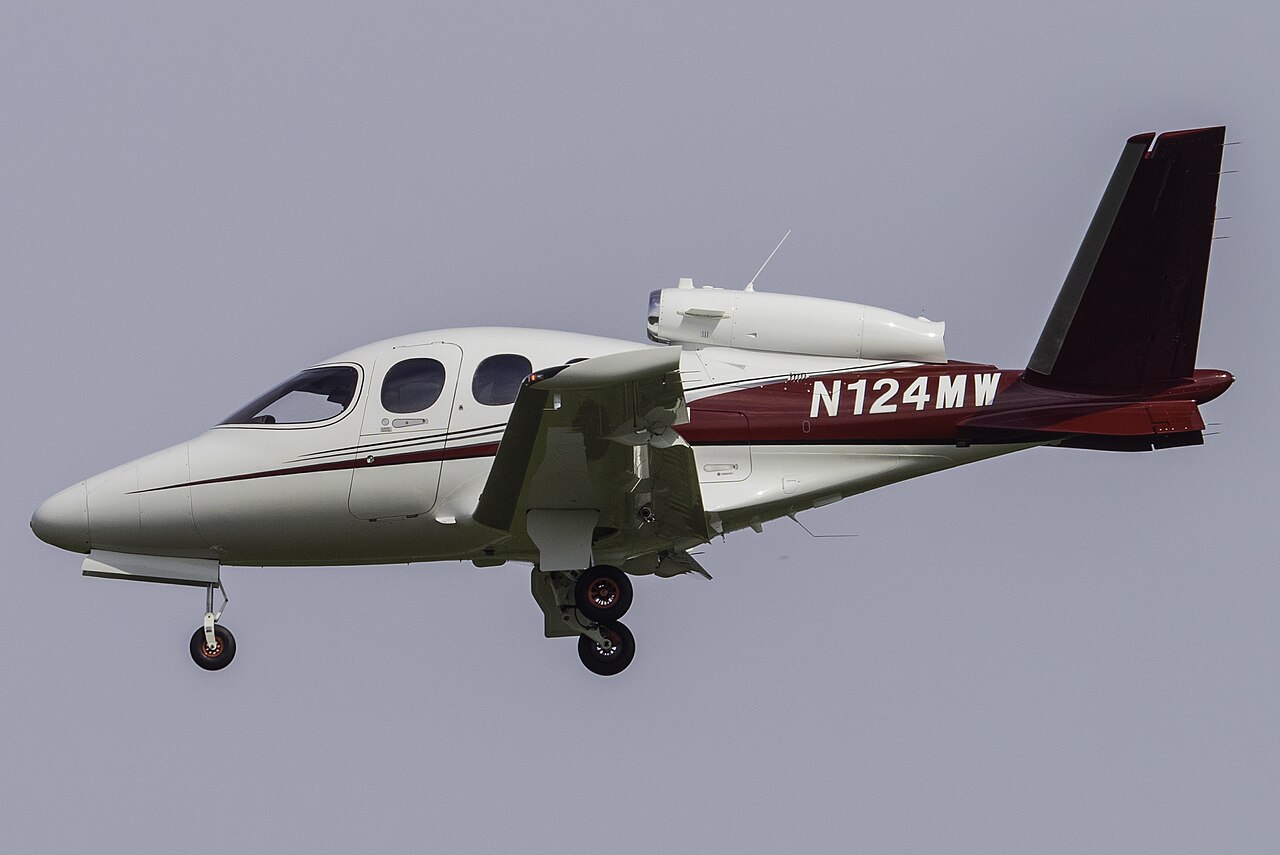
The Cirrus Vision SF50, known as the Vision Jet, is a single-engine very light jet designed and built by Cirrus Aircraft of Duluth, Minnesota, combining an all-carbon-fibre airframe, a single aft-mounted turbofan and a V-tail with the safety features Cirrus pioneered on its piston singles. It was the first single-engine civilian jet ever certificated, has been the world's best-selling business jet every year since 2018, and is of particular interest to sim pilots as a bridge between high-performance piston or turboprop flying and true jet operations, complete with a whole-airframe parachute and an autoland emergency system.
The Cirrus Vision SF50, marketed as the Vision Jet, is a single-engine very light jet produced by Cirrus Aircraft of Duluth, Minnesota. It is an all-carbon-fibre, low-wing aircraft with a distinctive V-tail and a single turbofan mounted above and behind the cabin, seating up to seven and pressurised for cruising at altitude. It holds the distinction of being the first single-engine jet certificated for civilian use, and it sits in the market between high-performance single-engine turboprops and conventional twin-engine business jets, having been the world's best-selling business jet every year since 2018.
The Vision Jet traces its lineage to Cirrus' first design, the 1988 pusher-prop homebuilt VK-30, from which the company developed a turboprop prototype, the ST-50, before beginning work on a jet in 2003 under founders the Klapmeier brothers and vice-president of advanced development Mike Van Staagen at an offsite Duluth facility nicknamed the Moose Works. The programme was announced publicly in June 2006 at a Cirrus Owners and Pilots Association meeting, and at the October 2006 NBAA Convention Cirrus detailed plans for US$100,000 customer deposits, a price below US$1 million and 2010 certification, targeting a 300 kn cruise around 25,000 ft using a Williams FJ33 engine and a whole-airplane parachute recovery system. Deposit holders received a mock-up unveiled on 28 June 2007, after Cirrus had used a jigsaw-puzzle marketing campaign to reveal the design piece by piece. The L-3 SmartDeck avionics package was selected in September 2007, and Cirrus leased a 189,000 sq ft former Northwest Airlines hangar at Duluth International Airport in which to build the aircraft. By May 2008 the company held 400 refundable deposits, and the prototype was shown publicly on 26 June 2008 before making its maiden flight at Duluth on 3 July 2008. Early flight testing, including 120 hours by December 2008 exploring the centre-of-gravity envelope, engine shutdown and restart, and stall characteristics, led to a redesigned nose, belly section, wing-root fairing, reduced tail sweep and a larger or dual ventral fin, along with replacement of the right-side door with a lighter emergency egress hatch. During this early phase the naming evolved from the project name The Jet, to Vision SJ50 in July 2008 (V for the V-tail, SJ for single-jet), to Vision SF50 by March 2009 to reflect the single-fanjet engine. Development slowed in 2009 owing to a lack of funding, and in 2011 Cirrus was bought by the Chinese enterprise CAIGA, which funded the project's revival a year later. A conforming prototype flew on 24 March 2014, followed by two further prototypes that year, and the FAA awarded a type certificate on 28 October 2016 under the name Model SF50. The first customer delivery took place on 19 December 2016 at a new US$16 million, 70,000 sq ft finishing centre in Duluth, against a backlog of 600 outstanding orders; by April 2017 Cirrus planned to deliver 25 to 50 aircraft that year and 75 to 125 in 2018. By July 2020, 200 jets had been delivered, and by December 2025 the total stood at 721. Production has continued at Duluth since December 2016, with the aircraft evolving through Generation 2 (G2), G2+ and G3 updates.
The Vision Jet is built almost entirely from carbon fibre, with a low-wing, V-tail configuration and a single Williams FJ33 turbofan mounted above and behind the pressurised cabin. The current G3 model offers seating for up to seven with a third-row option, a cabin the manufacturer describes as the largest in its class, and a flight deck built around Garmin's Perspective Touch+ avionics with a Garmin Touch Controller. Standard equipment includes the Cirrus Airframe Parachute System (CAPS), a stick shaker and pusher tied to an angle-of-attack indicator, Electronic Stability and Protection (ESP) to passively correct unusual attitudes, an automatically scanning Auto Radar system, alerts-linked checklists, 3D SafeTaxi with taxiway routing, and Runway Occupancy Awareness. Published G3 figures give a takeoff distance of 1,910 ft, a maximum range of 1,275 nm, a cruise speed of 317 KTAS, a useful load of 2,446 lb and seating for up to seven occupants.
Cirrus has described general cruise performance of 300 kn (560 km/h; 350 mph) with a range of over 1,200 nautical miles (2,200 km; 1,400 mi), figures that have improved with successive generations; the current G3 model is quoted at 317 KTAS cruise speed, a maximum range of 1,275 nm and a takeoff distance of 1,910 ft. Early development targets called for a 300 kn maximum cruise and 1,100 nmi range around a 25,000 ft cruising altitude on the Williams FJ33 engine. Reviews have compared the Vision Jet's performance to high-performance single-engine turboprops, and Cirrus markets it as having forgiving low-speed handling and approach speeds intended to ease the transition from piston aircraft into turbine flying.
The aircraft entered production as the original Generation 1 SF50 following FAA certification in October 2016. It was subsequently developed into the Generation 2 (G2) and G2+ models, which introduced features such as enhanced takeoff performance, Garmin Auto Radar, Safe Return emergency autoland and auto-throttle. The current G3 Vision Jet brings a reimagined cabin with premium materials, an expanded seating option for up to seven occupants via a new third row, ATC Datalink and more than thirty other refinements over earlier models.
The Vision Jet is used principally in private and personal ownership, the market Cirrus specifically targeted with its
Cirrus positions the Vision Jet as the easiest turbine aircraft to fly, citing the intuitive displays and robust automation of the Perspective Touch+ flight deck, simplified aircraft systems, and forgiving low-speed handling and approach speeds, backed by a type-rating programme tailored specifically to Cirrus owners moving up from piston singles. The type has been modelled for Microsoft Flight Simulator 2024, giving simulator pilots the chance to fly the same single-engine jet layout, V-tail and Cirrus safety systems, including the CAPS whole-airframe parachute and the Safe Return autoland function, that define the real aircraft.