Departure
95%
vs 95%
 MY FS FLIGHTS
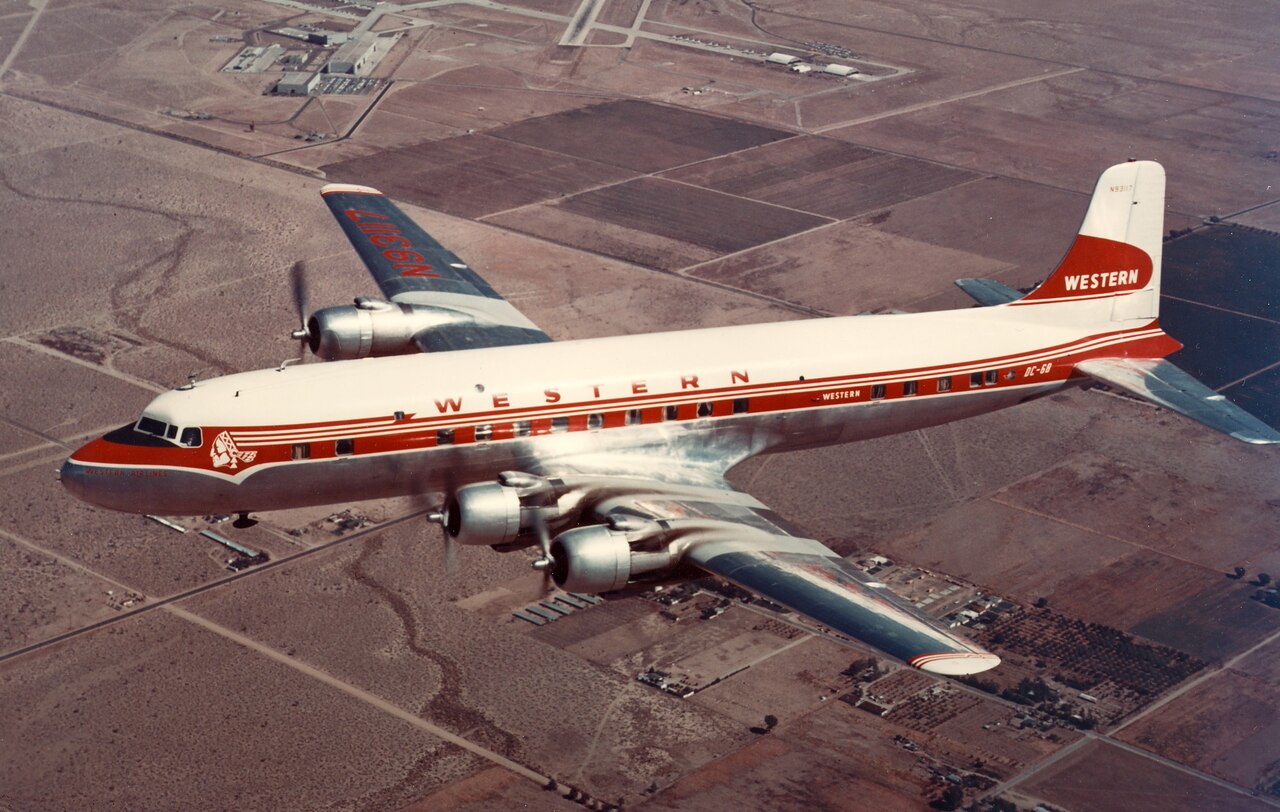
The Douglas DC-6A was the pure-freighter member of the DC-6 family, a stretched, higher-gross-weight development of Douglas's classic four-engined piston airliner built specifically for cargo work. Powered by more potent Pratt & Whitney R-2800 engines and fitted with double cargo doors, it became a mainstay of postwar air-freight operators and, in military guise as the C-118A/C-118B and Navy R6D, of the US armed forces. For simulator pilots it represents the golden age of round-engine, flight-engineer-crewed airliner operations, with surviving airframes still flying on cargo and heritage duties today.
The DC-6A was a cargo-configured derivative of the Douglas DC-6 airliner family, sharing the same basic fuselage cross-section and Pratt & Whitney R-2800 power as its passenger-carrying stablemates but stretched in length and strengthened for freight work. It sat alongside the DC-6B, the definitive passenger version, and the DC-6C, a convertible passenger/cargo model whose production was counted together with the DC-6A. Military versions of the same airframe were operated by the US Air Force as the C-118A Liftmaster and by the US Navy and Marine Corps, giving the type a dual civil and military career spanning decades.
The DC-6A emerged once more powerful Pratt & Whitney R-2800 engines became available, allowing Douglas to stretch the DC-6 airframe by over 4.5 feet to create a dedicated freighter with a heavier-duty cargo floor and forward and aft cargo doors on the left side of the fuselage. The first DC-6A was delivered to Slick Airlines in April 1951. Civil production of the DC-6A ran to 74 aircraft by the time the DC-6 line closed in December 1958, with three of the very last examples off the line becoming known individually for their subsequent preservation and film careers, including the aircraft later nicknamed "The Six". Alongside civil production, the US Air Force bought 100 C-118A Liftmasters based on the DC-6A, and the US Navy acquired 40 R6Ds.
The DC-6A used the same wing, tail and R-2800 radial engines as other members of the DC-6 family but with a fuselage stretched to a length of 32.18 metres (105 feet 7 inches), an increase of about 1.52 metres (5 feet) over the basic DC-6, to accommodate freight. It had a wingspan of 35.81 metres (117 feet 6 inches), a wing area of 135.9 square metres (1,463 square feet) and a height of 8.66 metres (28 feet 5 inches). Empty weight was 20,805 kilograms (45,860 pounds) and maximum take-off weight was raised to 48,600 kilograms (107,200 pounds) to cope with the increased structural and payload demands of freight operations. The cargo configuration featured C-54-style double doors aft of the wing plus a separate lift-up cargo door ahead of the wing, both on the port side, over a reinforced cargo floor. A convertible passenger/cargo derivative, the DC-6C, retained the same twin cargo doors but could be fitted with removable passenger seating; its production numbers were included within the DC-6A total.
Published figures for the DC-6A give a cruise speed of 510 km/h (315 mph / 275 knots), a service ceiling of 6,700 metres (22,000 feet) and a range with full load of 5,460 kilometres (2,565 miles / 2,950 nautical miles). These figures reflect an aircraft optimised to carry heavy freight loads over medium-to-long ranges rather than for outright speed, trading some of the performance of the later DC-7 for the strong reliability and economical operation for which the R-2800-powered DC-6 family was well regarded.
The DC-6A was the pure cargo variant of the family, distinguished from the passenger-only DC-6B by its forward and aft cargo doors and reinforced floor, and from the basic DC-6 by its fuselage stretch and higher maximum weight. The DC-6C was a convertible passenger/cargo model built on the same stretched airframe with the same twin cargo doors but removable seating, and its production figures were folded into the DC-6A total. Military derivatives included the USAF C-118A Liftmaster, of which 100 were procured, the US Marine Corps C-118B, and the US Navy R6D, 40 of which were built on the same basic design.
Slick Airlines was the launch operator of the DC-6A, taking delivery of the first example in April 1951, and the type went on to serve widely with dedicated freight carriers. Flying Tiger Line, which had operated Curtiss C-46s, C-47s, C-54s and Constellations after the Second World War, added the DC-6A to its all-cargo fleet, while American Airlines used DC-6A freighters on transcontinental cargo services. In passenger-carrying guise as convertible or leased aircraft, DC-6As also flew with airlines such as Eagle Airways and its successor Cunard Eagle Airways, including one example acquired from Maritime Central Airways in Canada in 1959; that aircraft's later career took in British Eagle, Saudi Arabian Airlines, Yemen Airways and eventually Air Atlantique, illustrating the long secondary careers typical of the type. Military C-118A Liftmasters served with the US Air Force, C-118Bs with the Marine Corps, and R6Ds with the Navy. Later in their careers a number of DC-6A airframes passed to smaller cargo operators such as Trans Continental Airlines, Northern Air Cargo, Conner Air Lines and Challenge Air Transport, with some surviving into recent decades on freight duties in North America.
Freeware and payware modelling of the DC-6A for desktop simulators has offered both combi and pure-freighter variants, with liveries recreating historical operators such as Flying Tiger Line and American Airlines' transcontinental freight service, reflecting the type's enduring appeal to enthusiasts of classic piston-engined cargo flying. Flying the DC-6A in the simulator puts the pilot in a four-engined, flight-engineer-crewed cockpit typical of the late piston airliner era, appealing to those who enjoy managing radial engines, cargo-configuration systems and the deliberate, workmanlike character that made the type such a reliable freight hauler in real operations.