Departure
91%
vs 95% ▼ 4
 MY FS FLIGHTS
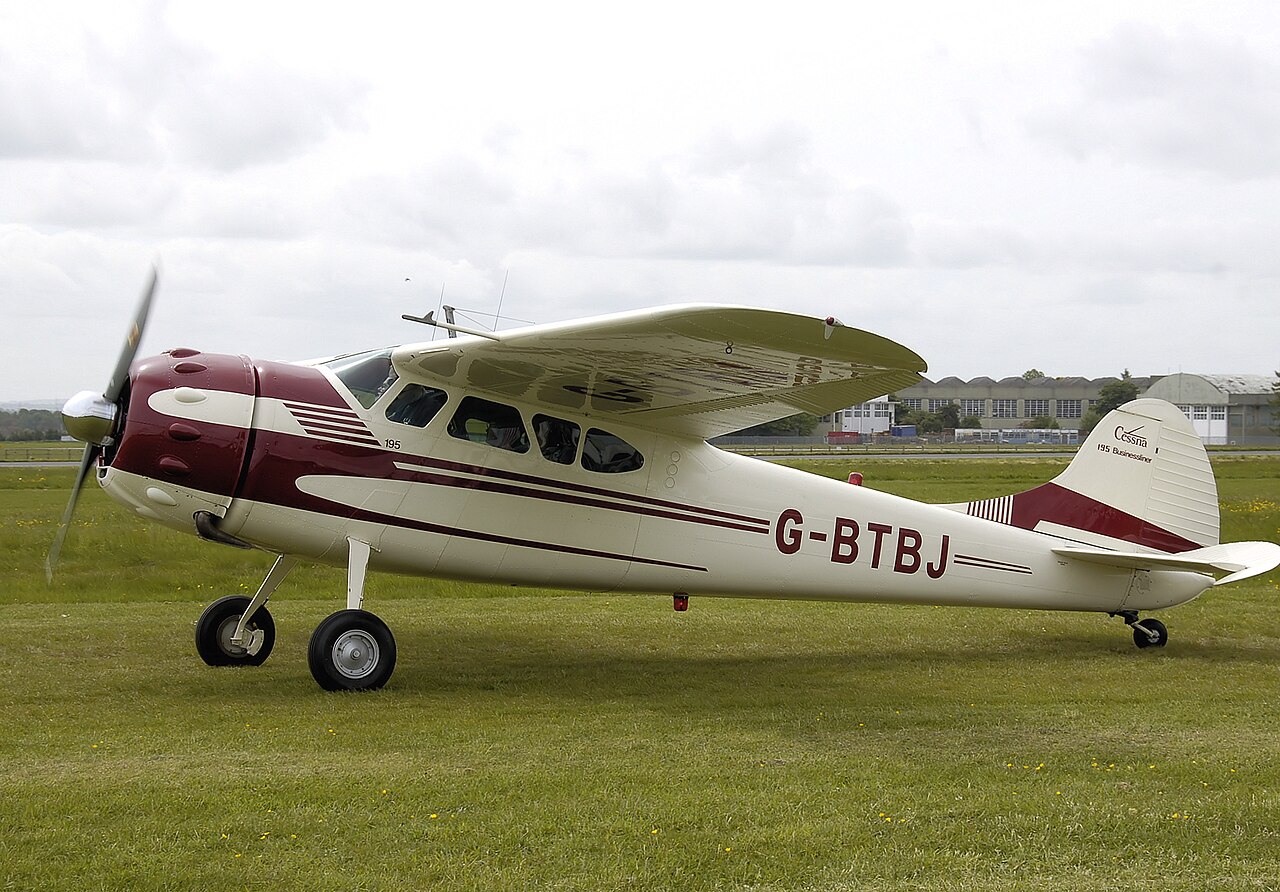
The Cessna 195 Businessliner is a five-seat, single-engine radial-powered light aircraft built by Cessna between 1947 and 1954, notable as the manufacturer's only postwar radial-engined design and the first Cessna built entirely of aluminium. Marketed as an executive transport for the business market and also flown by the US Air Force, Army and Air National Guard as the LC-126/U-20, it remains prized today as a graceful, torque-laden taildragger with genuine vintage character for the sim pilot who enjoys hand-flying a classic.
The Cessna 195 is a light personal and business aircraft, one of a family alongside the Cessna 190 that Cessna produced from 1947 to 1954. It is a conventional-gear (tailwheel), high-wing, single radial-engine design seating up to five, marketed under the name Businessliner because of its expense to buy and operate relative to other light aircraft of the period. It was the only postwar radial-engined type Cessna built, and besides civilian use it served the United States Air Force, United States Army and Army National Guard as the LC-126 and later U-20.
Plans for the 190/195 series began before US involvement in the Second World War, developed from the earlier Cessna Airmaster, but civilian development was shelved while Cessna built military types during the war. The first prototype, the P-780, flew on 7 December 1944 with a fabric-covered steel-tube fuselage rather than the all-metal structure of the eventual production aircraft. A further prototype flew in 1945 after the war ended, and production began for the 195 in July 1947 with serial number 7003, with the Continental-powered 190 following in October 1947. The 195 received its first type certificate on 12 June 1947 (Type Certificate A-790, which governed all subsequent 190/195 production). Serial numbers ran from 7003 to 7999 and then jumped to the 16,000 series, finishing at 16,183, giving a total production run of 1,180 aircraft including the 83 military LC-126 examples. Production ended in the autumn of 1954. The type is derived from the pre-war Cessna 165 Airmaster and was Cessna's first all-aluminium aircraft.
The 195 has a cantilever wing with a straight taper from root to tip and no dihedral, using a NACA 2412 airfoil, the same section later used on the Cessna 150, 172 and 182. Its fuselage is unusually large for a Cessna of its size because the 42-inch diameter radial engine required space in the nose. The cabin has two individual seats in the front row and a bench seat for up to three passengers behind, for a total capacity of five. Landing gear consists of flat sprung-steel legs derived from Cessna's purchase of the rights to Steve Wittman's Big X gear; many aircraft were later fitted with swiveling crosswind gear allowing landing with up to 15 degrees of crab, which eases the landing itself but makes ground handling more difficult. A retractable step, extended by opening the cabin door, is fitted, though some aircraft have been modified with a fixed step. Landing lights also retract into the wings when not in use. The pilot's side window rolls down, and pulling back the parking brake lever after pressing a release button locks the flight controls. The tailwheel is steerable for low-speed ground handling, and the engine swings out on its mount for maintenance access without removing the main cowling. The engine, a Jacobs R-755A2 rated at 300 hp on the original 195, is a seven-cylinder air-cooled radial known for high oil consumption of around 2 US quarts per hour; the aircraft carries a 5-US-gallon oil tank, with 2 US gallons regarded as the minimum for flight. Reported dimensions include a wingspan of 11.02 m (36 ft 2 in), external length of 8.33 m (27 ft 4 in), a fuselage diameter of 1.30 m (4 ft 3 in), and a wheelbase of about 6.3 m. Maximum takeoff weight is given as around 3,350 lb (1,500 kg) with a maximum payload of about 1,300 lb (600 kg). A factory floatplane version was fitted with a triple tail for improved yaw stability, and the float installation kit was one of the most extensive options, including a smaller left-side exit door and complete Zinc Chromate priming of the airframe. Other factory options included a propeller spinner, wheel fairings, dual landing lights, dual control wheels and radio equipment; rudder trim, crosswind landing gear and lighter gear legs were introduced progressively from certain serial numbers. Customers could even order a 195 without an engine and fit their own.
The 195 cruises at a true airspeed of around 148 knots (274 km/h, 170 mph) burning about 16 US gallons per hour, with a maximum cruise speed cited as 155 knots. Service ceiling is given as 18,300 feet with a rate of climb of about 1,200 feet per minute, and range is around 700 nautical miles. In the air the type is often compared to driving a car with a big V-8: the high-torque Jacobs radial swinging its large propeller produces a comforting rumble rather than the higher-pitched note of flat-engined light aircraft. Because the wing has no dihedral, the 195 lacks a degree of roll stability, and pilots need to use more rudder than in other large Cessnas, along with rudder trim after significant power changes to counter the Jacobs' torque. In the landing pattern the split flaps mainly serve to reduce angle of attack, improving the pilot's view over the cowling on final approach, rather than significantly affecting stall speed. The 195B's larger, re-designed elevators gave better cruise stability, and its enlarged split flaps improved pitch attitude on approach and speed-bleed characteristics without changing stall speed. Owners describe the aircraft as graceful and comfortable, handling turbulence well, though it demands active piloting rather than being a hands-off type, particularly given the crosswind gear's tendency to complicate ground handling despite simplifying the actual touchdown.
The 190 is powered by a Continental W670-23/24 engine of 240 hp, first certified 1 July 1947; it uses a shorter cowling than the Jacobs-powered variants, is about 10 mph slower, climbs roughly 200 fpm less, and burns about half a gallon per hour less than the 195, and few survive in original configuration since most have been converted to Jacobs powerplants for better parts availability. The 195, the original model, uses a Jacobs R-755A2 of 300 hp, certified 12 June 1947. The 195A uses a Jacobs L-4MB (R-755-9) of 245 hp, certified 6 January 1950, an engine that was cheaply available as military surplus and widely fitted by owners taking advantage of Cessna's bring-your-own-engine option, though it offers slightly less performance than the -A2 or -B2 engines. The 195B, certified 31 March 1952 and produced from mid-1952 until the end of the line in autumn 1954, uses a Jacobs R-755B2 of 275 hp, considered the most reliable and best-liked powerplant by owners, and features flaps increased in area by 50 percent along with redesigned, shorter-chord elevators for improved cruise stability. Military variants include the LC-126A (five-seat communications aircraft for the US Army, fitted with skis or floats, 15 built), the LC-126B (for Air National Guard use, five built) and the LC-126C (for instrument training and liaison, 63 built), all powered by the Jacobs R-755A2 and fitted with crosswind gear and other ground handling upgrades; after 1962 the USAF redesignated the LC-126B and LC-126C as the U-20B and U-20C respectively.
Cessna marketed the 195 chiefly as a business aircraft, the