Departure
—
 MY FS FLIGHTS
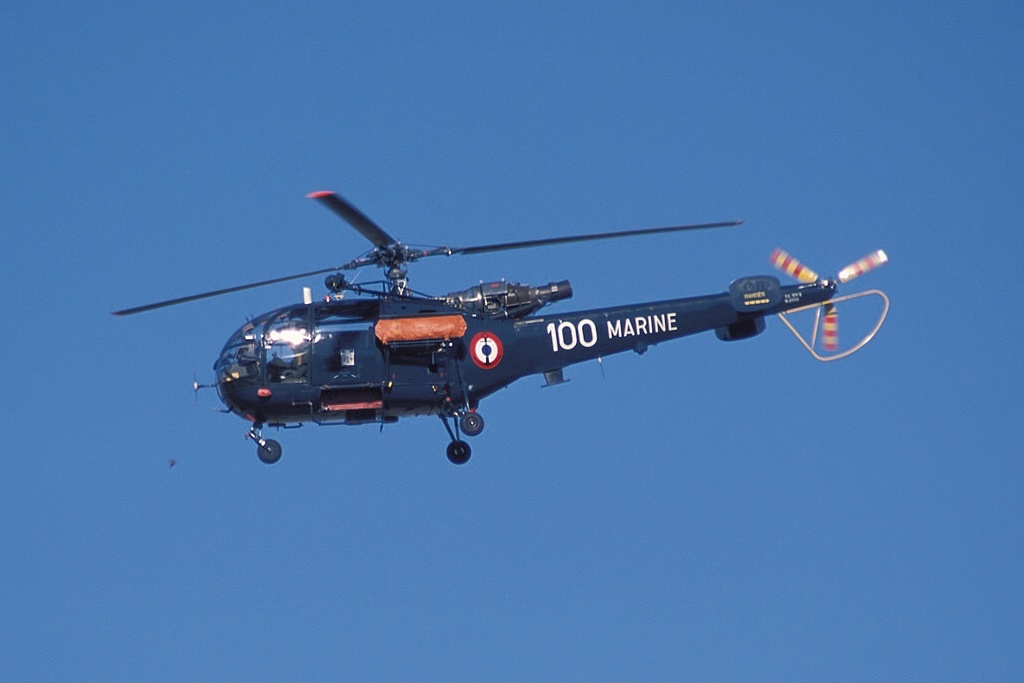
The Aérospatiale Alouette III is a single-engine, light utility helicopter developed by Sud Aviation and refined by Aérospatiale, first flown in February 1959 as an enlarged, more capable successor to the Alouette II. Renowned for its high-altitude performance and simplicity, it became one of the most widely produced helicopters of its era, serving military and civil operators worldwide in roles from mountain rescue to armed reconnaissance. For a sim pilot it represents an important slice of turbine helicopter history, prized for its glazed cockpit visibility and its reputation as a rugged, dependable mountain and utility machine.
The Alouette III (company designations SA 316 and SA 319, originally SE 3160) is a single-engine, light utility helicopter designed by French manufacturer Sud Aviation and later built by Aérospatiale following the 1970 merger. It was developed as an enlarged derivative of the earlier Alouette II, offering an extra pair of seats and a range of refinements while retaining much of its predecessor's basic layout. Introduced in the early 1960s, it went on to be manufactured for six decades, with more than 2,000 examples built, and it became a fixture of both military and civil rotary-wing operations across the world.
The Alouette III traces its origins to the Sud-Est SE 3120 Alouette, a piston-powered design that broke helicopter speed and distance records in July 1953 but proved too complex to be a viable commercial product. French government backing steered development toward a turbine-powered successor, made possible by Joseph Szydlowski's Turbomeca Artouste turboshaft, a 260 hp engine derived from his earlier Orédon design; this combination produced the Alouette II, which flew in March 1955 and became the first production turbine-powered helicopter in the world. Riding the commercial success of the Alouette II, Sud Aviation committed to a larger derivative capable of seating up to seven or carrying a pair of stretchers, with the design team led by engineer René Mouille. The resulting SE 3160 featured improved external visibility for the pilot and a more aerodynamically efficient, streamlined airframe. The prototype made its first flight on 28 February 1959, piloted by Jean Boulet, and the type soon became known as the Alouette III. During flight testing it repeatedly demonstrated exceptional high-altitude capability, landing at over 4,000 metres in the Mont Blanc range in June 1959 and at more than 6,000 metres in the Himalayas in October 1960, on both occasions flown by Boulet carrying two passengers and 250 kg of equipment. Serial production of the initial SE 3160/SA 316A model began in 1961, and the type received its airworthiness certificate on 15 December 1961. Although the French Army had ordered an initial batch of 50 aircraft in June 1961, the first two customers to actually take delivery were export buyers. Production ran under Sud Aviation from 1961 to 1970 and continued under Aérospatiale from 1970 to 1985, with the French production line eventually closing in the early 1980s. Licensed production extended the type's life considerably: Hindustan Aeronautics Limited in India built it from 1965 to 2021 as the HAL Chetak, Industria Aeronautică Română in Romania produced it from 1971 to 1987 as the IAR 316, and it was also assembled by Eidgenössisches Flugzeugwerk (F+W Emmen) in Switzerland and by Fokker and Lichtwerk in the Netherlands. Approximately 1,500 were built in France, with more than 300 built in India, around 200 in Romania and some 60 in Switzerland. The Alouette III's success eclipsed that of its Alouette II predecessor and it remained Aérospatiale's most successful helicopter by numbers built until surpassed by the Ecureuil in the mid-1980s. It was developed into further derivatives, including the high-altitude SA 315B Lama, which combined the Alouette III's Artouste powerplant and rotor system with a reinforced Alouette II airframe and entered operational service in July 1971, and it influenced later designs including the Aérospatiale Gazelle and the Atlas XH-1 Alpha.
The Alouette III is a light utility helicopter seating up to seven, a significant increase over the smaller Alouette II, and it retained the glazed, highly visible cockpit favoured for observation and rescue work. The initial SE 3160/SA 316A was powered by a Turbomeca Artouste turboshaft; the improved SA 316B, introduced in 1969 to replace it, retained the same Artouste III engine but featured a strengthened transmission and a greater maximum take-off weight. A further development, the SA 319B Astazou, entered production in 1968 fitted with a 450 kW (600 shp) Turbomeca Astazou XIV turboshaft in place of the Artouste, giving improved hot-and-high performance and better fuel economy. A preserved SA 316B Mk3 example is fitted with a single Turbomeca Artouste IIIB turboshaft rated at 649 kW (870 hp), has a length and height of 10.03 m by 3 m, and a rotor diameter of 11.02 m. The cabin could accommodate seven seats, or be configured with six seats removed to carry two stretchers or cargo, and most aircraft were equipped with a cargo hook for external slung loads. Military examples could be fitted with anti-tank missiles, anti-ship torpedoes and a fixed cannon, while civil aircraft were commonly equipped with external stretcher panniers for casualty evacuation.
The Alouette III was specifically designed for high-altitude flight and quickly earned a strong reputation for its favourable handling characteristics during mountain and rescue operations, demonstrated by its prototype landings at over 4,000 metres in the Alps and more than 6,000 metres in the Himalayas while carrying two passengers and 250 kg of equipment. A preserved SA 316B Mk3 is quoted with a maximum speed of 130 mph and a cruise speed of 115 mph, a range of 340 miles, and a service ceiling of 10,500 ft.
The initial production model was the SE 3160, later redesignated SA 316A, which remained in production for almost a decade until 1969. It was succeeded by the SA 316B, featuring a strengthened transmission and a higher maximum take-off weight while retaining the same Artouste III turboshaft. The SA 319 Alouette III Astazou, entering production in 1968 as the SA 319B, replaced the Artouste with a 450 kW (600 shp) Turbomeca Astazou XIV turboshaft for improved hot-and-high performance and fuel economy. The type was licence-built as the HAL Chetak in India, the IAR 316 in Romania, and was also produced under licence in Switzerland by F+W Emmen and in the Netherlands by Fokker and Lichtwerk. A related high-altitude derivative, the SA 315B Lama, combined the Alouette III's Artouste powerplant and rotor system with a reinforced Alouette II airframe and entered service in July 1971.
The Alouette III served a wide range of military and civil operators, with principal military users including the French Armed Forces, Indian Armed Forces, Portuguese Air Force and Rhodesian Air Force. In military service it performed aerial observation and photography, air-sea rescue, communications liaison, transport and training, and could be armed with anti-tank missiles, anti-ship torpedoes and a fixed cannon. Civil operators used it for casualty evacuation with external stretcher panniers, crop spraying, personnel transport and external load carrying. The Irish Air Corps operated the type for 44 years until its retirement on 21 September 2007, during which its fleet amassed over 77,000 flying hours, flew 1,717 search-and-rescue missions credited with saving 542 lives, and completed a further 2,882 air ambulance flights. The French Air Force retired the type in June 2004 after 32 years of service, while the Swiss Armed Forces announced retirement from front-line service by 2006 and complete withdrawal by 2010, and Venezuelan forces retired their Alouette IIIs in the late 1990s. The French Navy began replacing its remaining Alouette IIIs with rented SA 330 Pumas from January 2018 owing to rising unreliability and operating costs, though the type remained in limited service until its final withdrawal from French Navy use in June 2022. By the 2010s many operators were drawing down their fleets in favour of more modern types, with the French Armed Forces moving toward the Airbus Helicopters H160 and the Indian Armed Forces toward the HAL Dhruv.
For a sim pilot, the Alouette III's appeal lies in the qualities that made it a real-world favourite for mountain and rescue flying: its large glazed cockpit gives excellent external visibility, and its documented high-altitude performance, including operations well above 4,000 metres, reflects a helicopter designed from the outset to work effectively in thin air and demanding terrain. Its straightforward turboshaft powerplant and simple systems, inherited in spirit from the pioneering Alouette II, made it a rugged and relatively easy type to operate and maintain, characteristics that carry over into an appreciation of its handling as a classic, unpretentious utility helicopter rather than a complex modern type.