Departure
96%
vs 95% ▲ 1
 MY FS FLIGHTS
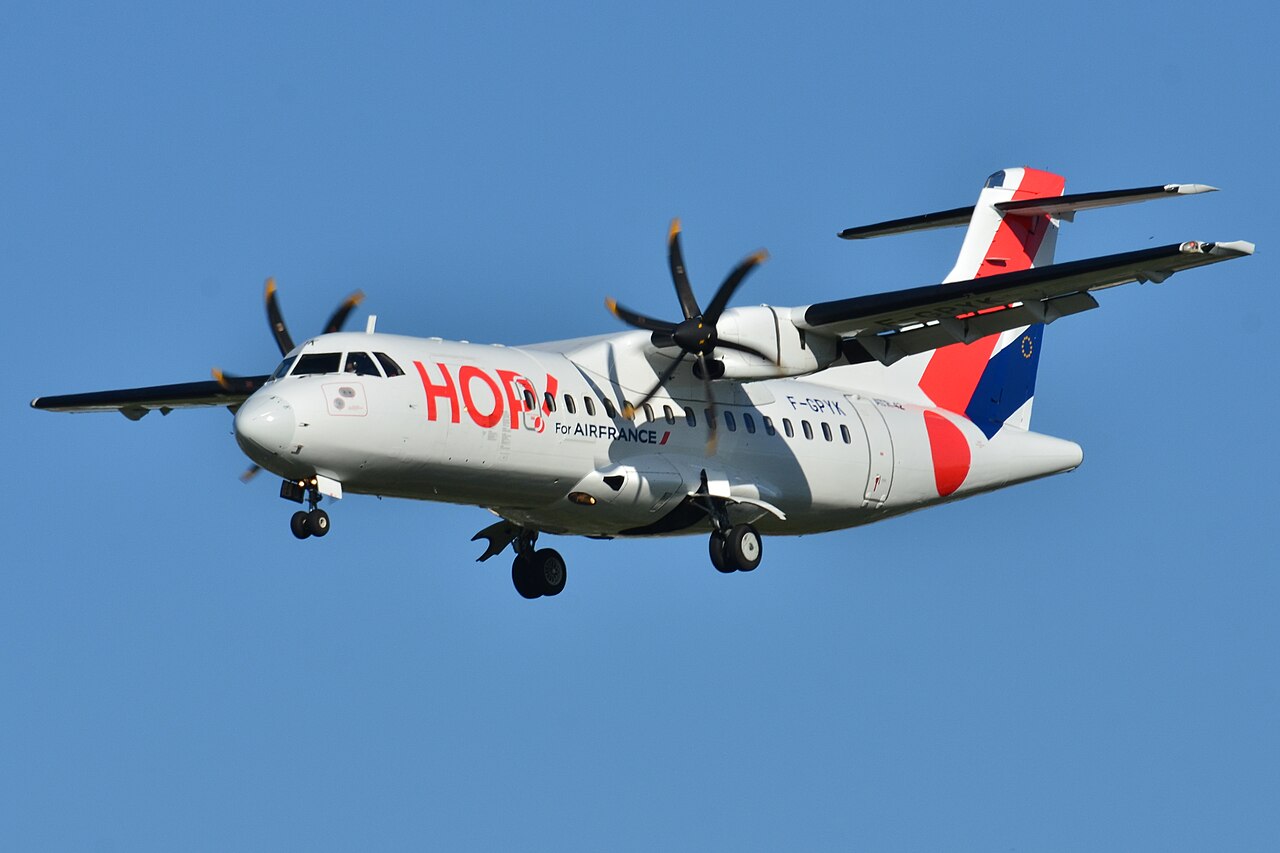
The ATR 42-500 is the top-of-the-line member of the original ATR 42 family, a twin-turboprop regional airliner built by the Franco-Italian manufacturer ATR, a joint venture between Aerospatiale and Aeritalia. Introduced in the mid-1990s as an upgraded evolution of the earlier ATR 42-300/320, it brought more powerful engines, six-blade propellers and improved hot-and-high performance, and it remains a familiar sight with regional and island carriers worldwide. For a sim pilot it represents a well-proven, short-field-capable turboprop with genuine performance depth rather than a token regional type.
The ATR 42-500 is a twin-engine, high-wing turboprop regional airliner produced by ATR, the joint venture formed by French Aerospatiale and Italian Aeritalia. It sits within the ATR 42 family, which itself gave rise to the larger stretched ATR 72, and the -500 designation represents the most capable pre-600-series version of the type, aimed at operators needing strong hot-and-high and short-field performance alongside improved cabin comfort.
Development of the ATR 42-500 was announced on 14 June 1993 as the next major production version of the ATR 42, following the original ATR 42-300/320. The aircraft performed its maiden flight on 16 September 1994 and was awarded certification by the British Civil Aviation Authority and France's Directorate General for Civil Aviation during July 1995. The first ATR 42-500 was delivered to Italian operator Air Dolomiti on 31 October 1995, and the type's first revenue service was flown on 19 January 1996. On 19 November 2000, 120-minute ETOPS approval was granted for the type. The -500 remained the flagship ATR 42 variant until 2 October 2007, when ATR CEO Stephane Mayer announced the launch of the further-improved -600 series, which succeeded it in production.
The ATR 42-500 is powered by two Pratt & Whitney Canada PW127E/M turboprop engines, driving six-bladed Hamilton Standard propellers of 3.93 m diameter, in place of the four-bladed propellers of earlier models. Take-off power is rated at 2,160 SHP per engine, rising to 2,400 SHP on one engine in the event of an engine-out take-off; maximum continuous power is 2,400 SHP, maximum climb power 2,160 SHP and maximum cruise power 2,132 SHP. The aircraft has an overall length of 22.67 m (74 ft 5 in) and a height of 7.59 m (24 ft 11 in). In standard configuration the cabin seats 48 passengers, with additional overhead bin volume compared with earlier models, able to accommodate items up to 2 m (6.5 ft) in length, and a high-capacity air conditioning system similar to that of jet aircraft.
The -500 upgrade brought new PW127 engines and six-bladed propellers specifically to improve hot-and-high take-off capability and short-field performance, with outstanding single-engine take-off performance retained even in demanding hot-and-high conditions. Typical cruise speed is around 300 kt, with a maximum operating altitude of 25,000 ft. Balanced field length is quoted at 4,192 ft with a landing distance of 2,821 ft, underlining its short-field capability. Range varies considerably with payload: up to 2,311 nm with a full passenger load in some operating configurations, versus a shorter-range figure of around 772 nm quoted for a 48-seat, high-density regional configuration. The type was approved for 120-minute ETOPS operations from 19 November 2000, extending its usefulness on overwater and remote routes.
The ATR 42-500 sits between the original ATR 42-300/320, which used earlier engines and four-bladed propellers, and the later ATR 42-600 and short-field ATR 42-600S, launched in 2007 and 2019 respectively, which introduced further engine, avionics and glass-cockpit improvements. The ATR 42 family as a whole also spawned freighter conversions, such as the ATR 42-300F operated by FedEx Feeder, and formed the basis for the stretched ATR 72.
Air Dolomiti was the launch operator of the ATR 42-500, taking delivery of the first aircraft on 31 October 1995 and flying the type's first revenue service in January 1996. Romanian flag carrier Tarom accepted delivery of its first two ATR 42-500s on 5 June 1998, part of a batch of seven ordered the previous year. The type has continued in service with regional and island operators, including interCaribbean Airways, which uses a 48-seat ATR 42-500 for short-field regional flights in the Caribbean, and Canadian North, which operates the type in the demanding conditions of northern Canada.
The ATR 42-500's defining characteristics for a pilot are its short-field capability and its retained single-engine performance in hot-and-high conditions, qualities that stem directly from its PW127 engines and six-bladed propellers. Balanced field lengths of little over 4,000 ft and landing distances under 3,000 ft mean it is well suited to operations into smaller or more challenging regional airports, while its 120-minute ETOPS clearance reflects a genuine long-range regional capability beyond simple short-hop flying. These traits make it an interesting type to fly for anyone wanting a turboprop that rewards careful energy and power management on approach and departure, rather than one flown purely as a scaled-down jet.