Departure
95%
vs 95%
 MY FS FLIGHTS
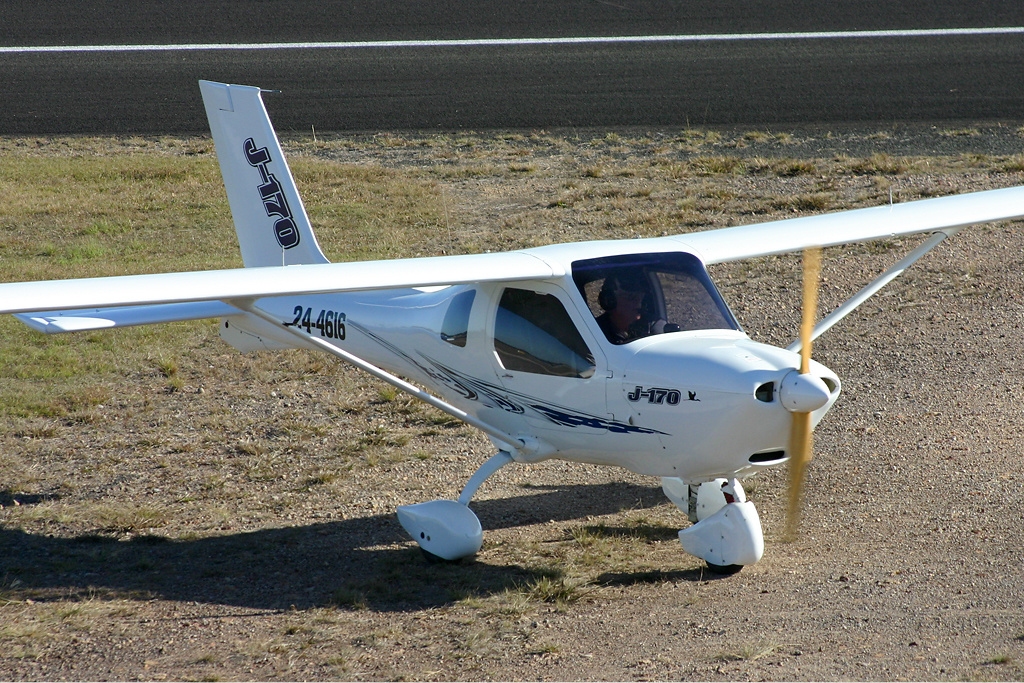
The Jabiru J170 is an Australian light-sport and ultralight aircraft built by Jabiru Aircraft of Bundaberg, Queensland, designed primarily as a rugged, low-cost trainer. Combining the J160 fuselage with the longer wings of the J430/J230 family and a bigger elevator, it offers strong climb performance in hot, high-altitude conditions, making it a familiar sight at flying schools around the world.
The Jabiru J170 is a two-seat, side-by-side, high-wing light-sport and ultralight aircraft designed and produced by Jabiru Aircraft in Australia. It is offered both as a complete ready-to-fly aircraft and as a kit for amateur construction, and it complies with US light-sport aircraft rules, United Kingdom BCAR Section S requirements, and qualifies in Canada as an Advanced Ultralight. Jabiru markets it as its workhorse trainer, calling it "The Worker" and describing it as Australia's trusted training aircraft.
The J170 was derived from the Jabiru J160 by combining the J160 fuselage with the wings from the Jabiru J430, along with a larger elevator to improve rate of climb at higher density altitudes. It was designed to comply with US light-sport aircraft rules at a gross weight of 600 kg. The model has also been described as the J160 fitted with the longer wings of the J230 and a bigger elevator, developed specifically with flying schools in hotter climates in mind, since the longer wings both improve climb performance in hot conditions and provide more float on landing, which is useful for student pilots learning to land. By 2011 around 400 examples had been built, and the type remained in production as of 2012. The aircraft has continued to evolve, with later production built around the Jabiru 2200 GEN4 engine and a factory-designed two-blade fixed-pitch composite scimitar propeller.
The J170 is a strut-braced high-wing monoplane with winglets, an enclosed two-seat side-by-side cockpit, fixed tricycle landing gear and a single tractor-mounted engine. Construction is all-composite, which avoids corrosion issues associated with metal airframes. The wet wing spans 9.66 m (31 ft 8 in) with an area of 9.56 sq m (102.9 sq ft) and an aspect ratio of 9.8:1, and incorporates flaps, large ailerons and winglets for good crosswind handling. Fuel capacity is 135 litres. Length is 5.775 m (18 ft 11 in) and height is 2.300 m (7 ft 7 in). Empty weight is given as 320 kg (705 lb) in Jabiru's general specification, though the South African-market J170-D lists a bare empty weight of 330 kg with a useable weight of 270 kg; maximum takeoff weight is 600 kg (1,323 lb) across sources. The standard powerplant is the Jabiru 2200, a four-cylinder, air-cooled, four-stroke engine; Jabiru's own current literature quotes 60 kW (80 hp), while other reference sources give 63 kW (85 hp). It drives a two-blade wood/composite or composite scimitar propeller of 1.52 m (5 ft 0 in) diameter. The cockpit features dual controls, adjustable rudder pedals, panel-mounted throttles, and a hard-wearing interior with removable seat covers; South African-built aircraft add a rear luggage door. Standard equipment includes carburettor air heating, dual ignition, a pressure-compensating carburettor with automatic mixture control for single-lever power management, an auxiliary electronic fuel pump, dual landing lights, wingtip navigation lights, a tail strobe and interior lighting for night flying. The type is built to the ASTM F2245 light-sport aircraft design standard.
Cruise speed at 75 percent power is quoted as 100 knots true airspeed, achievable at 2850 rpm, while Wikipedia's figures give a cruise speed of 185 km/h (115 mph, 100 kn) and a maximum speed of 240 km/h (150 mph, 130 kn), with a never-exceed speed of 260 km/h (160 mph, 140 kn). Stall speed without flaps at 600 kg is 45 knots (72 km/h, 45 mph, 39 kn full flaps in some listings), while Jabiru's own current data gives VS0 clean at 45 knots and VS1 full flap at 40 knots. Range at max range speed is 850 nm (nil-reserve endurance of 8.5 hours), while an alternative figure quotes a maximum range of 1,910 km (1,190 mi, 1,030 nmi). Fuel consumption is 16-19 litres per hour. Rate of climb is 500 ft/min (2.5 m/s), service ceiling is 4,600 m (15,000 ft), and the aircraft is rated to +4/-2 g with a maximum glide ratio of 10:1. Maximum crosswind capability is listed at 14 knots. Handling is described as gentle and predictable through the stall, with light and responsive controls; the wide wingspan and high aspect ratio wing give good stability in turbulence and comfortable operation at high altitude or from short runways. Intentional spins are prohibited, and the aircraft is not approved for flight in known icing conditions or heavy rain.
The J170 sits within the wider Jabiru light aircraft family, sharing its fuselage lineage with the J160 and its wing design with the J430/J230. A specific sub-variant, the J170-D, is documented in Jabiru's pilot operating handbook and described as having been developed with hot-climate flying schools in mind while continuing to embody the original Jabiru design philosophy. Aircraft built in South Africa are supplied as standard with a Jabiru ground-adjustable Scimitar composite two-bladed propeller and a rear luggage door not necessarily fitted elsewhere.
The J170 is used extensively as an ab-initio trainer, valued for its straightforward, safe platform for teaching stick-and-rudder flying and for its low operating costs, which Jabiru presents as giving flight schools and operators a competitive edge. It is also used as a rugged utility aircraft. In South Africa the type has seen extensive use both for flying training and for anti-poaching operations, including the aircraft registered ZU-OPS used in the Rhino Jab anti-poaching programme. Jabiru describes the J170 as Australia's trusted training aircraft, built in Bundaberg and flying in over 50 countries as part of the broader Jabiru fleet.
Pilots can expect the J170 to handle as a docile, predictable trainer: stall behaviour is gentle, controls are light and responsive, and the wide, high-aspect-ratio wing lends stability in turbulence, making it forgiving for students learning circuits and landings. The longer wing and larger elevator relative to the J160 give it noticeably better climb performance in hot or high-density-altitude conditions, and the extra wing area provides more float on landing, a trait worth anticipating when practising approaches. The simple, single-lever power control from the pressure-compensating carburettor and the clear, uncluttered panel layout keep cockpit workload low, in keeping with its role as an entry-level ab-initio type.