Departure
94%
vs 95% ▼ 1
 MY FS FLIGHTS
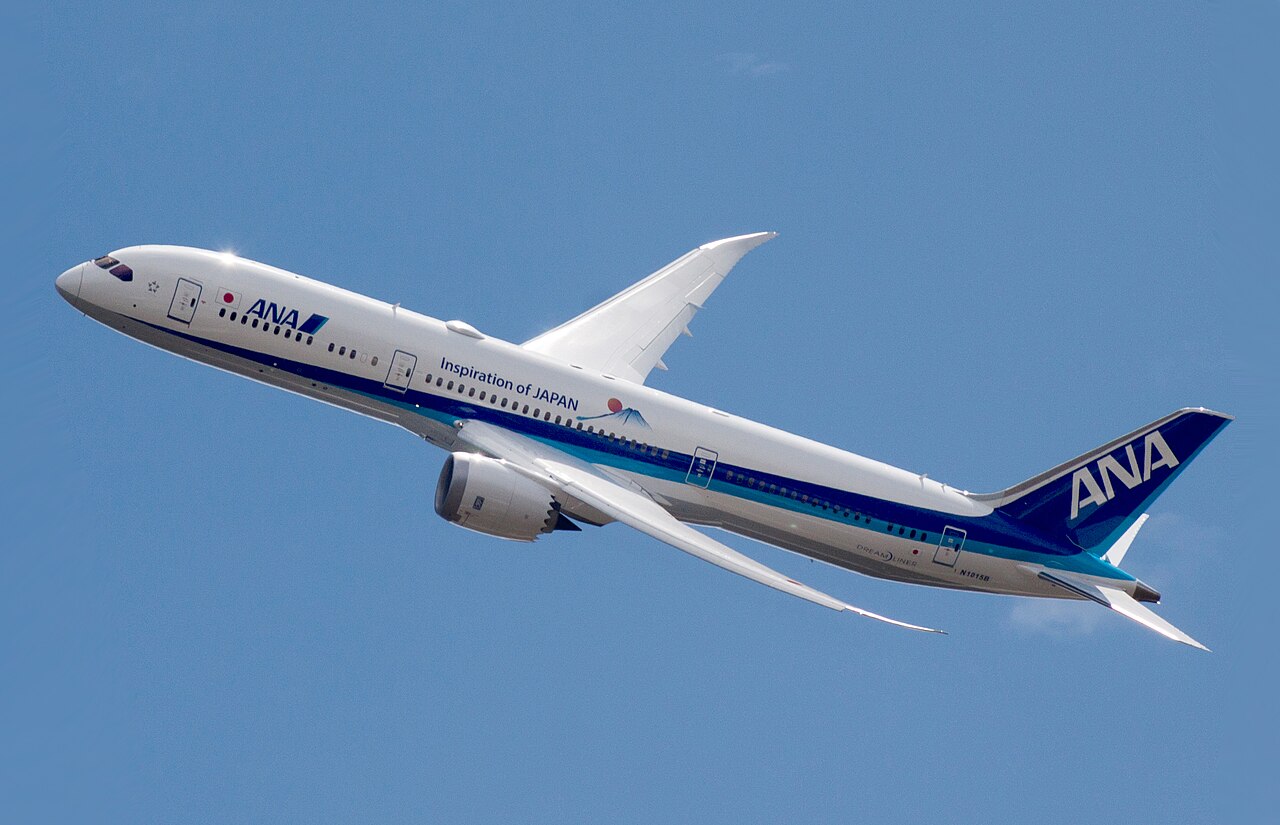
The Boeing 787-9 is the midsize, best-selling member of Boeing's 787 Dreamliner family, a twin-engine, wide-body airliner built largely from composite materials and designed to fly point-to-point long-haul routes with markedly lower fuel burn than the aircraft it replaced. Stretched from the original 787-8, it is the variant flown in greatest numbers worldwide, led by launch and largest operator All Nippon Airways, and is of interest to sim pilots as the archetype of the modern electric, composite long-haul twinjet.
The Boeing 787 Dreamliner is an American wide-body airliner family developed and built by Boeing Commercial Airplanes, conceived to carry 200 to 300 passengers on point-to-point routes rather than through traditional hub-and-spoke hubs. The 787-9 is the midsize and most common variant of the family, sitting between the original 787-8 and the stretched 787-10. It is a twinjet powered by either General Electric GEnx or Rolls-Royce Trent 1000 high-bypass turbofans, and it was the first airliner to use an airframe primarily made of composite materials, with much greater reliance on electrical systems than earlier Boeing designs. Externally it is distinguished by a four-window cockpit, raked wingtips and noise-reducing chevrons on the engine nacelles.
The 787 programme grew out of Boeing's decision in the early 2000s to abandon its unconventional Sonic Cruiser project, which was officially cancelled on December 20, 2002, after airlines shaken by the September 11 attacks and rising fuel prices prioritised efficiency over speed. On January 29, 2003, Boeing announced a conventional replacement, the 7E7, applying some Sonic Cruiser technology in a more efficient, midsize twinjet configuration aimed at point-to-point rather than hub-and-spoke travel. The programme was formally launched on April 26, 2004, with an order for 50 aircraft from All Nippon Airways, which originally specified a mix of 30 one-class 787-3 domestic aircraft and 20 787-8 long-haul aircraft; the 787-3 was never built, and the 787-9 was originally intended to enter service in 2010. A prototype without major operating systems was rolled out on July 8, 2007, but the programme suffered repeated delays before the type's maiden flight on December 15, 2009, which was made by a 787-8. Type certification followed in August 2011, and the first 787-8 was delivered and entered commercial service with All Nippon Airways in October 2011. The stretched 787-9 first flew in September 2013 and entered service on August 7, 2014, again with launch customer All Nippon Airways. Early 787 operations were disrupted by problems with the aircraft's lithium-ion batteries, including onboard fires, which led the US FAA to ground the entire fleet in January 2013 until a revised battery design was approved in April 2013. From 2019 onward, significant quality control issues caused a production slowdown and, between January 2021 and August 2022, an almost total halt in deliveries. Final assembly, originally centred at the Boeing Everett factory in Washington state, has been consolidated at the Boeing South Carolina factory since March 2021. Boeing has spent an estimated 32 billion dollars developing the programme, with break-even sales estimates ranging between 1,300 and 2,000 aircraft; as of June 2026 the 787 family as a whole had received 2,434 orders and made 1,289 deliveries.
The 787-9 measures 62.8 metres (206 ft 1 in) in length, with a wingspan of 60.1 metres (197 ft 3 in) shared across the whole 787 family, and a height of 17.0 metres (55 ft 10 in). Maximum takeoff weight is 259,220 kg (571,500 lb), heavier than the 227,930 kg (502,500 lb) of the original 787-8. Two-class seating capacity is quoted at 250 to 325 passengers, with a typical arrangement carrying around 296. Power comes from a choice of two engine types, the GEnx-1B from GE Aerospace or the Trent 1000 from Rolls-Royce, both high-bypass turbofans. The 787 was the first airliner to have an airframe made primarily of composite materials, reported to be built from roughly 50 percent composite material, 20 percent aluminium, 15 percent titanium, 10 percent steel and 5 percent other materials, an approach intended to reduce weight and ease recycling. The design also makes greater use of electrical systems than previous Boeing airliners, and is recognisable by its four-window cockpit, raked wingtips and noise-reducing chevrons on the engine nacelles. Large cabin windows, among the biggest in the airliner industry, are a notable feature of the passenger experience.
Boeing's own figures give the 787-9 a range of up to 8,300 nautical miles (15,370 km), while independently reported typical performance quotes a range of 7,565 nautical miles (14,010 km; 8,706 mi) carrying around 296 passengers, reflecting the difference between maximum-range and typical mission figures. At launch, Boeing targeted the 787 family for around 20 percent lower fuel burn than comparable aircraft such as the Boeing 767, with one operator quoting fuel consumption of around 2.5 litres per passenger per 100 kilometres of flight. These efficiency gains, combined with the type's range capability, have allowed operators to open long, thin routes that were not previously viable non-stop, extending the point-to-point model the aircraft was designed around.
The 787 family comprises three passenger variants distinguished chiefly by fuselage length, seating and range. The original 787-8 is 56.7 metres (186 ft 1 in) long, typically seats around 248 passengers, has a maximum takeoff weight of 227,930 kg (502,500 lb) and a range up to around 8,000 nautical miles (14,820 km); it was the first variant to fly, in December 2009, and entered service in October 2011. The 787-9 is the stretched midsize variant at 62.8 metres (206 ft 1 in) long, with a maximum takeoff weight of 259,220 kg (571,500 lb), seating 250 to 325 passengers and a quoted range up to 8,300 nautical miles (15,370 km); it first flew in September 2013 and entered service on August 7, 2014, with All Nippon Airways. The further-stretched 787-10 is 68.3 metres (224 ft 1 in) long, seats 300 to 375 passengers, has a maximum takeoff weight of 260,360 kg (574,000 lb) and a shorter range of up to 7,500 nautical miles (13,890 km); it entered service with Singapore Airlines on April 3, 2018. A proposed 787-3 short-range, high-density domestic variant was included in All Nippon Airways' original launch order but was never built. In ICAO type designator terms the three variants are known as B788, B789 and B78X respectively.
All Nippon Airways was both the launch customer for the 787 programme and remains the type's first and largest operator, having introduced the 787-8 in October 2011 and the 787-9 on August 7, 2014. The 787-9 has since become the most widely operated variant in the family and is flown by major long-haul carriers worldwide, including United Airlines, American Airlines, Japan Airlines and KLM, the last of which introduced the type to its fleet in 2015. United Airlines configures its 787-9 fleet with United Polaris business class alongside Premium Plus and Economy cabins, while other operators similarly use the type on long-haul international routes previously served by larger or less efficient aircraft. The wider 787 programme suffered its first fatal crash and hull loss on June 12, 2025, involving Air India Flight 171; a preliminary report issued in July 2025 by Indian accident investigators did not recommend any actions against Boeing or 787 operators.
For a simulator pilot, the 787-9 represents the archetype of the modern composite, electrically-architected long-haul twin, with its four-window flight deck, raked wingtips and chevron-equipped nacelles giving it a distinctive look on approach and departure. Its heavy reliance on electrical rather than traditional pneumatic and hydraulic systems, a defining feature of the type's real-world design, is part of what distinguishes it from earlier Boeing widebodies and makes it a natural subject for study of contemporary fly-by-wire, electric-systems airliner operations.