Departure
93%
vs 95% ▼ 2
 MY FS FLIGHTS
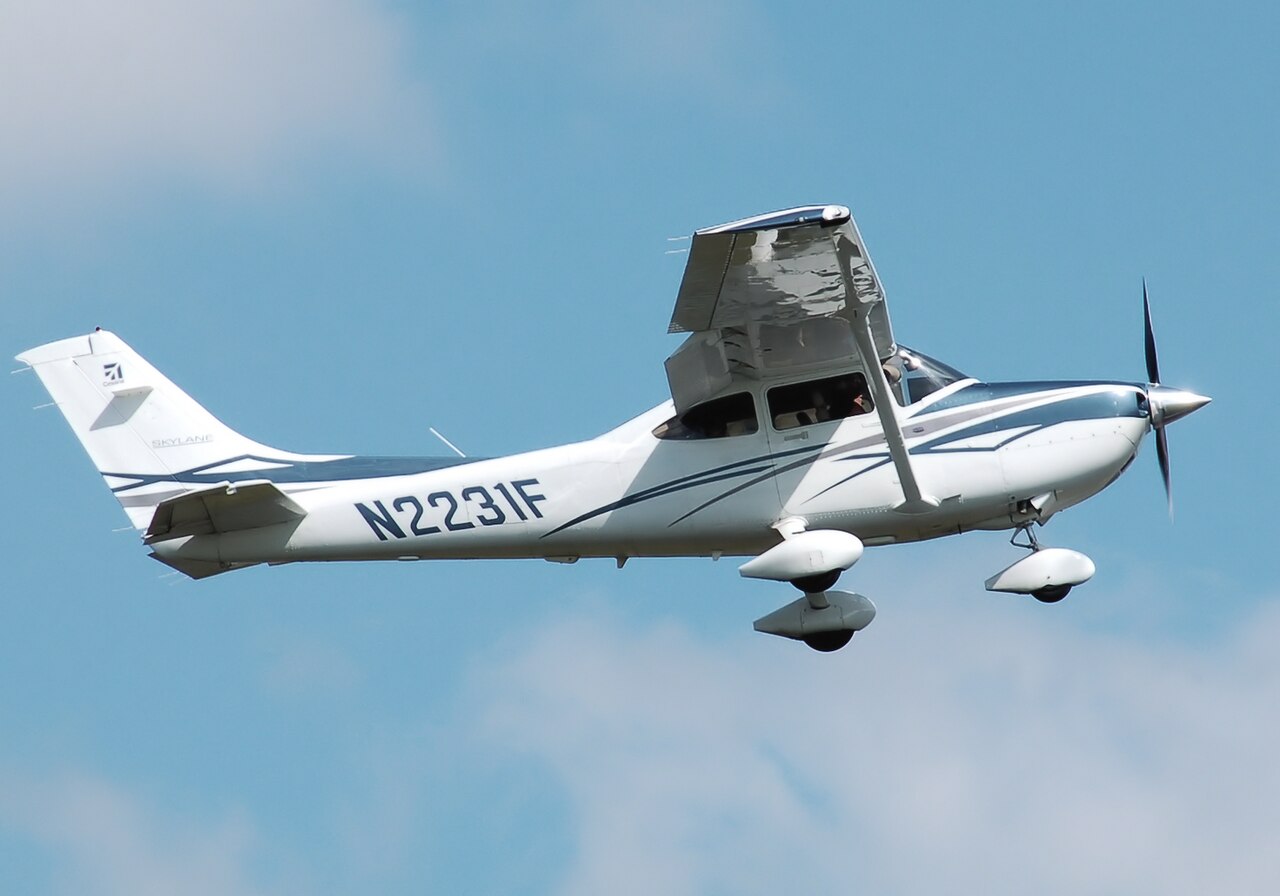
The Cessna 182 Skylane is an American four-seat, single-engined, high-wing light aircraft built by the Cessna Aircraft Company of Wichita, Kansas, introduced in 1956 as a tricycle-gear derivative of the Cessna 180. With more than 23,237 built across nearly seven decades of on-and-off production, it remains Cessna's second most popular model still in production after the 172, valued by pilots for its useful load, wide cabin and forgiving handling.
The Cessna 182 Skylane is a four-seat, single-engined light utility aircraft with a high, strut-braced wing, built by the Cessna Aircraft Company. It was developed as a tricycle-gear version of the Cessna 180 and introduced in 1956, and it occupies a well-known step up from the Cessna 172 Skyhawk in Cessna's piston-single lineup, offering greater payload capacity and cruise speed. It has remained one of general aviation's most enduring types, produced in the United States, and also built under licence in Argentina by DINFIA as the A182 and in France by Reims Aviation as the F182.
The Cessna 182 first flew on 10 September 1955 and was introduced for the 1956 model year as a tricycle-gear variant of the taildragger Cessna 180. The initial 182 was certified on 2 March 1956, powered by a carbureted 230 hp Continental O-470-L engine at a gross weight of 2,550 lb, with 844 built. The 182A followed in 1957 with manual flaps, redesigned landing gear and a higher gross weight of 2,650 lb, and a deluxe version introduced the following year became known as the Skylane, adding full exterior paint, wheel fairings and an improved cowling. Subsequent yearly models brought a more streamlined cowling with cowl flaps (182B), a redesigned swept vertical tail and cabin with more headroom (182C), a key start switch and lower landing gear height (182D), and a cut-down rear fuselage with 'Omni-Vision' rear windows, electric flaps and neoprene fuel bladders (182E). In 1965 Cessna extended the horizontal stabilizer and elevator span by 10 inches to address elevator authority issues in the landing flare. Retractable-gear versions, the R182 and turbocharged TR182, marketed as the Skylane RG, were offered from 1978 to 1986. The normally aspirated, avgas-fuelled 182 went out of production in 2012 but returned in 2015. Cessna also developed a diesel-powered variant, initially called the Turbo Skylane NXT and later the JT-A, using the SMA SR305-230 engine running on Jet-A, though only 16 aircraft were built by 2014 and the programme was eventually discontinued after most orders were cancelled by 2017.
The 182 is an all-metal airframe, predominantly aluminium alloy, though components such as the engine cowling nosebowl and wingtips are made of fibreglass or thermoplastic material. Its wing shares the same planform as the smaller Cessna 172 and the larger 205/206 series, though the flap and aileron design follows the 172 rather than the 205/206. Early aircraft were powered by the carbureted 230 hp Continental O-470-L, with later models moving to the O-470-R and other Continental and Lycoming variants; a diesel-powered SMA SR305-230 engine of 227 hp, burning 11 US gallons per hour of Jet-A at cruise, was developed for the later JT-A variant. The retractable-gear R182/TR182 uses hydraulic actuators powered by an electrically driven pump to raise and lower the landing gear, with a gear position warning tone in the cabin and a hand pump as a hydraulic backup, though the system cannot manually retract the gear. Gross weight rose from 2,550 lb on the original 1956 182 to 2,650 lb on the 182A, with further increases on later models. In 1965 the horizontal stabilizer and elevator span were extended by 10 inches to improve pitch authority. Many 182s built through the mid-1960s used bladder-type fuel tanks, which owners are advised to inspect carefully for water contamination.
The 1978 Cessna R182 has a sea-level climb rate of 1,140 ft/min and a cruising speed at 75 percent power of 156 knots true airspeed at 7,500 feet under standard temperature. Retractable-gear R182 and TR182 models offer a 10 to 15 percent improvement in climb and cruise speed over their fixed-gear counterparts, with a similar improvement in fuel economy at equivalent speeds, at the cost of increased maintenance and reduced gear robustness. The planned diesel JT-A variant, using the SMA SR305-230 engine, was designed for a cruise speed of 155 knots burning 11 US gallons per hour of Jet-A. Owners and experienced operators note that the 182 has a wide centre-of-gravity envelope and can carry a substantial load, but tends to be nose-heavy; on pre-1965 models it was not uncommon to run out of up-elevator authority in the landing flare, risking a nosewheel-first touchdown and a bent firewall, a characteristic addressed by the 1965 extension of the horizontal stabilizer and elevator span.
Key US-built variants include the original 1956 182 (230 hp Continental O-470-L, 2,550 lb gross weight, 844 built); the 182A of 1957 with manual flaps and redesigned landing gear, followed by the deluxe Skylane version from 1958 (1,713 total built across both years); the 182B of 1959 with a streamlined cowling and cowl flaps (802 built); the 182C of 1960 with a swept vertical tail and redesigned cabin (650 built, plus four L-19L models for the Canadian Army); the 182D of 1961 with a key start switch and lower landing gear (591 built); and the 182E of 1962 introducing the cut-down 'Omni-Vision' rear fuselage, electric flaps, redesigned tail surfaces and neoprene fuel bladders. Retractable-gear versions, the R182 and turbocharged TR182, were marketed as the Skylane RG and produced from 1978 to 1986. Later 'restart' aircraft built from 1996 introduced a different engine and new seating design among other changes. Overseas production included the Argentine-built A182 by DINFIA and the French-built F182 by Reims Aviation. A diesel-engined variant, the Turbo Skylane NXT/JT-A with the SMA SR305-230 engine, was built only in very small numbers before the programme was discontinued. An aftermarket STOL conversion, certified in 1967, altered the wing leading edge and aileron controls to reduce stall speed below 35 mph.
The Cessna 182 has served widely as a private and training aircraft in general aviation, valued for its payload capacity and short-field performance. Its high-wing configuration and stability at low speed have made it a mainstay of the skydiving industry, where aircraft are commonly modified with passenger seats removed, an upward-opening door fitted, and a large external step added for jumpers. The type has also been used for surveillance work, including by the Federal Bureau of Investigation, which is reported to have operated at least 27 examples equipped with optical, infrared and cellphone interception equipment.
Pilots and long-term owners describe the 182 as a forgiving but nose-heavy aeroplane with a wide centre-of-gravity range, meaning care is needed with loading, particularly with full fuel and heavy front-seat occupants, since an out-of-limits forward CG can be reached easily. On pre-1965 airframes this nose-heaviness could translate into a shortage of up-elevator authority in the flare, a trait corrected on later models by the extended tail surfaces. Engine management is a significant part of flying the type well: gentle starts, careful priming, leaning on the ground to prevent spark plug fouling, and monitoring cylinder temperatures are all recommended practices for the Continental and Lycoming engines fitted across the model range. On the retractable-gear R182 and TR182, an audible gear warning tone sounds through the cabin speaker if the gear is retracted with reduced power or extended flaps, and a hand pump provides emergency gear extension in the event of hydraulic pump failure, adding a system familiarisation element not present on the fixed-gear versions.