Departure
94%
vs 95% ▼ 1
 MY FS FLIGHTS
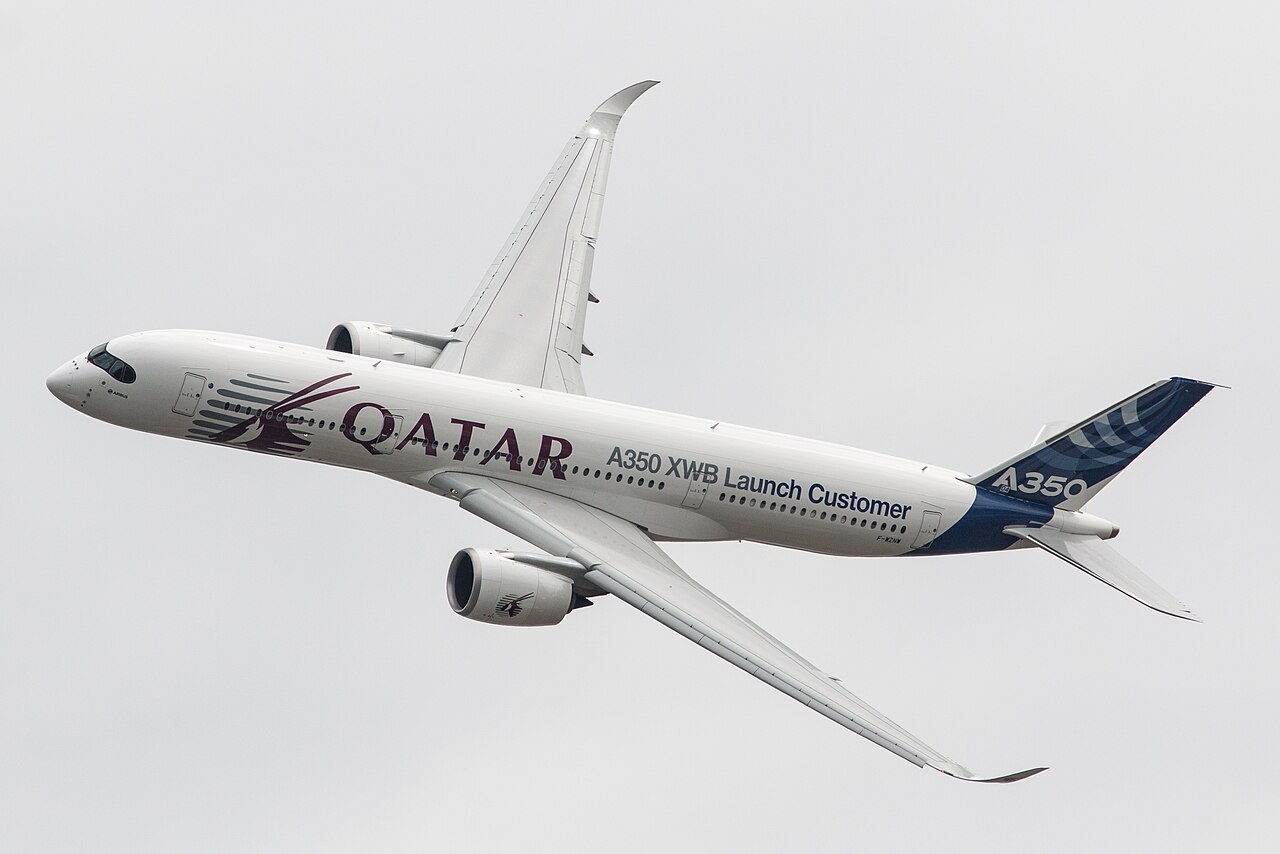
The Airbus A350-900, identified by the ICAO type code A359, is the baseline variant of Airbus's long-range, wide-body A350 XWB family, a clean-sheet twin-engine airliner built largely from carbon-fibre-reinforced polymer. Powered by two Rolls-Royce Trent XWB turbofans, it entered service with launch operator Qatar Airways in January 2015 and has become a mainstay of long-haul route networks worldwide, making it a widely studied type for simulator pilots interested in modern fly-by-wire widebody operations.
The A350-900 is the original and smaller of the two members of the Airbus A350 XWB family, a long-range, wide-body, twin-engine airliner developed and produced by Airbus. It carries the ICAO designator A359 and was the first Airbus aircraft to be built largely from carbon-fibre-reinforced polymers. The type shares a common type rating with the A330, and it sits alongside the larger A350-1000 as the two production variants of the family, succeeding the A340 in Airbus's long-haul lineup and competing directly with Boeing's 777, 777X and 787 Dreamliner.
The A350 programme originated in 2004 as a response to the Boeing 787 Dreamliner. Airbus initially proposed the improved A330-200 Lite and then a derivative design based on the A330's fuselage cross-section, with modified composite wings, new winglets and new engines, and an aluminium-lithium rather than composite fuselage. On 10 December 2004 Airbus shareholders EADS and BAE Systems approved an authorisation to offer the A350, targeting a 2010 service entry, with an initial 245-seat A350-800 and a 285-seat A350-900 envisaged. Qatar Airways placed a launch order for 60 aircraft at the 2005 Paris Air Show, and in September 2006 signed a memorandum of understanding with General Electric to launch the GEnx-1A-72 engine for the type, while the programme's industrial launch was announced on 6 October 2005 with an estimated development cost of around 3.5 billion euros. Airline dissatisfaction with this A330-derived concept, including Emirates declining to order it, led Airbus to abandon the design in 2006 in favour of a clean-sheet extra-wide-body aircraft powered exclusively by Rolls-Royce Trent XWB engines. The prototype first flew on 14 June 2013 from Toulouse. Type certification was awarded by the European Aviation Safety Agency in September 2014 and by the Federal Aviation Administration two months later. The A350-900 entered commercial service on 15 January 2015 with launch operator Qatar Airways.
The A350-900 is built with an airframe that is largely carbon-fibre-reinforced polymer, a first for an Airbus product, and features a 3-3-3 nine-across economy-class fuselage cross-section, wider than the eight-across 2-4-2 layout of the A330 and A340. It is powered by two Rolls-Royce Trent XWB engines, offered in two thrust ratings: the Trent XWB-84 and the lower-thrust Trent XWB-75. As the smaller variant of the A350 family, the A359 is supported by two four-wheel main landing gear trucks, compared with the six-wheel trucks fitted to the larger A350-1000. The type shares a common type rating with the A330, easing crew transition between the two families. From MSN 579, an airframe delivered to Iberia, Airbus introduced an improved New Production Standard that includes a weight reduction of 1.2 tonnes (2,600 lb), a maximum take-off weight increase of 3 tonnes (6,600 lb), and a wider interior cabin permitting up to 30 additional seats.
With the Trent XWB-84 engine, the A350-900 has a maximum take-off weight of 283 tonnes (624,000 lb); with the lower-thrust Trent XWB-75 the maximum take-off weight is 255 tonnes (562,000 lb). The aircraft typically seats around 325 passengers, though the wider family description gives a range of 300 to 350 passengers depending on configuration, and it is rated for a range of 8,500 nautical miles (15,700 km; 9,800 mi).
The A350 family comprises two production variants. The A350-900, covered here under the ICAO code A359, is the original, smaller model, typically carrying 300 to 350 passengers with an 8,500 nmi (15,750 km) range and a maximum take-off weight of up to 283 tonnes (624,000 lb). The longer A350-1000 accommodates 350 to 410 passengers, has a maximum range of 16,700 km (9,000 nmi), a maximum take-off weight of 322 tonnes (710,000 lb), and uses six-wheel main landing gear trucks in place of the -900's four-wheel units, reflecting its greater weight. From airframe MSN 579 onward, A350-900 and A350-1000 aircraft can be built to an improved New Production Standard with reduced weight, increased maximum take-off weight, and a wider cabin offering extra seating.
The A350-900 entered service on 15 January 2015 with Qatar Airways as launch operator, with the larger A350-1000 following into service with the same carrier in February 2018. The type succeeds the Airbus A340 in long-haul widebody operations and competes against the Boeing 777, the forthcoming 777X, and the 787 Dreamliner. Singapore Airlines has grown to become the largest operator of the A350 family, while Turkish Airlines holds the largest outstanding order. Across the A350 programme as a whole, more than 1,595 aircraft have been ordered, with over 725 delivered and in service with dozens of operators worldwide.
For simulator pilots, the A350-900's chief points of interest lie in its status as Airbus's first largely composite airliner and its shared type rating with the A330, which reflects a common fly-by-wire philosophy and cockpit philosophy across the two families. Its widespread adoption by major long-haul carriers such as Qatar Airways and Singapore Airlines makes it a natural choice for simulating ultra-long-range international routes on a modern twin-engine widebody.