
Difference between IFR and VFR flights
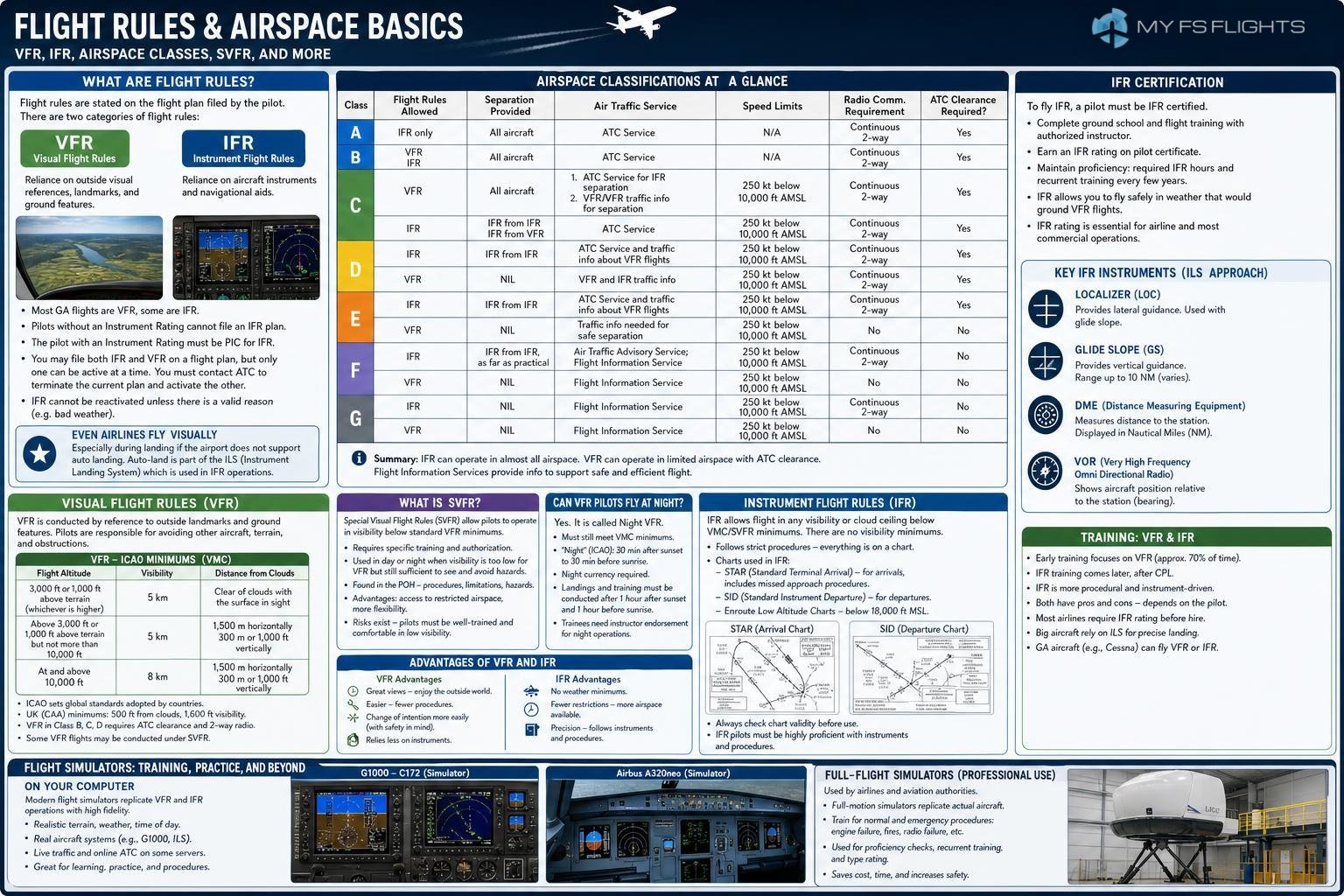
The handbook answer to "what's the difference between IFR and VFR" is easy to find and you've probably already read it. Visual Flight Rules mean navigating and avoiding traffic by looking out the window, and they require decent weather. Instrument Flight Rules mean flying by reference to instruments, on a filed flight plan, under ATC clearance, and they let you fly in cloud. All true, and almost useless to someone flying at a desk, because it doesn't tell you which one you should be flying tonight, why the split exists in the first place, or what happens to it when the weather is a menu setting, the traffic is sparse AI, and the controller is a text-to-speech engine.
The more awkward problem is that the real-world hierarchy, VFR as the beginner's rule set, IFR as the advanced rating, quietly inverts at a desk. Several of the things that make instrument flying hard in an aircraft don't exist in a simulator, and several of the things that make visual flying easy in an aircraft don't survive being rendered on a monitor. If you've been treating "learning IFR" as the graduation from VFR, I'm going to argue you have it roughly backwards, and explain why on the way through.
Eyeballs or procedure
Strip away the acronyms and the whole IFR/VFR split reduces to a single question. What stops two aircraft occupying the same piece of sky? There are only two available answers. Either the pilots look out and avoid each other, or a procedure, clearances, assigned altitudes, controlled routings, keeps them apart before they ever get close. VFR is the first answer, IFR is the second, and nearly every rule downstream is derivable from which mechanism is in force.
Start with the weather minimums. VFR requires Visual Meteorological Conditions because see-and-avoid needs functioning eyeballs with something to see. The specific distances are collision geometry rather than arbitrary bureaucracy. You must stay 500 ft below cloud so that an IFR aircraft descending out of the base has vertical room before it fills a VFR pilot's windscreen. You must stay 2,000 ft horizontally clear so that an aircraft emerging from cloud at a closing speed of a few hundred knots gives you seconds, rather than nothing, to spot it. The three-mile visibility requirement exists because see-and-avoid against a converging target needs time, and time is distance.
The cruising altitudes follow the same logic. In the US, IFR traffic flies whole thousands (odd for magnetic courses of 0 to 179 degrees, even for 180 to 359) and VFR traffic more than 3,000 ft above the surface flies the same scheme plus 500 ft. That offset is not a quirk. It means opposite-direction traffic under the same rules gets 1,000 ft of separation automatically, and traffic under different rules gets 500 ft plus see-and-avoid as the backstop. The hemispheric rule is a traffic-separation machine that every pilot participates in without saying a word to anyone.
The most useful reframing, and the one the handbook treatment tends to bury, is that IFR is a contract with ATC. It is not "flying in cloud". You can fly IFR on a flawless day, and airlines do exactly that on every clear day of the year, because the contract, ATC accepts responsibility for separating you from other IFR traffic, and in exchange you fly precisely what you are cleared to fly, is valuable regardless of the weather. Weather conditions and rule sets are two separate axes. IMC and VMC describe the sky. IFR and VFR describe who is responsible for keeping you alive. Draw it as a two-by-two grid and the cells become clear. IFR in VMC is the ordinary airline case. VFR in VMC is the ordinary GA case. IFR in IMC is what the instrument rating exists for. VFR in IMC is the illegal cell, and historically the lethal one. The continued-VFR-into-weather accident is a fixture of every accident database.
Why is that cell lethal, rather than merely against the rules? Because the human vestibular system cannot distinguish a sustained coordinated turn from level flight. Deprived of a visible horizon, a pilot without instrument training will follow false sensations of level flight into a descending spiral while the instruments plainly say otherwise. This physiological fact is the foundation the entire IFR edifice is built on. The training, the currency requirements, the equipment rules. Hold onto it, because it's the single most important thing that does not exist at your desk.
The numbers, briefly
The canon deserves a compact statement, because you'll meet these figures in the sim's weather menus and on VATSIM. These are the US (FAA) figures, and other regimes differ, which I'll come back to.
| Airspace (US) | Visibility | Cloud clearance |
|---|---|---|
| Class B | 3 SM | Clear of cloud |
| Class C, D, E below 10,000 ft | 3 SM | 500 below / 1,000 above / 2,000 horizontal |
| Class E at/above 10,000 ft | 5 SM | 1,000 below / 1,000 above / 1 SM horizontal |
| Class G, day, below 1,200 ft AGL | 1 SM | Clear of cloud |
The Class G table has many more cells than shown, but a workable rule of thumb covers most flying. Below 10,000 ft, remember "3-152", 3 miles, 1,000 above, 500 below, 2,000 horizontal, and treat everything else as an exception to learn later. Marginal VFR, as a weather-reporting category, is 3 to 5 miles visibility and/or a ceiling between 1,000 and 3,000 ft. Special VFR lets you operate in a surface area at 1 SM and clear of