
The Stabilised Approach: The One Habit That Fixes Most Bad Landings
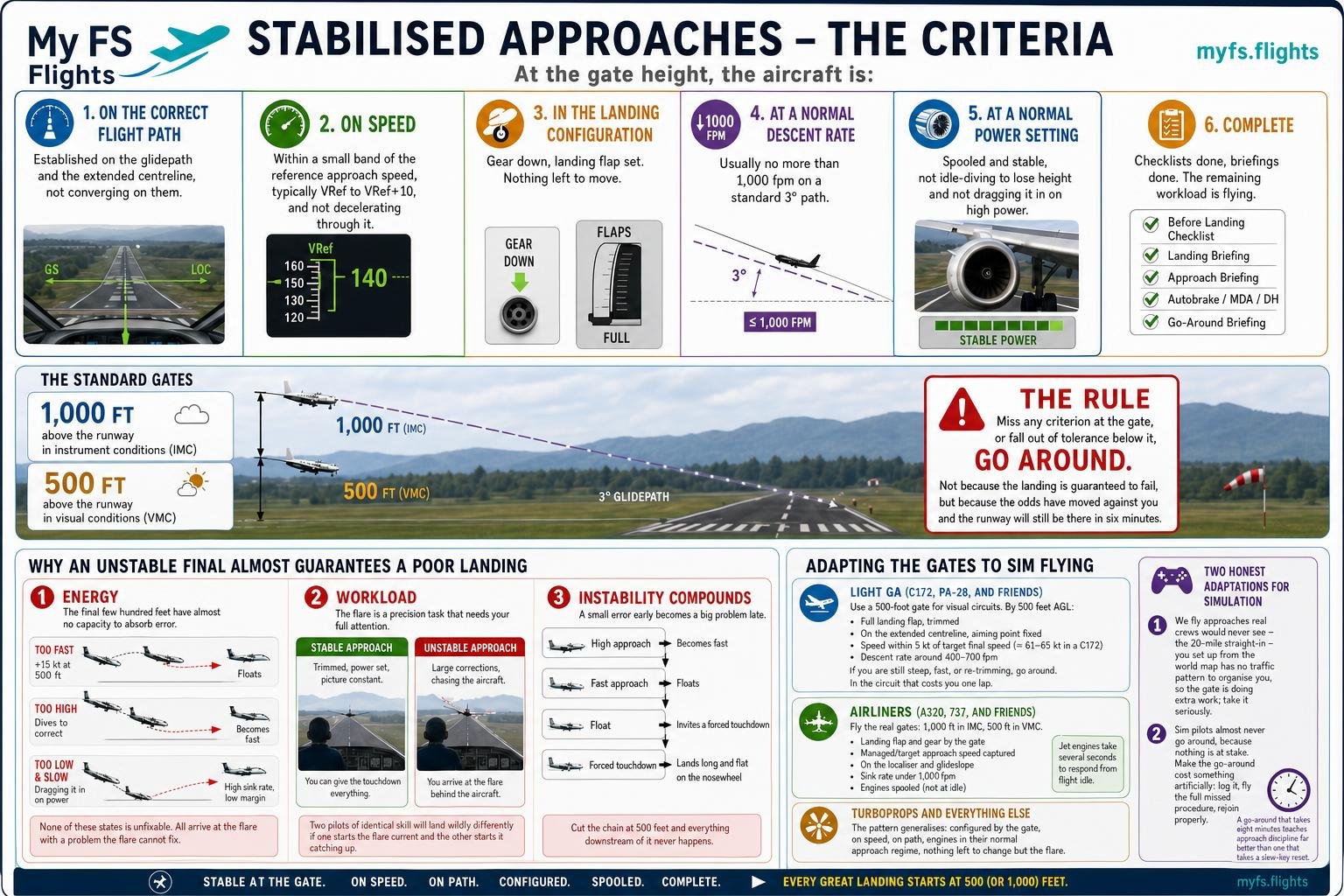
The advice you've already read about bad landings is almost all about the flare. Flare higher, flare later, look at the far end of the runway, count yourself down from the radio altimeter. You've probably tried most of it, and your landings are still a lottery. A greaser one flight, a slam the next, a float and a bounce the one after. The problem with all of that advice is that it treats the landing as a four-second problem, and it is not. By the time you cross the threshold, the aeroplane has an energy state, a trim state, a sink rate and a lateral track, and the flare can only work with what it's given. It cannot add energy and it can only shed excess energy by floating. Your landing was decided thirty seconds before you started thinking about it.
Airlines worked this out decades ago, and their answer was a rule rather than a better flare technique. Be stabilised by a set height, or go around. The rule looks like bureaucracy and is actually arithmetic, and the arithmetic changes at a desk in ways the airline material never had to consider.
The time budget, and where it runs out
Start with the arithmetic. On a 3° glidepath you descend roughly 318 feet per nautical mile, which gives the familiar rule of thumb that your required sink rate is about five times your groundspeed in knots (5.3, strictly, and the difference matters once you start checking your own numbers). At 140 knots groundspeed, 1,000 feet above the runway is about 3.2 miles and 82 seconds out. Five hundred feet is 41 seconds. Two hundred feet is about 17 seconds. Fifty feet is four.
Now count the time it takes to fix a problem. You have to notice it, which takes a second or two. You have to decide what to do, which takes another few. If the fix involves thrust, a jet engine needs several seconds to spool from near idle to a useful setting. Then the aeroplane has to actually respond, and then you have to settle it back onto the path, which takes longer than any of the previous steps. Add it up honestly and a meaningful correction costs you somewhere around twenty-five to thirty seconds from recognition to re-stabilised. That budget runs out at roughly 300 feet. This is why the gates sit where they do. A typical operator policy is stabilised by 1,000 feet in instrument conditions and 500 feet in visual conditions, and those numbers are not arbitrary caution. They are the last points at which you have time to fix one problem and still arrive at the flare in a known state.
There's a second, nastier reason unstable approaches don't just stay bad but get worse. As you descend, the time available shrinks, so the corrections you need become larger and quicker. Your reaction time, meanwhile, stays constant. A control loop with rising gain and fixed delay is the textbook recipe for oscillation, which is why an approach that was merely untidy at 800 feet turns into pitch-and-power thrashing at 300. The aeroplane didn't change. Your available time did.
The energy picture makes the same point from another direction. The landing has essentially one control that matters in the last seconds, pitch, and one currency, your excess speed over VRef, the reference landing speed the approach is built around, typically about 1.3 times the stalling speed in landing configuration. If you arrive fast and high you have two errors and one lever. Something has to give, and it gives as float, a long touchdown, or a firm arrival, depending on which error you prioritise. A jet on approach also sits near the bottom of its drag curve, where drag barely changes with speed, so a speed error doesn't correct itself. And if you get slow enough to cross onto the back side of that curve, pulling the nose up makes you sink faster, which is exactly the wrong instinct rewarded at exactly the wrong moment.
What the criteria actually say, and what they are proxies for
The common airline formulation runs something like this. On the correct lateral and vertical path, in the landing configuration, speed between VRef and roughly VRef+20 (conventions vary by operator), sink rate typically no more than 1,000 fpm, thrust at an appropriate setting and spooled, checklists complete, with only small corrections needed to stay there. If any of those are not true at the gate, go around.
Read as a checklist, this looks like a set of positions to hit. It's better read as a set of rates. You can be exactly on speed and exactly on the glideslope at 1,000 feet and still be wildly unstable, because your speed is decaying at three knots a second and your thrust is at idle. The criteria are snapshots standing in for trends, and the phrase doing the real work is "only small corrections needed". An approach held on profile by twenty thrust movements and constant stick work is not stabilised. It's a divergence being manually suppressed, and it will break the moment your attention moves to the runway.
Two of the criteria deserve unpacking because they hide asymmetries. The sink-rate limit is not pedantry. 1,000 fpm at 1,000 feet is sixty seconds from the ground, and it means arresting several hundred fpm more than a normal profile before touchdown, which is where bounces come from. A bounce is a vertical-speed error at contact rather than a flare error, and the energy for it was imported from 500 feet. And "one dot" of glideslope is an angular measure, so a dot at 3 miles is a much larger height error than a dot at half a mile. The criterion quietly tightens as you descend, which is exactly what you want it to do.
Being high is also worse than being low by the same amount, even though the criteria treat them symmetrically. Low and slow can be fixed with thrust, which you have in hand. High and fast with the thrust already at idle means you have spent your only lever, and the only remaining way to lose energy is time, which is the one thing an approach runs out of by design. Even a modest height error carries straight through to the touchdown. Geometry alone says that crossing the threshold 10 feet high on a 3° path moves your touchdown roughly 190 feet further down the runway before the flare adds anything.
The parts that break at a desk
All of the above is true in any aeroplane. What the airline material silently assumes is a cockpit, and you don't have one. Three differences matter enough to change how you should fly the approach.
The first is your field of view. Humans read sink rate and lateral drift largely from optic flow in peripheral vision, and a monitor shows you a narrow cone of a scene your eyes would otherwise sample across roughly 200 degrees, deleting precisely that channel. This is why sim pilots so often report that the approach "suddenly" went wrong at 400 feet. It went wrong gradually, in cues that fell outside the screen. VR restores much of this, mostly through head-motion parallax and genuine peripheral flow rather than stereo depth, which contributes little at approach distances. The practical consequence for a monitor pilot is uncomfortable but useful. Your stabilised-approach discipline has to be more instrument-driven and more procedural than a real pilot's, not less. The gate matters more at a desk, because you will not feel destabilisation coming.
The second is your stick. A spring-centred joystick returns to the same physical position regardless of trim state, so you cannot feel an out-of-trim aeroplane the way a real yoke's forces would tell you. The single most common technique failure in sim flying, never trimming on final, is a hardware artefact rather than laziness, and it's fatal to consistency. An untrimmed aeroplane requires continuous unconscious back pressure, your speed drifts with your attention, and your "sight picture" is a different pitch attitude on every flight. There's a three-second test for it, described in the drills below.
The third is latency and frame rate. Between input polling, the simulation step, rendering and your display, the delay from moving your hand to seeing the result is commonly somewhere in the tens of milliseconds and can grow much larger when frame rate drops, and frame rate drops exactly where you need precision most. Dense scenery, rain, night, short final. A stutter at 100 feet in a gusty crosswind means flying blind for a fraction of a second at the worst possible moment, and no amount of practice fixes it. This matters for diagnosis. If you oscillate on the glideslope, there are three candidate causes. Your technique, your sensitivity curve, and your frame time. Test them in reverse order, because two of them are a five-minute fix. Fly the same ILS with scenery and traffic sliders pulled down, and if your tracking visibly improves, stop blaming your hands. A modest sensitivity curve, by the way, is not cheating. It restores the fine input resolution near centre that a real yoke gets from its physical travel, for a task where the correct inputs are tiny.
One more desk-specific confounder is worth naming. Weather engines and flight models differ between MSFS, X-Plane and Prepar3D, and between add-ons within each. Wind gradients and gusts on final are modelled very differently across platforms, and default aircraft often under-model gear and flap drag, letting you salvage an energy state that a study-level model would not forgive. If your approaches feel stable in one aeroplane and ragged in another, some of that is you and some of it is the model, and it's worth knowing which before you spend a month practising against software.
A diagnostic map: which landing you have, and where it came from
The reason to learn the criteria is not to recite them but to run them backwards. Each characteristic bad landing points to a specific criterion that failed, usually well upstream.
| What happened at touchdown | What it usually means | Where it started |
|---|---|---|
| Long float, touchdown far down the runway | Excess speed over VRef at the threshold | Speed never settled; often idle-thrust-and-hope from a high, fast state at 1,000 ft |
| Firm or bounced touchdown | Sink rate too high at 50 ft | Sink-rate criterion busted at the gate, or a late correction that never finished |
| Balloon, then drop | Fast and out of trim; a small pull produced a big response | Untrimmed approach flown on muscle |
| Side-load, off-centreline arrival | Chasing the localiser needle below 200 ft | Lateral path never truly settled; the needle only looked settled |
| Mushy, nose-high arrival short of the aim point | Slow, behind the drag curve, high power | Speed decay unnoticed after configuration changes |
| Everything fine until 400 ft, then a scramble | Passed the gate, then destabilised | Wind gradient, an autopilot disconnect handing you a mistrimmed aeroplane, or the moment you went head-up and stopped scanning |
A few of these deserve a sentence more.