
Improve Your Take-Offs
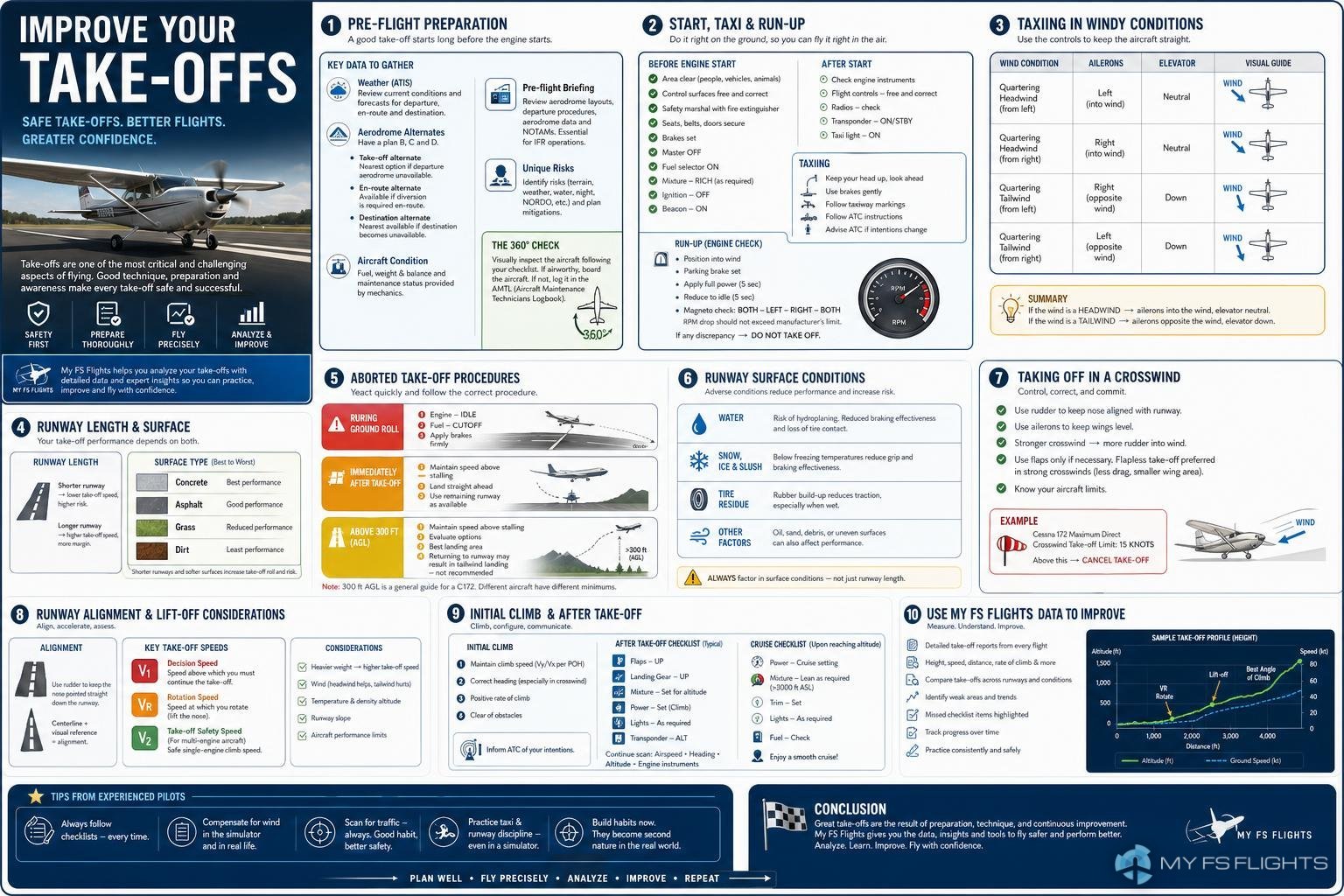
Ask a virtual pilot to describe their last landing and you'll get touchdown rate, centreline, float, the lot. Ask about their last takeoff and you'll get a blank look. It was fine. The aircraft left the ground, nothing bent, the flight happened. If you searched for takeoff tips because your rotations feel snatched, or the aircraft keeps wandering left of centreline, or you fly a 737 and suspect your rotation technique would horrify a training captain, you already sense that "fine" is not an assessment.
The takeoff is the phase desktop pilots examine least, practise least deliberately, and are most confidently wrong about, because nothing in the simulator punishes a mediocre one. The checklist version, flaps, trim, power, rotate at Vr, climb at Vy, the best-rate-of-climb speed, is in every tutorial and it's all true, but it describes a sequence of events, not a standard of performance.
The phase with no finish line
Airlines settled this question decades ago. Flight-data monitoring programmes record every takeoff a fleet flies and flag the ones that drift outside defined bands. Speed at rotation against the computed Vr, pitch rate through the rotation, pitch attitude at liftoff, lateral deviation during the roll, climb-out profile. A takeoff that "felt fine" and a takeoff that rotated two degrees per second too fast with a five-metre centreline excursion look identical from the flight deck and completely different in the data.
The same criteria apply to a Cessna at a grass strip, scaled appropriately. A good takeoff has a defined shape. The aircraft tracks the centreline within a metre or two through the whole roll, rotation begins at the target speed and not before, pitch rises at a steady rate to a target attitude without overshoot, and the climb-out holds a speed rather than chasing one. It also has a defined end. For an airliner that's thrust reduction and acceleration, commonly somewhere around 1,000 to 1,500 ft above the airfield depending on the operator, while for a light aircraft it's established at Vy with the flaps on schedule. Most simmers have no defined end to their takeoff, which is exactly why it never gets judged.
The second uncomfortable point follows directly. "It felt smooth" is worthless, because without measurement your memory of the takeoff is a memory of your intention. The drift you corrected at 60 knots and the pitch spike you caught at 200 ft don't register. The brain smooths them into the takeoff you meant to fly. Everything in the rest of this article assumes you'll eventually check your impressions against evidence, because otherwise you're practising your existing habits, not improving them.
The roll is a moving target
Propeller aircraft yaw left on takeoff, so apply right rudder. The version almost nobody writes down is that the four left-turning effects are neither equal nor simultaneous, so the rudder input is a changing profile through the roll.
Spiral slipstream, the corkscrew of propwash striking the left side of the fin, dominates at the start, when power is high and airspeed is low. Torque loads the left main wheel throughout the roll, adding a small steady pull. P-factor, the asymmetric blade loading that yaws the nose left, depends on the angle of attack of the propeller disc, so in a tricycle aircraft it only appears once the nose comes up. A taildragger has the opposite profile. Sitting tail-down, its disc is already at a high angle of attack, so P-factor is there from the moment power comes up and eases as the tail rises, which is precisely when gyroscopic precession arrives to replace it, because precession appears only while the pitch attitude is actually changing. So the demand on your right foot starts large at power application, eases as speed builds and the rudder gains authority, then jumps again at rotation. If you've been applying a fixed correction and wondering why the nose still wanders, this is why, the target moves.
Directional control also changes hands partway down the runway. At low speed the aircraft steers with the nosewheel, and as speed builds, the rudder takes over and the nosewheel unloads. The transition between the two is where most centreline excursions begin, which is the real argument for flying the nosewheel off gradually rather than yanking at Vr. A gentle unloading makes the handover gentle too. The opposite fault, holding forward pressure past rotation speed, transfers weight onto the nosewheel exactly as the mains are unloading. Directional control then gets worse with speed instead of better, which is precisely backwards from what intuition expects, and it's why a wheelbarrowing takeoff feels so alarmingly squirrelly.
One more piece of ground-roll mechanics that gets dismissed as housekeeping. Trim. The trim position determines how much elevator displacement rotation requires. Set correctly, rotation is a small, controllable input. Set for cruise, the same rotation needs perhaps twice the stick travel, arrives late, and gets snatched. In a simulator, where there's no control force to warn you something is off, a mis-set trim is routinely misdiagnosed as "the flight model is wrong". It's checkable in two seconds before the roll and it's worth those two seconds every single time, particularly if you load saved flights.
Rotation is a rate, not a pull to a number
The tutorials say "rotate to 15 degrees" or "rotate to the flight director". Both describe the destination and neither describes the journey, and the journey is where takeoffs go wrong, because the wing starts flying during the rotation, ground effect is strong within roughly a wingspan of the surface, and the aircraft is accelerating the whole time. Pull to 15 degrees at one rate and you get a clean liftoff; pull to the same 15 degrees at twice the rate and you get an overshoot, a push, and an oscillation through the first few hundred feet.
Airliners make the point vividly. The type-general rule of thumb is a rotation rate of about 2 to 3 degrees per second, which means roughly five to seven seconds from starting the pull to reaching the initial climb attitude of around 15 degrees nose-up. Count it out loud during your next takeoff and you will almost certainly discover you have been rotating in two seconds flat. The reason for the discipline is geometric: with the gear struts compressed, the tail of a 737-800 contacts the runway at a pitch attitude of roughly 11 degrees, and an A321 at roughly 9 to 10 - single digits of margin between a normal liftoff attitude and scraping metal. The penalties are asymmetric. Rotating slowly costs a second or two of runway and nothing else; rotating fast buys that second back at the price of a real tailstrike geometry problem. That asymmetry is the entire argument for the technique.
Light aircraft have a subtler version of the same trade. A typical trainer rotates in the mid-50s of knots - a 172 at around 55 KIAS, climbing out at a Vy in the low 70s, though check your own POH rather than memorising Cessna's numbers - and the transferable rule is that Vr sits just above the stall speed in takeoff configuration. Rotate early because "it felt ready" and the aircraft lifts off inside ground effect, where induced drag is reduced, then climbs out of it into more drag. On a marginal-performance day the result is an aircraft that lifts off and then refuses to climb, sagging back towards the runway. The simulator models this, and most simmers have never seen it demonstrated because they always fly light aircraft at half fuel from sea-level runways.
What changes on the simulator
Every paragraph above assumes cues that your setup does not provide, and this is where takeoff advice written for real cockpits quietly stops working.
The biggest missing cue is peripheral vision. In a real aircraft, centreline drift registers in the periphery before the eyes ever move; on a monitor with a compressed field of view, the drift has to reach the middle of the picture before you see it, so desk pilots correct later and larger. The practical compensation is old flight-instructor advice that becomes far more important at a desk: pick a reference point at the far end of the runway and keep your eyes on it through the roll. Small heading changes displace a distant point visibly long before the nearby centreline stripes look wrong. Head-tracking and VR restore some of the peripheral cue; a fixed view does not, and pilots on a fixed monitor tend to end up staring at whatever is centred on screen, which during the roll is usually the instrument panel. Related, and worth knowing about yourself: if you change field of view or zoom between aircraft, the same pitch attitude looks flatter at a wide FOV, so a pilot who rotates "by the picture" is carrying the wrong picture.
The controls are the second problem. The aircraft needs a sustained right-rudder deflection through the roll, but spring-centred pedals (or a twist stick) return to zero the instant you relax, so the input you think you are holding decays unless you actively defend it. This is why sim takeoff yaw control feels like an endless series of re-corrections: it is. Rotation has its own version. A desktop stick offers perhaps ten centimetres of aft travel where a real yoke offers a long arm and building airspeed loads, so the same rotation demands much finer inputs. A modest pitch sensitivity curve helps; a heavy one deadens the initial response and invites a late, snatched pull to compensate. Curves are a trade, not a fix, and hardware setup generally is a subject that deserves its own article.
There is also no motion. The first hint of a swing in a real aircraft arrives through the seat, hundreds of milliseconds before the eyes confirm it; at a desk the visual cue is all you get, which is one more concrete reason to fly the roll eyes-out rather than glancing at the airspeed tape. And frame rate is a flight-control input: a stutter at a heavy payware hub airport arrives exactly when fine rudder work is needed, so a takeoff there is a harder control task than the same takeoff at a default field, independent of your skill.
Finally, be honest about what you are calibrating against. Ground handling is the weakest and most divergent part of most flight models - low-speed steering, tyre friction and crosswind weathervaning behave noticeably differently between MSFS and X-Plane, and between add-ons within the same simulator. Technique tuned in one partially mistrains for the other. The community over-uses this as an excuse, though. The test is whether the fault follows you across aircraft and simulators: a persistent left-of-centreline bias in three different add-ons is you, not the ground model.
The recognisable failure modes
Most bad takeoffs are one of a small set of patterns, and being able to name yours is most of the way to fixing it.
The snatch rotation. Airspeed fixation through the roll, Vr arrives, an abrupt near-full-scale pull, pitch overshoots, a push, and an oscillation through the first 200 ft. It feels like "this aircraft is twitchy"; the actual fault happened before liftoff. The pitch trace shows a spike and a wobble instead of a clean ramp.
The creeping drift. A small uncorrected heading error at 40 knots becomes a metre of offset per second by 100 knots, noticed only at rotation, producing a crabbed liftoff. Root cause is nearly always eyes on the tape instead of the far end of the runway.
The early unstick. Rotating below Vr because it "felt ready". In a real aircraft that feeling comes from elevator lightness; at a desk there is no force cue to fake readiness, so early rotation is either impatience or a misread tape. The aircraft lifts off in ground effect and sags.
The trim surprise. Rotation feels impossibly heavy or violently light, and the pilot blames the flight model. The trim was set for the previous flight's cruise.
Chasing the flight director. At liftoff the FD commands a climb attitude, and the freshly airborne pilot tries to capture it immediately rather than fly towards it, pulling aggressively past 15 degrees in the first seconds. The FD is a target, not a step input.
The frozen crosswind aileron. Full into-wind aileron at brakes release is correct in a light aircraft; the fault is holding all of it after the controls come alive, so the aircraft lifts off rolling. In a real aircraft the growing aileron forces tell you when to wash it out; at a desk nothing does, so the rule becomes "full, then progressively less as speed builds", flown deliberately.
One diagnostic worth understanding, a weathervane swing pulls the nose into wind and grows with speed until the rudder wins, while a P-factor and torque swing pulls the nose left regardless of wind and is worst at low speed and high power. The correction is rudder either way, but the anticipation differs, and misattributing one to the other means the next takeoff is planned wrong. Crosswind technique as a whole - takeoff and landing together - is its own subject and its own article, as is taildragger ground handling, where half the tricycle advice inverts: forward stick to raise the tail, a precession yaw arriving exactly as it comes up, and the worst directional stability of any takeoff at precisely the moment the desk gives you the fewest cues.
The variations matter more than most simmers expect. A turboprop's power arrives instantly with yaw attached; a jet's thrust is symmetric but spools slowly, so the first five seconds of the roll are a different task and habits do not transfer cleanly between them. Weight changes everything in the same airframe: a lightly loaded narrow body and a max-weight one can rotate 30 knots or more apart and respond differently in pitch to the same input, so a pilot who only ever flies default payload has learned one point on a curve. Performance planning - weight, flap selection, derated thrust, runway-length calculation - deserves separate treatment, but flying the same aircraft at both ends of its weight range is a session well spent.
What this practice is actually worth
Rotation-rate discipline, callout habits, crosswind sequencing and the eyes-out scan all transfer to real flying essentially intact. Some things do not, and it is worth being plain about them. Real aircraft signal rotation readiness partly through elevator feel, and a sim-trained pilot will under-weight force cues at first; no desk hardware teaches the physical rudder-force calibration of a real takeoff. And the sim's total forgiveness breeds one habit an instructor would kill in the first lesson: going heads-down to the airspeed tape for seconds at a time during the roll. Adopt the airline countermeasure, which costs nothing: a self-callout gate at 80 or 100 knots - thrust set, engine instruments normal, airspeed alive - said out loud, structuring the roll and forcing the check without the stare.
What the desk offers in exchange is repetition no real pilot can afford. A circuit buys one takeoff per ten minutes of flying and burns real fuel; repositioning to the threshold buys twenty takeoffs in the same time. Use that honestly and takeoff practice becomes its own session rather than the incidental first minute of a two-hour flight:
- The ten-takeoff block. Same runway, same weight, same wind, ten consecutive takeoffs. Blocked repetition stabilises the basic motor pattern first.
- Then interleave. Once consistent, change one variable per takeoff - wind, weight, flap setting. It feels worse and works better; interleaved practice is slower to feel fluent and stronger for retention.
- The crosswind ladder. Same runway, crosswind component up five knots per takeoff until you lose it. Almost no simmer knows their actual limit, and no real aircraft could survey it.
- The rotation-rate drill. Airliner, external replay after each takeoff, count seconds from rotation to liftoff attitude, target the 2-3 degrees per second band. Replay is the debrief tool real crews only get from flight-data monitoring.
- The covered-ASI takeoff. In a light aircraft, rotate on the picture alone, then check what speed it happened at. This builds the visual calibration the desk otherwise starves.
- The density-altitude demonstration. Identical takeoff at sea level, then at 5,000 and 8,000 ft of field elevation. The ground roll stretches dramatically - the honest figure varies by aircraft, which is why the POH performance section exists - and one session buys permanent respect for it.
- Deliberate faults. Fly one takeoff with the trim mis-set, one with the wrong flap, one deliberately snatched. A failure mode you have experienced on purpose is one you recognise when it happens by accident.
The engine failure at V1 is the canonical full-motion-simulator exercise and it is available free at your desk; rejected takeoffs and the V1 decision are a large enough subject to be their own article, as is engine-out handling in twins after liftoff. The short version is that a pilot who has flown a thousand takeoffs and never rejected one has rehearsed a decision they have never actually made.
Closing the loop
Every drill above is sharper with numbers attached, and this is the one place where a simulator flatly beats a real aircraft: it knows the exact centreline offset in metres, continuously, the precise speed at rotation, the pitch trace through the liftoff. It is a better-instrumented aircraft than most real ones. A clean takeoff shows up as a near-linear pitch ramp; a snatched one is a spike and a correction. The heading trace at power application catches the swing you corrected fast enough that it never registered as having happened. And some faults are only visible across many flights: a consistent rotation two knots early, or a persistent metre-left centreline bias, is invisible in any single takeoff and unmistakable across twenty. That is the FOQA logic airlines run on, applied at home.
You can extract some of this by scrubbing replays and watching the instruments, which works but is laborious enough that nobody sustains it. This is the problem My FS Flights was built for: it records every flight automatically in the background, detects the takeoff as a scored stage within the flight's Departure score, and produces a metric-level takeoff report - so each repetition in a practice block comes back as evidence rather than impression, and the logbook accumulates the cross-flight trends no single takeoff can show. However you get the data, the principle stands: a takeoff you have never measured is a takeoff you are guessing about.
If you do only one thing after reading this, fly a block of ten takeoffs tonight in the aircraft you know best, counting the rotation out loud, and then look at what actually happened rather than what you remember. The gap between the two is where your next month of improvement lives.