
How Airline Pilots Grade Landings - and How You Can Score Yours the Same Way
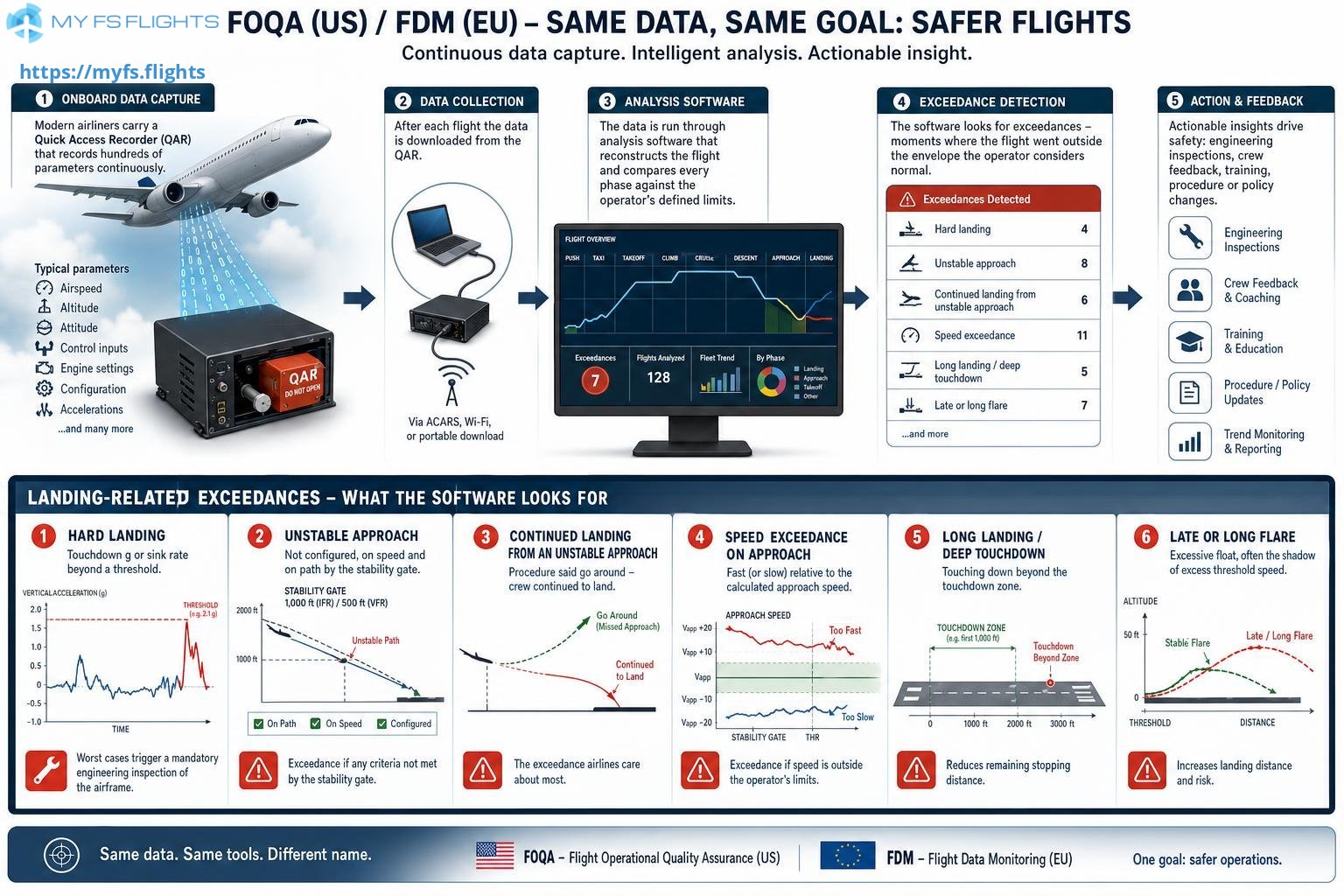
Here is a fact that surprises most passengers: on virtually every airline flight in the developed world, the landing was recorded, measured and - in effect - graded. Not by the captain's feel for it, and not by the passengers' applause, but by data: sink rate at touchdown, g-loading, speed over the threshold, where on the runway the wheels met the ground, and whether the approach that preceded it met the airline's stability criteria. The programme behind this is one of the quiet triumphs of aviation safety, and it happens to be a perfect blueprint for how a simulator pilot can actually get better.
FOQA: the airline that watches itself fly
The system goes by a few names - FOQA (Flight Operational Quality Assurance) in the US, FDM (Flight Data Monitoring) in Europe - but the machinery is the same. Modern airliners carry a Quick Access Recorder, a data logger that captures hundreds of parameters continuously: airspeed, altitude, attitude, control inputs, engine settings, configuration, accelerations. After each flight the data is collected and run through analysis software that compares every phase of the flight against the airline's defined limits.
The software is looking for what the industry calls exceedances - moments where the flight went outside the envelope the operator considers normal. The landing-related ones read like a checklist of everything we have discussed on this blog over the past month:
- Hard landing - touchdown g or sink rate beyond a threshold; the worst cases trigger a mandatory engineering inspection of the airframe.
- Unstable approach - not configured, on speed and on path by the stability gate, typically 1,000 feet in instrument conditions or 500 feet visually.
- Continued landing from an unstable approach - the exceedance airlines care about most, because the procedure said go around and the crew didn't.
- Speed exceedances on approach - fast (or slow) relative to the calculated approach speed.
- Long landing / deep touchdown - touching down beyond the touchdown zone, eating into stopping distance.
- Late or long flare - excessive float, often the shadow of excess threshold speed.
Individual flights are usually de-identified: the point is not to catch a pilot, it is to see the patterns. When the data shows, say, a rise in unstable approaches at one particular airport, the airline changes its briefing for that runway, adjusts its procedures, or takes the finding into recurrent training. Crews, meanwhile, get the culture that comes with measurement: pilots who know that continuing an unstable approach shows up in the data go around more, and the accident statistics of the last thirty years suggest that loop - record, measure, correct - works better than any amount of exhortation to "fly more carefully".
The scale of it is worth pausing on. A major airline's FDM programme processes thousands of flights a week, automatically. No chief pilot's opinion, no memory of how the landing felt through the seat - the same objective yardstick applied to every single arrival, which is exactly what makes trends visible and improvement provable.
Why feel fails - in the flight deck and in the sim
There is a reason airlines trust the recorder over the crew's impression, and it is not that pilots are careless. It is that humans are genuinely poor at judging their own landings from the inside.
A touchdown's perceived firmness depends on where you are sitting, on the seat structure, on whether the arrival was expected - and it correlates surprisingly badly with the measured sink rate. Real crews sometimes log a suspected hard landing that the data shows was ordinary, and - more dangerously - the reverse. That is with thousands of hours of professional calibration. In a home simulator, with no vestibular cues at all, feel is nearly worthless: a long float onto the mains reads as a greaser, a perfectly placed firm arrival reads as a failure, and thirty seconds later all you remember is the impression.
Memory then makes it worse. Ask yourself what your average touchdown rate was over your last twenty landings, or how many of your approaches last month would have passed a 500-foot stability gate. If you are like most sim pilots, you have no idea - not because the information is unknowable, but because nothing was writing it down. The airlines' insight was never really about the sensors. It was about the honesty of a record.
Scoring your own flying, airline-style
The good news: a flight simulator is the easiest environment in aviation to run a FOQA programme in, because the "aircraft" will hand over every parameter without you installing anything in an avionics bay. Here is the sim-pilot translation of the airline method.
1. Record everything, automatically. The defining feature of FDM is that it is not optional per flight - every sector goes in the pot, good and bad. The moment you choose which flights to record, the record stops being honest, because nobody logs their embarrassments. This is exactly what My FS Flights was built to do: run the companion app and every flight in MSFS 2020/2024, X-Plane or P3D is captured and analysed without you touching anything - including the scruffy ones, which are the ones that teach.
2. Measure the airline parameters. The metrics in your landing report are, not coincidentally, the FOQA landing set: touchdown rate in fpm with a grade band, threshold crossing speed against reference speed, touchdown distance past the threshold, centreline offset, and how well each segment of final approach held the glidepath. One flight's numbers are a curiosity. Twenty flights' numbers are a profile of you as a pilot.
3. Look for exceedances, not averages. Copy the airline mindset: define your personal limits and count the flights that bust them. Something like - touchdown worse than -400 fpm; threshold speed more than 10 knots over reference; touchdown beyond your aiming zone; an approach you would honestly class as unstable at 500 feet. The goal over a month is not a prettier average, it is fewer exceedances - the average landing was never the thing that bends aeroplanes.
4. Debrief the trend, then change one thing. Airlines do not fix twelve findings at once, and neither should you. If the data says your long landings cluster behind fast thresholds, spend a fortnight on approach speed alone - fly VRef discipline, keep the stability gate honest - then look at the numbers again. Measured, targeted, verified: the whole FOQA loop, at one-pilot scale.
The part worth copying most
It would be easy to take from all this that airlines grade landings to find bad pilots. They learned the opposite lesson: the grading is what protects pilots, because "the data shows this approach profile bites crews at this airport" is a systemic finding, where "try to land better" is just blame with manners. The measurement removed the argument, and removing the argument is what changed behaviour.
The same shift is available to you, and it is surprisingly liberating. A firm touchdown stops being a small failure and becomes a data point with a cause you can go and find. A go-around stops feeling like defeat and starts looking like what the record says it is: the professional move. You stop arguing with your impressions and start reading your numbers.
Every airline in the world decided decades ago that the honest record beats the confident memory. Your simulator will happily give you the same record - and the community flight pages will show you how your numbers sit alongside everyone else's. All you have to do is let it.