
VRef Explained: Why Your Approach Speed Matters More Than Your Flare
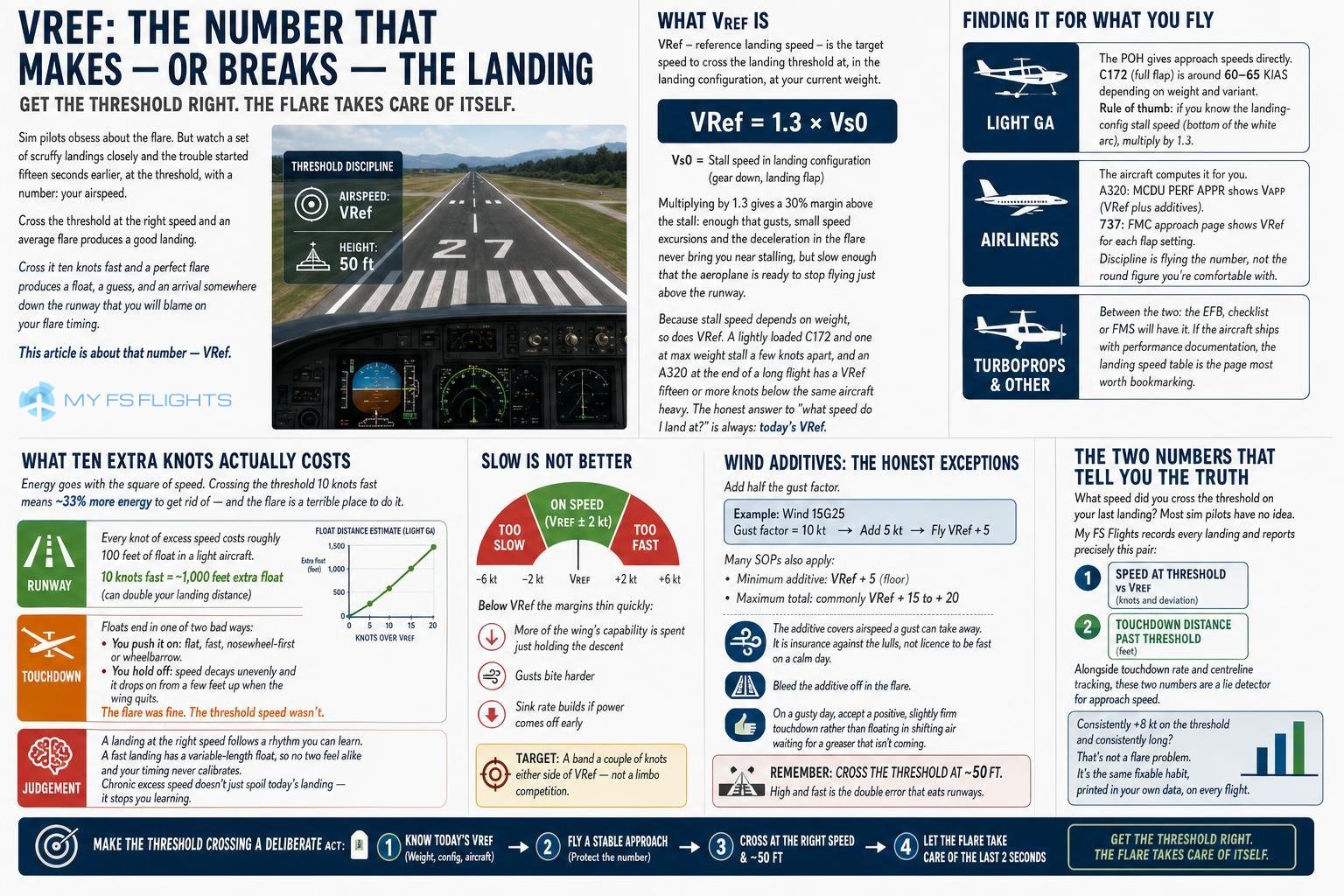
This article is about VRef, where it comes from, what each knot above or below it physically does to the landing, and how to actually fly it in the simulator, where several of the cues real pilots use to hold speed don't exist.
Where the reference speed comes from
VRef in its classic handbook form is 1.3 times Vs0, the stalling speed in landing configuration, gear down and full flap. Cross the threshold at 50 ft at that speed and the certified landing distances in the manual apply. That much appears in every training text. What the texts rarely explain is why the multiplier is 1.3, and the reason matters, because it tells you what you're giving away when you drift off the number in either direction.
Stall speed is not fixed, it rises with the square root of load factor. Bank 30 degrees and the stall speed goes up about 7 per cent, bank 45 and it goes up about 19 per cent. A gust that momentarily loads the wing does the same thing. The 1.3 margin exists so that normal manoeuvring in the final stages of an approach, a correcting turn, a bump, a slightly firm pull to arrest sink, happens comfortably away from the stall. That's why "I'll fly 5 knots below VRef to land shorter" is a worse trade than it looks. The distance saving is linear, but the margin you're spending protects against effects that grow with the square root of load factor, and the low side of the speed range runs out of options much faster than the fast side does.
Modern transport-category jets are certified to a slightly different formula, VRef at or above 1.23 times VSR, the reference (1g) stall speed, and the two produce comparable margins, because VSR is measured differently and sits higher than the old minimum-speed-in-the-stall figure. It's why Boeing and Airbus numbers can look "tighter" than the GA rule of thumb without actually being so.
The other thing the formula tells you is that VRef moves with weight, because stall speed does, again with a square root. The practical version is that roughly half of any percentage change in weight appears as a percentage change in speed. Land 10 per cent lighter than the weight your habit number was learned at and the correct speed is about 5 per cent lower. In a Cessna 172 that's a couple of knots and forgiving. In a 737 landing 15 tonnes under a full-load figure it's enough to turn a "normal" approach speed into a float on every single flight. This is why study-level airliner add-ons compute VRef in the FMC from actual weight and flap setting, and why the right technique there is to trust the computed figure, not a remembered one. In a default aircraft with a single placard approach speed, the placard is usually the max-weight figure, which means at typical sim weights it already contains a few knots of fat.
A 172's full-flap stall speed is published around 40 knots calibrated, but at that end of the range a 172's airspeed indicator reads several knots low, and the same stall is nearer 48 indicated. Multiply the indicated figure by 1.3 and you get about 62, which is essentially the POH short-field approach speed of 61. The gap between the raw rule and the POH's 60-to-65 normal figure is smaller than it looks. Part of what appears to be a safety buffer is really position error, and the rest is a handling and wind margin someone already added for you. Which is one reason adding your own margin on top is usually double-counting.
What ten knots actually costs
Kinetic energy scales with the square of speed. Cross the threshold at 140 knots instead of 130 and you're not carrying 8 per cent more energy to get rid of. You're carrying 16 per cent more. Every joule of it has to go somewhere before the wheels can carry the weight, and in the flare there are only two places for it to go. Drag, and distance.
Drag is the problem, because you've just lost most of it. Within roughly one wingspan of the surface the aircraft enters ground effect, where induced drag drops sharply. The speed-bleed rate you calibrated at altitude, close the throttle, count the knots coming off, roughly halves in the flare. Excess speed that would decay in a few seconds at 500 ft takes twice as long at 10 ft, and while it decays the aircraft will not sit down, because at that speed the wing is still producing enough lift to fly. This is the physical engine of the float. It also explains why big aircraft suffer more per knot. A 172 with its 36 ft span enters ground effect at about flare height, but a widebody with a span around 200 ft has been in it since well before the flare began.
While the excess bleeds off, the runway is going under you. At 130 knots you're covering about 220 feet per second, so every second of float at jet speeds spends 200 to 250 feet of runway. A float you would describe as "a bit long", three or four seconds, is 800 feet gone. The commonly quoted rule of thumb is that 10 per cent of excess threshold speed adds something like 20 per cent to the landing distance. The exact figure depends on braking and surface assumptions, but the shape of it is the squared relationship again, and it's unforgiving. The touchdown zone is conventionally the first 3,000 ft of runway or the first third, whichever is less. On a 6,000 ft runway, a 10-knot float can eject you from it entirely.
The slow side costs differently. Below VRef the energy available to arrest the descent in the flare shrinks fast, so the flare arrests less sink than you expect, the aircraft arrives rather than lands, and in long-body types the geometry adds a trap. Low energy demands a higher flare attitude, and the tail can meet the runway before the lift does. Slow is also aerodynamically nastier than fast, because jets on approach sit on the back side of the drag curve. Below minimum-drag speed, slowing down increases drag, which demands more thrust, which is why a jet's approach speed is unstable and needs continuous thrust management rather than a power setting you can set and forget. A 172 sits close to the bottom of the curve and is far more forgiving. A 737 is not, and technique that works in one actively fails in the other.
The wind additive, and what it is for
The standard guidance, in its typical Boeing FCTM form, is to add half the steady headwind component plus the full gust factor, with a minimum of about 5 knots and a cap around 20, and to bleed the additive off approaching touchdown. Airbus arrives somewhere similar by a different route: VAPP is VLS (itself 1.23 times the 1g stall speed) plus a correction, and with GS mini active the target speed moves live with the gusts, holding a minimum groundspeed - which is why the magenta target dances on a Fenix or FlyByWire final and why "the correct speed" on an Airbus is a moving object, not a bug you set once.
The reason the additive exists is worth understanding, because it explains both halves of the rule. A shear that removes 10 knots of headwind removes 10 knots of indicated airspeed instantly, with no stored energy to replace it. The additive is insurance against exactly that event. That is why it is scaled to the wind rather than to the pilot's nerves, and why it is bled off in the flare: it was never meant to be carried to touchdown, because at touchdown it is no longer insurance, only float.
Which brings us to additive creep - the most common speed habit in the sim community and probably in GA too. Five knots for the wind, five because it was gusty last week, five for confidence, and the pilot is now flying a habit number 10 to 15 knots above VRef on every approach. Two things follow. Every landing is long, which at a 12,000 ft sim hub costs nothing and teaches nothing. And every flare is learned against the wrong energy state, so on the day the pilot flies an actual on-speed approach, the calibrated flare is wrong and the landing is firm - which "confirms" that the extra speed was needed. The habit is self-reinforcing, and at a big airport the simulator never pushes back. A 2,000 ft strip inverts the tolerance completely: the same 10 knots that cost nothing at the hub is the difference between stopping and the fence.
Why speed discipline is harder on the simulator
Real-world advice on approach speed silently assumes cues that a monitor and a spring-centred joystick do not provide, and it is worth being explicit about what is missing.
The first is stick force. In a real aircraft trimmed for VRef, 10 knots of excess speed is a constant push in your hand - the aircraft is telling you, through force, that it wants to fly slower. Spring-centred hardware has no stick force per knot; the joystick pushes back exactly as hard at VRef+15 as at VRef. This is why sim pilots fly persistently out of trim without knowing it, and it points at the fix: the trimmed speed is the speed the aircraft wants to fly, and an aircraft properly trimmed for VRef resists both the float and the sink. Most fast approaches at a desk are really out-of-trim approaches with the excess held on the stick. (Hardware setup - curves, trim wheels, why they matter for pitch - is its own subject.)
The second is peripheral vision. Real pilots sense excess speed in the flare partly as a rush of ground texture in their peripheral view. A monitor's compressed field of view removes most of that cue; VR and head tracking restore some of it. The consequence inverts a piece of real-world advice: an instructor says "eyes outside in the flare", but at a desk the airspeed tape is the only honest witness to your speed, and glancing at it on short final is a reasonable adaptation, not a bad habit. It is also a genuine negative-transfer risk worth knowing about - a sim-trained pilot may be head-down at 50 ft where a real aircraft would be speaking through wind noise, buffet and stick force instead.
Two simulator-specific caveats. Frame stutters are a flight-control input: a 200-millisecond hitch at 130 knots is about 44 feet of unobserved travel, and a pilot who blames their speed control on short final over dense scenery should check their frame times before their technique. And flight models differ on the slow side - some default aircraft under-punish approaches near 1.1 Vs, with soft buffet and gentle sink penalties where a real aircraft would be mushing and sinking hard. The same +10 knots also floats differently in MSFS, X-Plane and P3D, and between default and study-level models in the same sim. Know which model you are calibrating to, and do not assume the low side is as benign as your default aircraft makes it feel.
Landings that look like flare problems
Four failure modes, each usually misdiagnosed as flare technique, each traceable to threshold speed.
The float. Fast at the threshold, normal flare, and the runway seems to refuse the aircraft. The instinctive fix - pushing it on - causes the next one.
The wheelbarrow or porpoise. A fast aircraft forced onto the runway touches nosewheel-first or nearly so. The tell is a touchdown that feels soft followed by a bounce that steepens. Pilots fix the bounce recovery; the cause was the 10 knots at the threshold.
The dropped-in landing. Slow, low-energy, and the flare arrests almost nothing: high sink at touchdown. From the cockpit this feels identical to "I flared too late", which is why diagnosing by feel fixes the wrong thing. Only the recorded threshold speed separates the two - and this is the failure that fastness-anxiety produces when a pilot overcorrects.
The duck-under. High on final, the pilot dives to the aim point, converting altitude directly into airspeed, and arrives on-glideslope but 15 knots fast. The vertical profile looks fine; the speed trace does not. It is one of the reasons the stabilised-approach concept - configured, on speed, on path by a gate, commonly 1,000 ft in IMC and 500 ft in VMC - checks speed and path together, and why the tolerances airlines use are asymmetric, typically allowing more on the fast side than the slow, because slow kills faster than fast. The full five-criteria stabilised-approach framework is its own article.
One more variation worth a sentence: flap setting changes VRef materially and changes the float behaviour with it. A 737 flown at flaps 30 and flaps 40 is two different landing problems, and a pilot who always lands one setting has only ever seen half of theirs.
The butter problem
Here is the uncomfortable part. The touchdown rate - the fpm figure the sim community has built an entire aesthetic around - is the least informative of the four numbers that describe a landing. Carrying 10 extra knots and skimming the aircraft on at 50 fpm produces a beautiful touchdown rate and a landing that every airline flight-data monitoring programme would flag, because FOQA systems alarm on long landings and threshold-speed exceedances, not on firm touchdowns. A normal airline touchdown is a distinctly felt arrival somewhere in the low hundreds of feet per minute; hard-landing inspection thresholds sit far above anything a competent sim pilot produces. Firm and in the touchdown zone is a good landing. Buttery and 3,000 ft past the zone is a bad one wearing a nice number.
The honest target order is: on speed at the threshold, in the touchdown zone, on the centreline, at a normal rate - in that order of importance. The community's leaderboard metric is the fourth item, and optimising for it directly trains the first failure mode in the list above.
Making it a measured skill
The desk has one enormous advantage over the aeroplane here: the simulator knows your exact threshold-crossing airspeed, the wind component, and your touchdown point on every flight - a measurement no real GA pilot ever gets. Repetitions are free, weather is on demand, and you can reposition to a five-mile final as many times as you like. The experiments that would be unaffordable in a real aircraft are the best use of a sim session.
The controlled-variable drill. Same aircraft, same weight, same runway, calm wind. Fly three approaches crossing the threshold at VRef, VRef+5 and VRef+10, and note the touchdown point each time. The squared relationship between speed and distance stops being a formula and becomes your own data in under an hour.
The trim drill. On final, trim properly for VRef, then go hands-off for five seconds. If the speed walks, the trim was lying and you have been holding your speed error on the stick. Free to run on every approach.
The slow-flight recalibration. Ten minutes at altitude, landing configuration, VRef−5. Learn what the low side handles like somewhere it costs nothing, before you ever meet it at 50 ft.
The additive drill. Fly the same approach in calm air, a 10-knot steady headwind, and 15 gusting 25, computing and flying the correct additive each time and bleeding it in the flare. Weather on demand turns the additive from a memorised slogan into a practised calculation.
Vary one parameter per session rather than grinding identical repetitions; ten identical calm-wind approaches plateau quickly, and mixed conditions are generally better for retention once the basic skill exists.
The other half of measurement is across flights, because one flight tells you what happened and twenty tell you your bias. A pilot who averages +7 knots at the threshold has a habit, not a bad day, and a habit is invisible in single-flight memory. This is exactly what My FS Flights records without any manual logging: its landing report captures the threshold-crossing speed against VRef alongside the touchdown rate, centreline and glideslope tracking, and its stabilised-approach badge checks speed-adjacent criteria - sink rate, glideslope, centreline, configuration - by 1,000 ft, so additive creep and duck-unders show up as a pattern in the logbook rather than a suspicion. Across a few weeks of flying, the correlation the article has been arguing appears in your own scatter: the long touchdowns cluster with the high threshold speeds, and the hard ones with the low.
One last honest note on transfer. Speed discipline is among the highest-transfer skills desktop simulation offers - the numbers, the additives and the stabilised-approach logic are the real procedures verbatim, and airliner pilots who fly study-level sims consistently report that the FMC, VRef and flap-schedule fluency carries over directly, because that layer is procedural rather than sensory. What does not transfer is the feel: the stick force, the buffet, the peripheral rush. Build the number discipline at the desk, and expect the sensory calibration to be relearned in the aeroplane.
Once your threshold speed is the same every flight, the flare finally becomes a learnable skill, because it is being asked to solve the same problem every time - and at that point the flare guides you have already read will start working.