
MSFS 2024 vs X-Plane 12 in 2026: Which Sim Actually Makes You a Better Pilot?
The comparison you've already read ends the same way every time. Microsoft Flight Simulator for the scenery, X-Plane for the flight model, "it depends what you want" for a verdict. If you're here, that answer didn't help, probably because your question was never really about software. It was about you. Which of these two platforms will make you a measurably better pilot, whether that means tighter landings, a real instrument scan, or something that survives contact with an actual aeroplane.
That question has an answer, and it's more useful and less flattering to both camps than the forum version. The short form is that the differences between MSFS 2024 and X-Plane 12 in 2026 are real, they matter for specific tasks, and they're small compared with the things both sims share and the things neither sim can give you. The rest of this article is the long form, including a way to settle the question for yourself in one evening instead of another week of reading.
Why the standard verdict keeps failing you
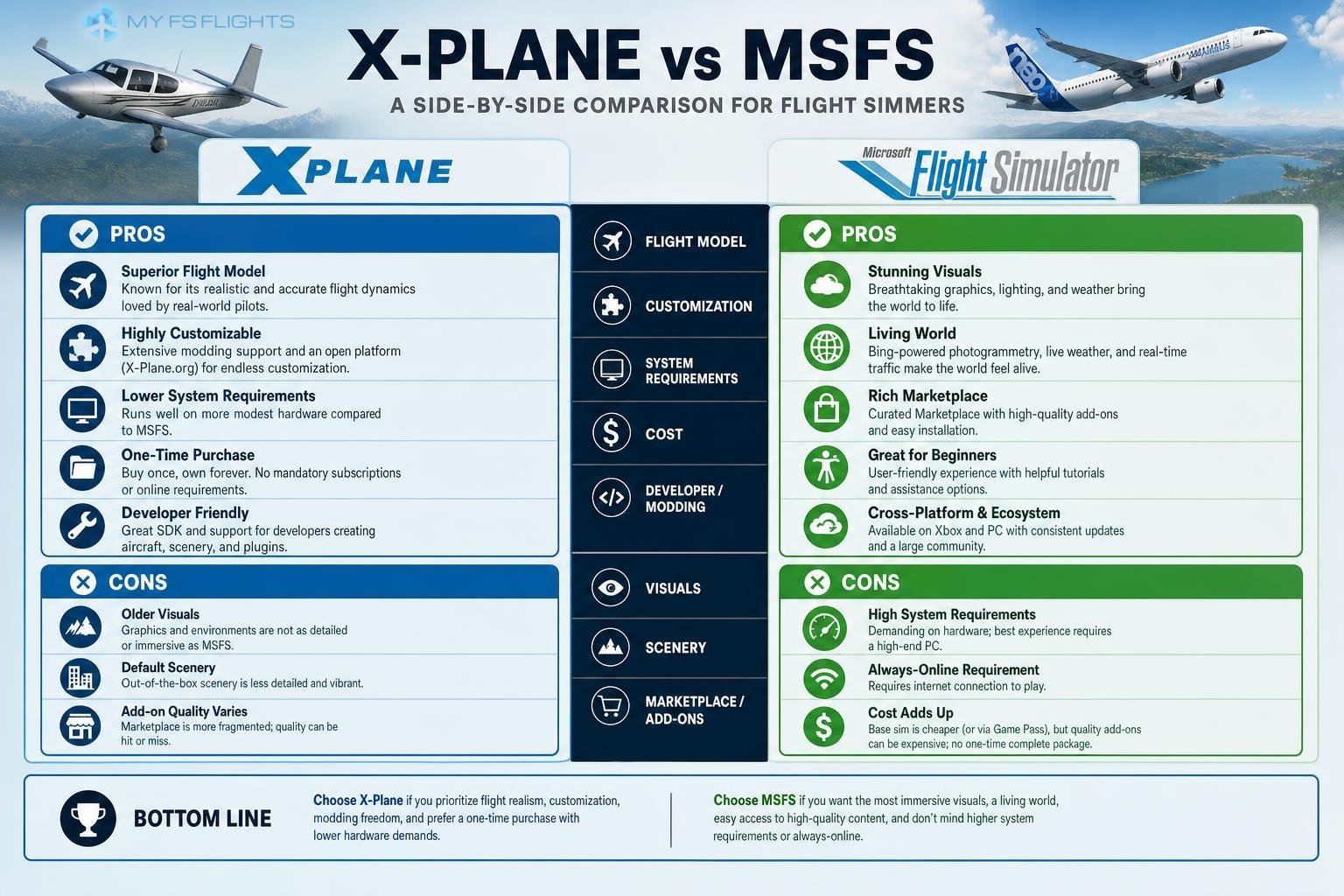
The canon goes like this. MSFS wins on the world. Streamed photogrammetry, live weather, default airports that look like the real ones. X-Plane wins on physics. Blade element theory, "it computes the aerodynamics rather than looking them up", the choice of real pilots and certified training devices. X-Plane has deeper default systems and failures, MSFS has the bigger fleet, the bigger marketplace, the gentler learning curve. Both are great. It depends.
Every clause of that is roughly true and almost none of it answers the training question. The first problem is that much of the flight-model folklore is a fossil. It describes the gap between FSX and X-Plane 10, two generations ago on both sides. The second problem is that the criteria are the wrong ones. A sim's value for skill acquisition doesn't come from a spec sheet. It comes from whether it gives you honest, repeatable feedback on the tasks you're actually trying to improve. Judged on that standard, the comparison looks quite different, and it stops producing a single winner.
What the two flight models actually do now
X-Plane's approach genuinely is different in kind. It divides each flying surface into segments, computes the airflow and resulting forces on each segment every frame, and lets the aircraft's behaviour emerge from its geometry. Left-turning tendencies, sideslip behaviour, asymmetric stalls, the way a wing drops when you abuse it. These fall out of the maths rather than being scripted. The practical consequence is that X-Plane tends to be most convincing at the edges of the envelope, in the regimes where behaviour has to emerge rather than be authored.
MSFS closed most of the historical gap in 2020, when Asobo replaced the old lookup-table model with one that samples the airframe at a large number of surface points (the developers have talked about roughly a thousand surfaces, though that's a manufacturer's claim rather than an independent measurement). MSFS 2024 added CFD-derived effects, including propwash over the control surfaces, which addresses one of the classic complaints about the platform. Elevator and rudder authority at low speed with power on. In cruise, in the circuit, and through most of a normal flight, a well-made aircraft in either sim now behaves plausibly enough that the differences are below the noise floor of most pilots' technique.
Here's the point the realism debate consistently misses. For learning, the property that matters isn't which model is correct but which is consistent. A learner improves by attributing error. The same input must produce the same output every time, so that when the output changes, the pilot knows the change came from them. Both simulators clear that bar comfortably in 2026. A flight model could be measurably wrong about a real 172 and still be an excellent training instrument, provided it's wrong the same way every flight. This is why the flight-model war, as fought in forums, is largely irrelevant to whether you improve.
Where the models do still diverge in ways a training pilot might meet.
- Ground effect and the last twenty feet. Ground effect begins at roughly one wingspan of height, which for a Cessna means the final 36 feet of every landing. The two sims model the float, the decay of sink rate, and low-speed pitch authority in the flare differently. This is the one flight regime where the platform difference could plausibly show up in your landing numbers, and, not coincidentally, it's where most "sim X feels more real" claims actually originate.
- Ground contact. Gear compression, bounce behaviour and derotation differ between the platforms. An identical touchdown, same sink rate and attitude, can produce a different bounce in each sim. Keep this in mind later, because it limits how directly you can compare raw touchdown figures across platforms.
- The atmosphere. Weather engines drive stick-and-rudder workload more than flight models do. The gust spectrum, thermal activity and wind-shear behaviour of each sim's air determines how much correction practice a circuit gives you. MSFS's live weather (built on Meteoblue data in the 2020 generation) produces a convincing large-scale picture, while X-Plane 12's rebuilt weather system produces turbulence and gusts with a texture many pilots find more demanding close to the ground. Neither is a validated atmosphere. Both are far better than the calm-air defaults most people actually fly in.
The desk is a bigger variable than either flight model
Every comparison between these two platforms happens inside a shared handicap, and the handicap is larger than anything being compared.
At a desk, you lose three channels of information that real flying depends on. Vestibular motion is gone entirely. No seat-of-the-pants onset cue, no sensation of sink arrested or not arrested in the flare. Peripheral vision is gone too. A single monitor gives roughly 50 to 60 degrees of horizontal field of view against roughly 200 degrees for human vision, and the flare-height judgement that in a real aircraft comes partly from runway texture flowing past the edges of your vision is equally compromised in both sims. There's no physics in either flight model that can fix this. VR and head-tracking recover some of it, and that's a separate article. Third, control forces are gone. X-Plane computes control forces with some sophistication, and then your spring-centred stick delivers none of them to your hand. Its superior force model is a paper advantage on the hardware nearly everyone owns.
Two desk-specific factors do differ between the platforms and are worth knowing. X-Plane's flight model is coupled to frame rate, and historically the sim slows simulation time when frame rate drops below roughly 19 to 20 fps, a behaviour that has persisted in some form into the current generation. MSFS degrades differently under load, holding real time but stuttering. Either way, a stutter on short final means you're flying blind for a fraction of a second at the moment that decides the landing, and the repetition is corrupted as practice. Frame rate is a flight-control input. Treat it as one when you set graphics options, whichever sim you choose.
The other differing factor is default sensitivity curves. The two sims ship with different response curves, so a pilot switching platforms is partly re-learning their own hardware calibration, not the new flight model. A large fraction of "I tried the other sim and the aircraft feels wrong" posts are describing an uncalibrated axis. Setting up curves properly is its own subject, but the comparison-relevant point is simple. Until your hardware is set up equivalently in both sims, you have no basis for comparing them at all.
What the desk gives back, it gives back identically in both platforms. Repositioning is free, weather is on demand, repetitions cost nothing, and the sim knows things no real cockpit does. Your exact touchdown rate, your continuous glideslope and centreline error, your speed over the threshold against VRef. That measurement capability, the same principle that airline FOQA programmes are built on, is the desktop sim's real advantage over the aircraft, and it's platform-agnostic.
Where the choice does change the answer
None of the above means the choice is arbitrary. It means the verdict is per task, not per pilot tribe.
VFR navigation favours MSFS, decisively. Pilotage, checkpoint identification and diversion practice depend on the ground looking like the ground. Photogrammetry and accurate terrain detail mean that a visual navigation exercise flown in MSFS transfers to the real chart and the real window in a way that generic autogen scenery does not. This is a genuine, task-specific win for the platform the forums call the "worse flight model" sim, and if your training goal is the cross-country phase of a PPL, it should probably decide the question on its own.
Airliner procedure work favours neither platform. For study-level airliners, the add-on is the simulator. A Fenix or PMDG aircraft in MSFS, a ToLiss or FlightFactor in X-Plane, contributes far more of the systems fidelity than the host sim does. Fleet availability on the type you actually fly, or want to fly for a virtual airline, should override every other criterion here. Navdata is close to a wash. Both ecosystems take it from the same providers on the same 28-day AIRAC cycle.
Helicopters, gliders and aerobatics favour X-Plane. These categories stress the flight model hardest, at the edges of the envelope where emergent behaviour matters, and this is where X-Plane's approach has historically shown its clearest advantage. The verdict flips by aircraft category, not by pilot seriousness.
IFR procedural training is close to neutral. Holds, approaches, the instrument scan, checklist and callout discipline. These live in the pilot and the procedures, not the physics. Default ATC is weak in both sims. Choose by the aircraft and avionics you want to fly them in.
Experience level inverts the answer. A beginner benefits more from MSFS's approachability and the density of visual reference in its world. The subtler flight-model differences only become detectable once your own scatter is smaller than they are, and for most pilots, honestly measured, it isn't yet.
One more piece of evidence deserves to be stated carefully, because it's the strongest objective fact in the whole debate and it's routinely overclaimed. Many certified aviation training devices are built on X-Plane's engine, and in the United States the FAA allows a capped amount of instrument training time in approved basic and advanced training devices to count toward the instrument rating (on the order of 10 hours in a BATD and 20 in an AATD under the current rules, and these are regulatory maxima, they vary by regime outside the US, and they apply to the certified device, not the retail desktop version). This is real regulatory lineage and it says something true. Instrument-procedure transfer from this class of software is well enough established that regulators grant logbook credit for it. It does not say that desktop X-Plane trains you better than desktop MSFS, and anyone deploying it that way is stretching it past what it proves.
Run the experiment instead of reading another comparison
The question in the title is empirically answerable, per pilot, and almost nobody bothers before declaring allegiance. Here's the test, runnable in an evening if you own both sims or can borrow time in one.
Take the default C172 in each platform. Enter the same METAR manually in both, including some crosswind, rather than trusting each sim's live weather to agree. Fix your camera position and field of view so the sight picture matches. Fly ten circuits in each sim, holding yourself to the same stabilised-approach standard, and record the touchdown rate for every landing.
Then look at the spread, not the average. A single greased landing means nothing in either sim, because anyone can get lucky once. The signal is the distribution. If your touchdown rates in one platform cluster between roughly 100 and 250 fpm and in the other they scatter from 50 to 500, that tells you something, though it may be telling you about your calibration to each sim's sight picture rather than about the sims. What you'll most likely find is that the spread within each platform dwarfs the difference between them. The variance is you. That's not a criticism. It's the finding that redirects your effort from the purchase decision to the practice.
This is the kind of question I built My FS Flights to answer, and I deliberately built it to refuse to take a side. It records and scores flights identically across MSFS 2024, MSFS 2020, X-Plane 12 and 11, and P3D, applying the same five-criteria stabilised-approach gate (gear, flaps, sink rate, glideslope, centreline, assessed by 1,000 ft) and the same landing report, covering flare, touchdown rate, threshold speed against VRef and centreline tracking, to every landing regardless of platform. Run the ten-circuit test in each sim and the logbook holds both distributions side by side. One caveat the data itself imposes. Because the ground-contact models differ, raw touchdown numbers aren't perfectly comparable across platforms, so the trend within each platform is more trustworthy than the comparison between them. A tightening spread over twenty flights means you're learning, wherever you fly.
The question behind the question
Now the part the comparison articles won't tell you, because it makes the comparison mostly moot.
Platform choice explains a small fraction of the variance in a pilot's measured performance. Practice frequency, practice structure and feedback quality explain the rest. The sim you fly three times a week beats the "better" sim you fly monthly, by any measurable definition of improvement. A structured hour, one variable at a time, with the numbers checked afterwards, in the platform the forums sneer at, will outproduce a free-flight hour in the platform they venerate. And unmeasured hours barely count at all. Total time is the community's favourite vanity metric and one of the weakest predictors of landing quality, because a thousand hours of autopilot cruise at FL350 exercises neither flight model and improves nothing.
It's also worth saying that most realism claims in this debate are unfalsifiable. The people arguing most fiercely about which sim models a 737 more accurately have, almost without exception, never flown a 737. Strip away the engineering vocabulary and most fidelity claims are aesthetic preferences, and the honest evidence base, certified-device lineage and regulatory credit for instrument procedures, is narrower and less flattering to either camp than the forums admit.
Watch for the failure modes this debate produces, because they cost more training time than any flight-model deficiency. Sim shopping as procrastination, weeks of research, zero flights logged in either platform. Blaming the physics for a bounce that the data shows was a late flare at ten knots over VRef, when the same input error bounces in both sims, and misdiagnosing it as a platform flaw is precisely what stops you fixing it. Judging realism by difficulty, assuming the sim you land worse in must be the accurate one, when it may just model gear compression differently. And switching platforms mid-training, which resets your calibrated sight picture, curves and sound cues and produces a temporary dip that pilots reliably misread as the new sim being "harder", which they take to mean "more realistic".
So if your flying is VFR navigation, buy MSFS 2024 and stop deliberating. If it's helicopters or gliders, buy X-Plane 12. If it's airliners, buy whichever platform hosts the study-level aircraft for your fleet. If it's landings and stick-and-rudder technique, the honest answer is that either will do, the desk is your real adversary, and the flight-model difference sits below your current scatter. Whichever box you tick, the decision is worth one evening, not another month. The pilot who picked either sim a month ago and has flown thirty measured circuits since is already better than the one still comparing them.