
Descent Planning: How to Stop Arriving High, Fast and Embarrassed
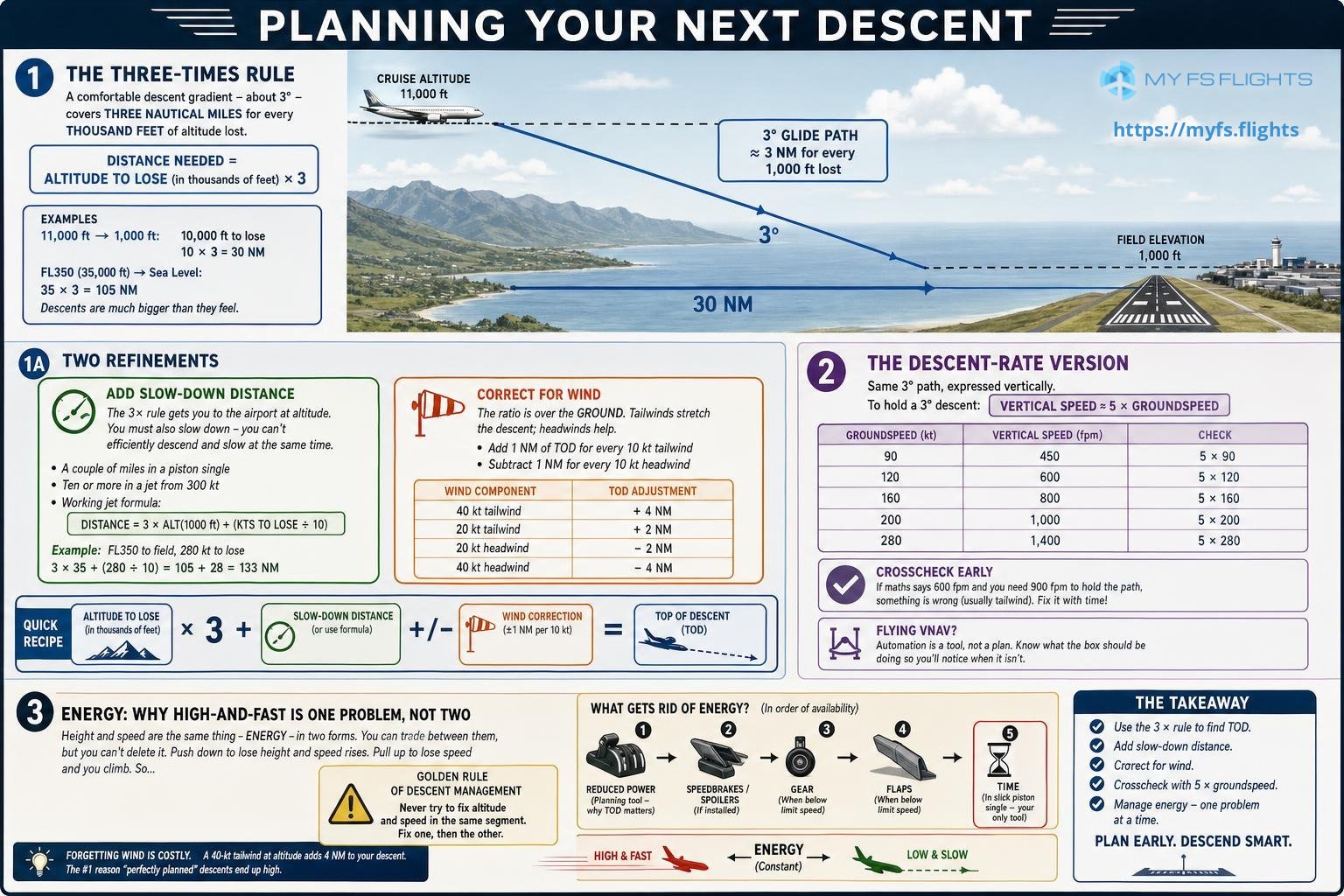
You crossed the last waypoint of the arrival at 8,000 ft when the chart wanted 5,000, the speed tape reads 280 kt, and the runway is 18 miles away. You already know the three-times rule, here you are again, watching the glideslope diamond sit stubbornly below you while the aircraft refuses to slow down. The rule isn't broken. What's missing is the reason it works, because without that you can't adjust it, and an unadjusted rule of thumb fails exactly when it matters.
In this article I want to rebuild descent planning from the energy up, so the numbers stop being incantations and start being arithmetic you can redo for any aircraft you fly, from a default 172 to a 737. By the end you should be able to look at an altitude, a distance and a groundspeed and know within a few seconds whether you're ahead of the aeroplane or behind it, which is the entire skill.
Where the three-times rule comes from
A standard descent path is 3 degrees and that's the angle of nearly every ILS glideslope, most RNAV vertical paths, and the profile airliners aim to fly from cruise. The tangent of 3 degrees is about 0.052, which means a 3° path loses roughly 318 ft for every nautical mile of ground covered.
The three-times rule says to take the altitude you need to lose in thousands of feet, multiply by three, and that's your track miles. Losing 30,000 ft needs 90 NM. Run that backwards and the rule delivers 333 ft per mile, slightly steeper than a true 3° path. That's deliberate, or at least fortunate. The small excess is a built-in buffer, and as I'll show, the buffer gets spent on deceleration whether you plan for it or not.
Two things follow immediately from knowing the rule is geometry.
First, the altitude to lose is height above the field, not above sea level. Descending to Denver from FL360, you're losing 36,000 minus roughly 5,400 ft, not 36,000. Planning to sea level at a high-elevation airport puts your top of descent 15 miles too early, and you'll spend those miles dragging along level with the thrust up, which is a quieter failure than arriving high but the same failure.
Second, the distance is track miles, the ground you'll actually cover, not the direct distance the FMS progress page shows to the destination. A STAR with a downwind leg and a base turn commonly adds 15 to 30 NM over the direct figure. Planning your descent against the direct distance while flying the full procedure is probably the single most common cause of arriving high, and it's invisible in the moment because every instrument agrees you did the maths right.
A worked check, because this is the arithmetic you should be able to run in your head in under ten seconds. You're at FL340 and the arrival requires FL200 at a fix 40 NM ahead. Altitude to lose is 14,000 ft. Miles needed, 14 × 3 = 42.
The descent-rate maths
The rule tells you where to start down. It says nothing about what vertical speed holds the path once you're on it, and this is where a second piece of arithmetic comes in. Required descent rate for a 3° path is groundspeed times five.
The exact multiplier is about 5.3, and the difference matters at cruise speeds. At 480 kt groundspeed, GS × 5 gives 2,400 fpm while the path actually needs about 2,540. Hold the ×5 figure from top of descent and you drift above profile by 140 ft every minute, which over a ten-minute descent segment is a 1,400 ft error that appeared from nowhere. If you consistently end up slightly high despite starting on time, this rounding error is a likely suspect. Use ×5 as the quick figure and add a couple of hundred feet per minute when you're fast.
Notice what the formula uses. Groundspeed, not indicated airspeed. At FL380 with a 100 kt tailwind, 280 kt indicated might be 550 kt across the ground, while on final at the same indicated speed you might be doing 130 kt. The path angle is fixed but the descent rate that holds it changes continuously as your groundspeed falls, which means two things. A descent plan built on one wind figure is built on sand, so segment it, at minimum treating above and below 10,000 ft as different problems. Picking a tidy 2,000 fpm and holding it feels controlled, but as you decelerate the rate you need falls away beneath the rate you're flying, or the wind shifts and the opposite happens, and you end up high or low and blame the aircraft. Constant-VS descent is the flight-sim equivalent of steering a car by holding the wheel still.
Speed is stored altitude
Kinetic energy and potential energy are the same currency, and the aeroplane draws on both accounts without distinguishing between them. Slowing from 250 kt to 200 kt releases the energy equivalent of roughly 1,000 ft of altitude. That's v²/2g, not an operational rule, but it tells you the scale of the thing.
The exchange rate isn't fixed, and that's the part worth carrying. Because energy goes with the square of speed, the same 50 kt reduction is worth about 1,200 ft if you're slowing from 300 and only about 800 ft if you're slowing from 200. As a working figure, at jet arrival speeds treat every 10 kt of excess as roughly 200 ft of excess height, and at light-aircraft speeds it's nearer 100. Excess speed costs you most when you're fastest, which is also when you have the fewest miles left in which to spend it. When you assess your situation on arrival, add both accounts together, because the aeroplane already has.
This is why pushing the nose down while fast solves nothing. You're moving energy from the altitude account into the speed account and calling it progress. It feels like decisive action, the vertical speed needle swings, the altitude unwinds, and it's the single most seductive wrong move in the whole phase, because you arrive at the platform altitude on time and 40 kt too fast.
The only way energy actually leaves the aircraft is through drag (and, at the margin, through reduced thrust, since an idle engine stops adding energy but removes none). A modern jet is designed to have almost no drag when clean, which is why a clean jet at idle descends at a fixed, shallow angle, somewhere around 2.5° to 3.3° depending on type, weight and speed. Everything about jet descent management follows from that one fact. The aircraft has a small, roughly fixed energy leak, so the plan must dispose of the energy over enough miles, because there's no way to dump it quickly without paying a cost. This is where "you can go down or slow down, but not both" comes from. It's a description of a jet's drag budget, not a law of aviation, and treating it as universal causes the reverse mistake in other types.
A propeller at low power is a large disc of drag sitting on the front of the aircraft. Pull a turboprop back and it descends and decelerates at once, happily, which is why turboprop crews fly noticeably steeper profiles, usable ratios closer to 2.5:1 rather than 3:1, though this varies by type and you should calibrate rather than assume. A draggy GA piston is limited less by drag than by the descent rate you're willing to fly. The convention of planning around 500 fpm is a comfort figure, not a limit, and in a simulator with no passengers and no ears to pop you can plan steeper if you choose to. For GA the arithmetic is more naturally done in time than in angle. Altitude to lose divided by your planned rate gives minutes, and minutes times miles-per-minute gives distance. A 172 at 110 kt groundspeed losing 4,500 ft at 500 fpm needs nine minutes and about 16 or 17 NM. Same energy accounting, different constants.
The corrections the standard rule needs now make sense rather than being a list to memorise.
- Deceleration allowance. Slowing while clean and level at idle costs roughly 1 NM per 10 kt in a jet, so 300 kt down to a 210 kt clean-manoeuvring speed costs around 9 miles of level flight, more when heavy. Add it to the three-times figure. A heavy jet holds energy longer and decelerates worse, and the allowance grows with weight.
- Wind allowance. A tailwind stretches every minute of descent over more ground. A workable approximation is to add about a mile per 10 kt of average tailwind component, and subtract for headwind, but treat the number as rough and the direction of the correction as the thing to remember. A wind that reverses with altitude, tailwind aloft, headwind on final, is why segmenting the plan matters more than refining the constant.
- The 250 kt restriction. Below 10,000 ft you're typically limited to 250 kt indicated (a US rule that much of the world mirrors in some form, though not universally). This forces a deceleration around 10,000 ft whether the profile wants one or not, so plan for it rather than discovering it.
Flying it on the simulator
Everything above is true in a real flight deck too. What changes at the simulator is what you have to work with, and most of it works against you.
A descent has almost no felt signature on a monitor. No ear pressure, no seat cue as the nose drops, no engine-note change you can trust through desktop speakers. In a real aircraft your body files a continuous report on the energy state. At a desk the instrument scan carries the entire monitoring load, and a pilot who hasn't consciously accepted that will drift for whole minutes without noticing the trend. The visual picture is worse than useless as a substitute. A flat screen compresses depth, and the runway's apparent size and angle depend on your field-of-view setting, so "the airport looks about right" means different things at different zoom levels and different things to two pilots in identical positions. Use the numbers.
Default sim ATC compounds this by descending you late, or not at all. The real-world crutch of "the controller will start me down" doesn't exist offline, which is irritating and better training. You're your own controller, and the discipline of setting your own top of descent is exactly the skill that atrophies in pilots who wait to be told.
Two desk-specific traps deserve naming. Time acceleration through the cruise is among the most common causes of a blown top of descent. At 4× the TOD flashes past in seconds, and some autopilots handle accelerated rates badly on top of it. If you use time compression, drop to 1× at a fixed distance before your calculated TOD, say 20 NM, and make that non-negotiable. And live-weather winds aloft can differ substantially from whatever forecast your FMS is working with, which means a sim VNAV path is often built on worse data than an airline VNAV path. The mental-maths crosscheck matters more in the simulator, not less. The widespread pattern, pilots who can programme a full FMS descent but can't do 3 × 14 in their head, is disabling precisely because the box's wind data is frequently wrong, and when the path lies the pilot with no fallback rides it faithfully into a 60 kt speed problem. The tell is the speed trend, not the path deviation. The intervention is on speed, early, not distrust of VNAV in general.
One more thing varies at the desk. The aircraft itself. Idle thrust, spool-up time, speedbrake effectiveness and clean drag are modelled very differently between default and study-level aircraft, and between MSFS, X-Plane and P3D. A descent technique tuned in a default airliner can be twenty miles wrong in a high-fidelity rendition of the same type. The fix is cheap and worth doing once per aircraft. From a fixed altitude, pull the thrust to idle, stay clean at a fixed speed, and note the ground distance to a fixed lower altitude. That measured gradient replaces the generic 3:1 with your number, for this airframe, in this simulator.
Kept high: three problems, three fixes
Sooner or later the plan fails anyway. A VATSIM controller holds you up for crossing traffic, a shortcut steals fifteen track miles, or you just started late. Being kept high isn't the controller's fault and isn't an emergency. Real crews plan for the slam-dunk as a normal case, and a plan with no margin was never a plan. What matters in the moment is diagnosing which problem you actually have, because "high and fast" is three distinct states.
| State | What it looks like | The fix |
|---|---|---|
| High, on speed | Above path, speed where you want it | Speedbrake. Trade the excess altitude for drag directly; speed stays put. |
| On path, fast | Diamond centred, 40 kt to lose | A level deceleration segment, or configure early, flaps and, if the situation is bad, gear. Pushing over makes it worse. |
| High and fast | Both accounts over budget | Nothing aerodynamic fully fixes this. You need track miles. Ask for them online, fly them offline. Extending the downwind is not failure, it is the correct answer. |
Speed brakes are limited or prohibited with landing flap on many types and cause buffet on others, so "when in doubt, boards out" has a floor. Check your aircraft. And early gear is enormously effective drag but noisy, speed-limited and hard to undo cheaply. It's the right tool when you're behind on both accounts inside 15 miles, and overkill before that.
Descending too early and dragging in low with the thrust up for 40 miles. It burns fuel, it wrecks any continuous-descent intention, and it has the same root cause as arriving high. The plan was wrong, just in the direction that happens to be recoverable with power. If your approaches are stable but your descents involve long level segments at 3,000 ft, you have a planning problem.
Building the top-of-descent habit
The maths only helps if you actually run it, repeatedly, and the way to make that automatic is gates. Fixed points where you compare where you are to where the profile says you should be. A workable set for a jet, stated as technique rather than regulation.
- 250 kt and 10,000 ft by roughly 30 NM out.
- About 3,000 ft above the field by 10 NM.
- Configuring and on speed by the platform altitude, stable by 1,000 ft.
Say them aloud as you pass them. "Twenty miles, 7,200 above field, need 6,600, slightly high, boards for a minute." The verbalising is the point. It forces the comparison a silent glance skips. The simulator hands you an advantage here no real single-DME cockpit ever had. Exact distance and exact altitude are always on screen, so the three-times check can be a rolling gate every ten miles rather than a one-off calculation at TOD.
Then practise the phase deliberately, because the way most simmers fly, one descent per two-hour flight, or worse, slewing past it to get to the landing, gives the hardest phase of flight the fewest repetitions. Repositioning past the descent is a skill-acquisition bug wearing a convenience feature's clothes. Instead, save a situation at a slam-dunk, FL240 at 25 NM works, and fly it five times with a different tool each time. Speedbrake only, early gear, a level deceleration, extended track, then a combination. No real aircraft could ever afford that rehearsal. Yours can, and after five runs you'll know each tool's actual yield in your specific aircraft rather than its reputation. The same logic applies to wind. Fly one arrival with a 50 kt tailwind and again with a 50 kt headwind and watch your required TOD move by tens of miles. That intuition can't be bought at any price in a real aeroplane. For a harder benchmark, fly the descent from TOD to platform altitude at idle without touching the thrust. Where you fail tells you exactly where your plan leaks energy.
The last piece is just measurement, because a descent that went wrong at 80 NM shows up as a landing that went wrong at 50 ft, and memory reliably misfiles the cause. This is where automatic flight logging earns its keep. I built My FS Flights to record every flight in the background and assess a stabilised-approach gate at 1,000 ft against five criteria, gear, flaps, sink rate, glideslope and centreline, which makes it, in effect, a descent-planning detector wearing a landing badge. Repeated failures on sink rate or glideslope were usually caused an hour earlier, not on final, and the landing report's threshold-crossing speed against VRef is the fingerprint of an energy debt that never got paid. The excess knots at the threshold are the miles you didn't plan. One rushed approach is weather. The same pattern across ten flights in a logbook is technique, and that distinction only exists in aggregate.
Which leads to the uncomfortable point worth ending on. The community optimises for the greased touchdown, but the landing is largely decided a hundred miles out, and most ugly arrivals are the last domino of a descent that was never planned. A firm touchdown off a stable, planned approach is a better flight, and a better habit, than a butter landing rescued from chaos in the last mile. The target state for this whole phase is that nothing interesting happens. The boards stay stowed, the gates pass on schedule, and the approach is boring. Boring is what a correct descent looks like from the inside.