
Bush Flying 101: Short Strips, Soft Fields and the Returning Bush Trips
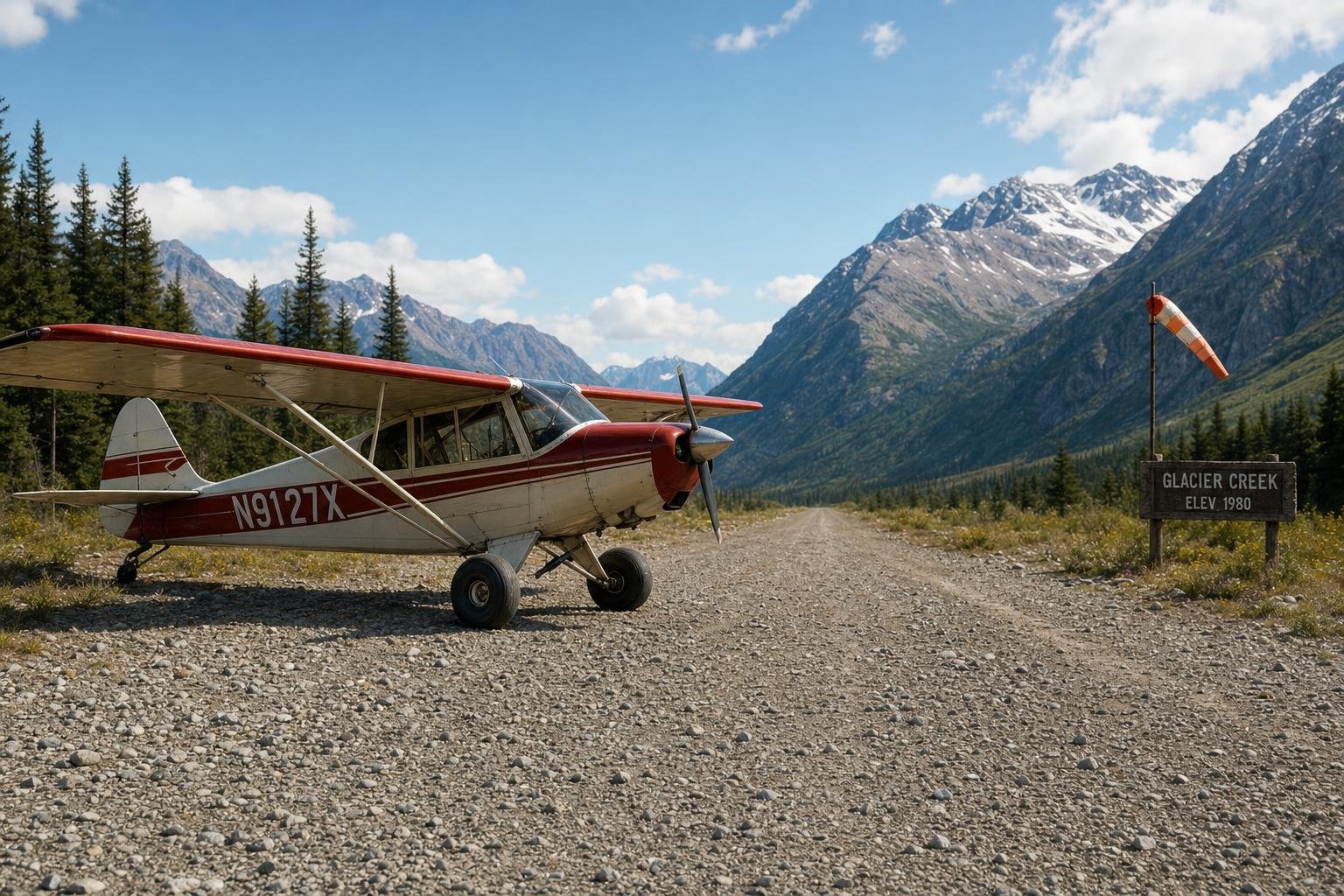
The bush trips are back in Microsoft Flight Simulator 2024, and the sim community has responded the way it always does. Load a Cub, point it at a gravel bar, and discover that the technique everyone quotes from the FAA handbooks doesn't work at a desk. You approached at 1.3 Vso like the book said, and floated half the strip away. You held the stick back for the soft-field roll and porpoised into the trees. You've read the short-field procedure three times and it still isn't translating.
That's not because the procedure is wrong. It's because every line of it silently assumes a real aircraft, with peripheral vision, control forces, and a seat that tells you when you're sinking. At a desk, all three are missing, and nobody rewrote the procedure for the version of you that is actually flying. So in this article I want to do two things. First, walk through what short-field and soft-field technique is actually doing, so you can rebuild it around what a monitor and a spring-centred stick can deliver. Second, lay out how to turn bush flying into the most effective skills training the simulator offers, rather than a scenic way to crash.
The whole discipline is one energy equation
Strip everything back and short-field landing is a single problem. Arrive at the threshold with the minimum energy the aircraft can safely carry, then get rid of the rest as fast as possible once the wheels are down. Every rule in the handbook is a corollary of that.
Start with approach speed. The standard figure is 1.3 times the stall speed in landing configuration, which for a Cub-class aeroplane means a final approach somewhere in the 45 to 55 knot range. The point of that number isn't that slow is virtuous. The point is that every knot above it is stored kinetic energy, and energy stored at the threshold must be dissipated in ground effect before the aeroplane will stop flying. Kinetic energy scales with the square of speed, so the excess grows fast. At a 45-knot approach, five knots hot is over a tenth more speed and roughly a quarter more energy to get rid of in ground effect. On a strip where a correct arrival barely floats at all, that can double the float. Ten knots hot at a 400-metre strip is a go-around you haven't admitted to yet. This is why the fix for "the plane just wouldn't come down" is never in the flare. It was decided three miles earlier, on final, at the airspeed indicator.
The same arithmetic is why headwind matters so much. What the strip cares about is groundspeed, not airspeed. A 10-knot headwind against a 45-knot approach cuts your rollout energy by roughly 40 per cent, which is why real bush pilots will accept a worse surface to land into wind, and why the sim's ability to set wind on demand matters for training. More on that later.
Second corollary. The back side of the power curve. Below best-glide speed, and unambiguously so as you approach minimum-power speed, the usual relationship between pitch and flight path inverts. Pull the nose up and induced drag rises faster than lift, so the aeroplane slows and sinks more, not less. At STOL approach speeds you're living in this regime, which means the controls swap jobs. Power controls your descent rate. Pitch controls your speed. Pilots who haven't internalised this chase the aim point with the stick, get slow, sink harder, pull more, and arrive in the classic decaying-speed, steepening-sink accident profile. Once you fly the approach with the throttle instead, the aim point stops wandering.
Third, and this is where the sim community's instincts actively fight the technique. The touchdown should be positive. A deliberate, firm arrival on the main wheels at minimum speed puts weight on the tyres immediately, kills lift, and starts the braking phase now. A greased-on landing means the wing is still flying, the wheels are barely loaded, and the brakes have almost nothing to work with. The sub-100-feet-per-minute "butter" the community celebrates is, at a short strip, a description of failure. STOL competitors fly demonstration approaches down around 1.1 to 1.15 Vso and plant the aeroplane. You shouldn't copy their speeds, which trade away every margin, but you should copy the attitude to touchdown firmness. A positive arrival at a couple of hundred feet per minute on gear built for it is unremarkable in this discipline. What matters is where and how slow, not how soft.
Fourth. Once down, transfer weight to the wheels. Braking force is proportional to the load on the tyres, which is why the handbook says to retract flaps on the rollout. In a light aircraft, dumping flaps shifts a meaningful fraction of the aircraft's weight from wing to undercarriage in a second or two, and in the sim you can see it as a distinct step in deceleration. In a retractable, confirm which lever your hand is on. In the sim this mistake costs a restart, but the habit is still worth building correctly.
Soft-field takeoff is the same equation run backwards, plus one piece of aerodynamics. Ground effect. Within roughly one wingspan of the surface, about 35 feet for a Super Cub, induced drag drops substantially. The soft-field technique exploits this as a kind of drag arbitrage. Lift the wheels out of the surface, which in reality is the draggy bit, at a speed far below climb speed. Accelerate level in ground effect, where the aeroplane can gain speed even though it can't yet climb. Only then pitch for the climb. It's not a trick. It's borrowing performance from the ground and paying it back once you have the airspeed.
Which brings me to the trap. Climb out of ground effect before reaching climb speed and the full induced drag comes back at exactly the moment you have no excess power, and the aeroplane settles. In a real aircraft the sink is felt instantly through the seat. At a desk it isn't felt at all, and by the time the VSI or the visual picture tells you, you may be past the trees. The desk answer is an airspeed gate, not a feeling. Pick the number, Vx or the POH's soft-field climb speed, and don't raise the nose out of ground effect until the needle touches it. This is a recurring theme, so it deserves its own section.
What the desk takes away, and what to substitute
Real short-field instruction assumes hardware you don't have. I'll go through the losses one at a time, because each has a specific workaround.
Height judgement in the flare. Real pilots judge the last ten feet largely with peripheral vision, the ground rushing past at the edges of sight. A monitor gives you a 60 to 90 degree cone and a flat image with almost no depth information. "Judge your height over the gravel" isn't advice you can follow. You need substitutes, and two of them work. Known-size references, such as a tree line of roughly known height or the strip's width, which your brain calibrates over repetitions at the same strip. And the far-end sight picture, where the far threshold sits in your windscreen at flare height. Both are learned per strip and per camera position, which is why your camera and field-of-view settings must never change between sessions. Move the virtual eyepoint two inches and every height judgement you've calibrated is wrong. Head-tracking or VR restores a real fraction of this and pays off in bush flying more than almost anywhere else in the sim, because curving, terrain-hugging approaches require looking somewhere other than dead ahead.
Control forces. The soft-field instruction "full aft yoke throughout the ground roll" assumes a yoke with forces you can lean against. On a spring-centred desktop stick, holding full deflection is tiring and imprecise, and half-deflection creep is invisible. The desk workaround, which would be poor technique in a real aeroplane, is to trim fully or nearly fully nose-up before starting the roll and let the trim hold the elevator for you, feeding in stick only for fine control. More generally, trim is your substitute for feel everywhere in slow flight. Trim for the approach speed and the aeroplane will tell you about speed changes by moving away from the trimmed attitude, which is a cue you can see even though you can't feel it.
The sink cue. The vestibular system announces a developing sink rate immediately. A desk pilot gets it visually or from the VSI, a second or more later, and on the back side of the power curve a second is a lot. Until your eye learns the visual signature of developing sink, the aim point sliding up the windscreen, fly your STOL approaches two or three knots faster than the real-world technique would prescribe. You'll give back a little float. You'll stop arriving in unrecovered sink.
Frame rate. At five feet and 45 knots, a 200-millisecond stutter is four to five metres of ground crossed with no visual input and no control response, which is a lost flare correction. Low-and-slow flying is the one case in the sim where you should ruthlessly trade scenery density for smoothness. A stable 40 fps beats a stuttering 60 with better trees.
Two caveats keep this whole topic practical, first, soft-surface modelling in every desktop simulator is thin. Grass and gravel are mostly a rolling-friction number, with no rut capture, no nosewheel dig-in, no consequence for a divot. The soft-field technique is worth practising for its energy management and its airspeed discipline, but the part of it that exists to protect the nosewheel from soft ground is being rehearsed against physics that isn't there. Second, ground handling, tailwheel behaviour, surface friction and low-speed stall character differ more between simulators, and between add-ons within one simulator, than cruise flight does. A Cub that is docile in MSFS may try to swap ends in X-Plane 12, and vice versa. Before trusting any aircraft as a slow-flight trainer, test its honesty. Fly it to the stall in landing configuration and see whether it mushes and warns like the real type, or flies on rails to one knot above the published number and then quits. Some third-party bush aircraft model the pre-stall region carefully. Some don't, and technique tuned on the latter is technique tuned on nothing. Terrain deserves the same scepticism. A strip that is famously humped or sloped in reality may be rendered flat, or with a phantom lip at the threshold that launches you. If the mesh is wrong, the sight picture you learn there is wrong too.
Against all of that, the desk holds one enormous advantage. Repetition density. A real pilot flying into Johnson Creek, at just under 5,000 feet in the Idaho backcountry, gets perhaps one approach per hour of flying, fuel and daylight. You can save a situation on three-mile final and fly the last three miles fifteen or twenty times an hour, in weather you chose. Everything in the training section below is built on exploiting that ratio, because it's the one thing no real aircraft can offer.
Reading the strip: slope, one-way, obstacles, altitude
Flat-runway technique assumes a flat runway with a go-around available in both directions. Bush strips break those assumptions one at a time.
Sloped strips reverse the usual trade. Land uphill and the slope does much of your braking. Take off downhill and gravity does much of your accelerating. That's why sloped strips are usually flown one way regardless of wind, and it means a light tailwind on the uphill landing is often the correct choice, which feels wrong to anyone trained on flat runways. Slope also lies to your eye on approach. Rising terrain under the flightpath makes a normal glidepath look steep, so pilots flatten out and arrive low and slow. Trust an angle you can verify, the far-end sight picture you calibrated in calm conditions, over the sensation of steepness.
One-way strips have no go-around beyond a certain point, because the escape path is a mountain. That point, the commit point, must be chosen before you start the approach. Pick a landmark by which you are either stable, on speed and landing, or turning away while turning away is still possible. Brief it out loud, even alone at a desk, because the entire value of the exercise is building the habit of deciding early. Past the commit point, the only remaining decision is where on the strip you touch down.
Obstacles are why the performance charts quote distance over a 50-foot barrier rather than ground roll alone, and why the climb-out is flown at Vx, best angle, until clear, then Vy, best rate. At a desk, look up the actual obstacle before flying. The sim will happily let you discover a tree line the hard way, and a two-minute look at the approach in the map view is the sim's cheap substitute for the strip walk a real bush pilot would do.
Altitude stretches everything. The rule of thumb for normally aspirated pistons is roughly 10 per cent more takeoff roll per 1,000 feet of density altitude, so a 5,000-foot-elevation strip on a hot afternoon behaves like a strip half its published length. This is also where the widely taught 50 per cent margin earns its keep. Take the POH landing or takeoff distance for the conditions, add half, and if the strip is shorter than that, the answer is no. The sim is the one place you can deliberately violate that rule to see exactly why it exists, which is a better lesson than being told.
Wind near the surface has its own gradient. 15 knots at pattern altitude can be 8 in the flare, so an approach trimmed at altitude arrives slower than you trimmed for. The common rule of thumb, add half the gust factor to your approach speed, is the operational patch for this, at the cost of some float you must budget for.
The failure modes, and how to tell them apart
Almost every botched short-strip arrival is one of five patterns, and each leaves distinct evidence.
The float. You crossed the threshold five to ten knots hot, and the aeroplane skimmed in ground effect for a third of the strip. It feels like the aircraft refusing to land. The wrong fix is forcing it down, which produces the next two failures. The right fix is on final, at the airspeed, three miles back.
The plop. You chopped power in a slow, draggy configuration and the sink rate spiked instantly, because on the back side of the power curve, power was the only thing holding the descent rate down. It feels like the runway coming up at you. Note that the float and the plop are the same energy equation mismanaged in opposite directions. One ends long and flat, the other short and hard. In a recorded trace they have opposite signatures in the last 100 feet, shallow and fast versus steepening and decaying.
The porpoise. Nosewheel first at speed, bounce, steeper second contact, worse bounce. The diagnostic is that pulling harder makes it worse. The lesson to learn isn't the recovery. It's the trigger. Second bounce, go around, every time. Sims reproduce porpoising well, so rehearse the trigger until it's reflexive.
The moose turn. The classic bush killer, named for the real-world habit of circling low over something interesting. Overshoot the turn to a short final at low speed, feed in inside rudder to tighten the turn without steepening the bank, and skid into a stall-spin with no altitude to recover. At 400 feet this is unrecoverable and no real instructor can safely demonstrate it. At a desk it costs nothing, which makes it a mandatory exercise rather than a warning. Set up the overshooting base-to-final deliberately, first at altitude, then at pattern height, and learn what the skid looks and sounds like before the wing lets go. Stall-spin aerodynamics in full is its own article. Here you only need to recognise the entry.
The ground loop. Taildraggers only, and it starts as a heading wobble you would feel through the seat in a real aircraft and can't feel at all at a desk. The on-screen tell is the far end of the strip beginning to drift sideways in the windscreen, and the correction window is under a second. Taildragger directional control is a discipline of its own, big enough for its own article. For now, know that in a taildragger the landing isn't over at touchdown, and pick your first training aircraft accordingly.
Behind all five sits the behaviour that actually separates outcomes. Go-around discipline. Here the sim works against you. A crash costs a reload, so pressing a bad approach is always cheaper than the discipline of abandoning it, and hundreds of consequence-free hours can quietly erode the single most important habit in this kind of flying. The fix is to impose the rule on yourself, unstable at your gate means go around, and to log the violations. That's the strongest argument for having something recording your flights that isn't you.
Aircraft class changes the technique
The technique above isn't one technique. It scales with mass and configuration. In a Cub-class aeroplane, energy decisions can be fixed in the last 200 metres, because there is so little inertia that a power change takes effect almost immediately. In a Kodiak 100 or a Beaver, the aeroplane carries its energy through the flare, and a Cub pilot's habit of sorting things out late arrives at the threshold with 400 kilograms of extra intention. In the heavy singles, the approach must be right a quarter of a mile earlier, which is a different skill and worth training separately rather than assuming it transfers down from the little aeroplanes. Tricycle versus tailwheel splits the discipline again. The tricycle short-field landing is an aim-point and energy exercise. The taildragger adds a directional-control exercise that begins at touchdown and doesn't end until the aeroplane stops.
Tourism is not training
Now the uncomfortable part, because it's the part that determines whether any of the above makes you better.
Most sim bush flying is scenery tourism. Fifty different strips, one landing each, screenshots of all of them. It's a fine way to spend evenings and a poor way to improve, because a single landing at a strip measures nothing. One landing can be lucky. What measures skill is the distribution. Fly ten approaches at the same strip and look at where the touchdowns actually landed. A proficient real-world STOL pilot's touchdowns cluster within a couple of aircraft lengths. A desk pilot who checks, and almost nobody checks, typically finds a scatter of a hundred metres or more, which at a 400-metre strip is the difference between the technique existing and not.
The same applies to the target. If your private definition of a good landing is a soft one, you're optimising against the discipline. The pilot who plants it firmly on the mains, on speed, inside the first 100 metres, is flying better than the pilot who feathers it on 400 metres down the strip, and any self-assessment that rewards softness alone is training the wrong skill. Pick which game you're playing.
So structure the practice. Three drills, ordered by where you are.
The touchdown box. The beginner's drill, and everyone's diagnostic. Mark a 100-metre box on a strip with plenty of margin. Fly ten approaches. Count how many touchdowns land inside, on speed. Eight out of ten is the pass mark, an arbitrary gate but a useful one, and only then should you shrink the box or move it toward the threshold. This is a spot-landing competition against yourself, and it converts "I'm pretty good at short fields" into a number.
The shrinking strip. The progression. Start at a strip roughly double your aircraft's required distance. When the touchdown box says you're consistent there, not when you have one good landing, move to a strip 20 per cent shorter. Gate every step on measured consistency. This is the drill that replaces flying twenty strips once with flying a ladder of strips properly.
The deliberate-failure set. The drill only a sim permits. Fly one approach ten knots hot on purpose and watch the float. Fly one five knots slow and feel how the controls go mushy and the sink builds. Chop the power at 50 feet and meet the plop. The research on skill acquisition consistently favours experiencing the failure boundary over merely avoiding it, and this is the one flying environment where the failure boundary is free. Add the moose-turn rehearsal from the failure-modes section to this set.
Multiply all of it with the desk's superpowers. Save a situation on three-mile final and fly only the final, twenty repetitions an hour. Step the wind up three knots per session at the same strip, including gust factor, so you isolate one variable at a time. The community flies the calm-morning version of every strip fifty times and the gusting-afternoon version never. And once you're stable at one strip, deliberately interleave three dissimilar ones, because repeating a single strip eventually trains a strip-specific trick, and interleaving is what converts it into a transferable skill.
Measurement is what makes any of this a regime rather than a mood. The numbers that matter are the ones this article has been circling. Threshold-crossing speed against reference speed, the single most predictive figure for the float. Touchdown rate, where firm and placed beats soft and long. Lateral tracking, and rollout distance trend across sessions. Recording those by hand mid-flare is impossible, which is where automatic logging earns its place, and it's why I built My FS Flights to record exactly those quantities on every landing without any input from you. Its logbook accumulates them across flights, which is what makes touchdown scatter, the metric one flight cannot show, visible over ten attempts at the same strip. One caveat about my own product. The stabilised-approach badge assesses gear, flaps, sink rate, glideslope and centreline by 1,000 feet, which reflects airline-style approaches, and a steep, curving, decelerating bush final will legitimately fail it. Treat that badge as a diagnostic lens on your energy state, not as a scorecard for a 300-metre gravel bar.
What carries from the desk to a real cockpit is judgement and procedure. Energy management, approach-speed discipline, aim-point discipline, commit-point thinking, and recognition of the stall-spin setup. What doesn't carry is the motor skill of the last ten feet, because you learned to read height from the sight picture and the instruments rather than from peripheral vision and the seat, and a real instructor will have to recalibrate that. Glancing at the VSI in the flare is a sim habit that would be dangerous head-down time in a real aeroplane. And nothing at a desk teaches surface assessment, the walking of the strip and the reading of the ground that real bush pilots consider half the job. The sim teaches the flying.
What to do with the returning bush trips
The bush trips, back in MSFS 2024, are multi-leg guided VFR journeys flown low, without autopilot, navigating from a leg-by-leg nav log. They're the best content the sim ships for this kind of flying, and they're best used as the exam, not the syllabus. Each leg ends at a strip you've never seen, in an aircraft you have by then drilled, which is precisely the interleaved, unrehearsed test that tells you whether the touchdown-box work generalised.
As for which to fly first, choose by strip length and elevation rather than by scenery. Start with whichever trip stays low and lands on the longest, flattest strips, where density altitude and slope aren't yet stacked on top of the technique, and save the high-elevation mountain legs for after the shrinking-strip ladder has done its work, because a 5,000-foot strip on a warm day is flying with the performance margin already spent. The navigation side of the trips, pilotage and dead reckoning without GPS, is a substantial skill in its own right and its own article. If the flying is drilled first, the navigation gets your full attention. The trips also make a satisfying permanent record. Flown on a platform with a world map and automatic screenshot geotagging, a completed trip becomes a visible chain of legs rather than a memory.
The order of operations, then. Pick one aircraft, verify its slow-flight honesty, calibrate one camera position and never move it, and fly ten approaches at one forgiving strip before you fly one approach at a famous one. The tourism will still be there when the touchdown box says you've earned it.