
How to Land a Plane Smoothly in Microsoft Flight Simulator
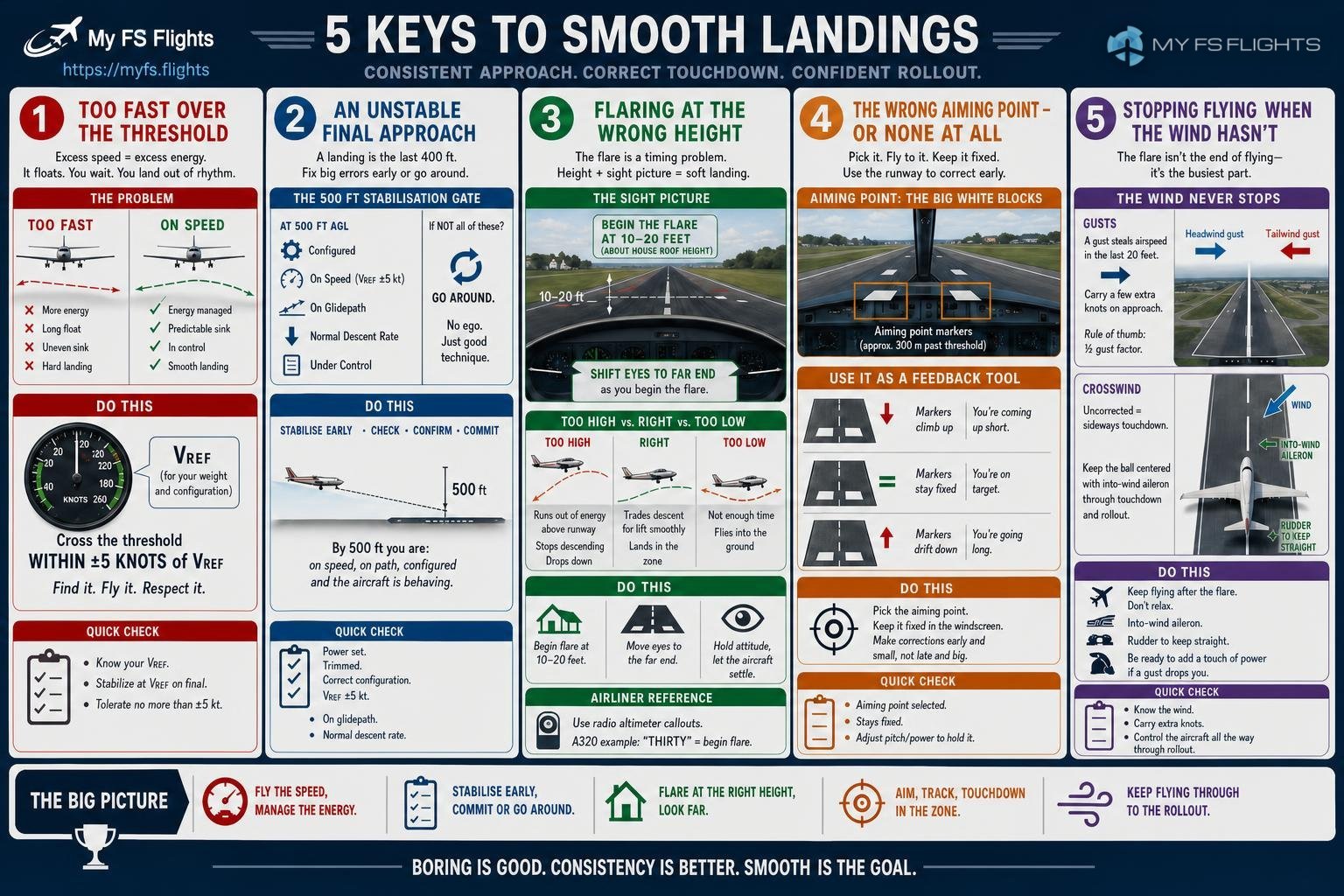
You've read the advice. Reduce power over the threshold, look down the runway, flare gently, hold it off. You've done all of it, and the landings are still wrong. Sometimes a slam that bounces the camera, sometimes a balloon followed by a drop, sometimes a touchdown so gentle and so far down the runway that you would have gone off the end of anything shorter. And nobody has told you what a good landing actually measures, so you can't even tell how far off you are.
The uncomfortable starting point is that smoothness is an output. It falls out of an approach flown at the right speed, in trim, on the right path, followed by a flare timed by height rather than by feel. Trying to produce it in the last three seconds, from whatever state you arrive in, is why the same advice keeps failing. Working backwards from the touchdown is the only order that makes sense of it, because every number that decides the landing was set before the flare began.
The number nobody shows real pilots
Touchdown quality has an exact number. Vertical speed at the moment the wheels touch, in feet per minute. Real pilots almost never see it, because only aircraft with flight-data recorders and a monitoring programme get told. Your simulator knows it on every landing, which is one of the few areas where a desk pilot has better feedback than a real student.
Rough bands, for orientation rather than gospel.
| Touchdown rate | What it is |
|---|---|
| Under ~100 fpm | The "greaser". Feels like nothing. |
| ~100 to 250 fpm | A normal, good landing. What airline pilots actually produce day to day. |
| ~250 to 400 fpm | Firm. Noticeable, unremarkable, sometimes deliberate. |
| Higher | Hard. In the real world, above a type-specific threshold it triggers a maintenance inspection. |
Two calibration points stop these bands being misread. First, transport-category landing gear is designed around a descent rate of 10 feet per second, 600 fpm, at the design landing weight. That's a certification design case, not a target and not a damage line, but it tells you that a 300 fpm touchdown is nowhere near the structure's limits. "Firm" and "hard" are different words for a reason. Second, an autoland typically puts the aircraft down noticeably firmer than the community's idea of a good landing, entirely on purpose. A positive touchdown spins the wheels up promptly and gets the ground spoilers and autobrake working.
So the target is not "as close to zero as possible". A good landing touches down around the first 1,000 to 1,500 feet, the aiming point, which sits comfortably inside the touchdown zone proper, conventionally the first 3,000 feet or the first third of the runway, whichever is less. Add the right speed, a rate somewhere in the normal band, and the centreline, and that's the whole definition. Hold that definition, because the last section of this article comes back to why the community's favourite number is the wrong one to chase.
What the flare actually does, mechanically
On a 3° glideslope your sink rate in feet per minute is roughly your groundspeed in knots times five (5.3, strictly). A Cessna 172 at 65 kt groundspeed is coming down at about 345 fpm. An A320 at 140 kt groundspeed is coming down at about 740 fpm. That rule is worth more than any table because it works for whatever you fly, and it makes two things obvious immediately. A headwind lowers your groundspeed and therefore the sink you must arrest, which is why everyone's best landings happen into wind. And the entire job of the flare is to take that 350 to 750 fpm and reduce it to something in the normal band, in roughly the last five seconds of the flight.
The flare does it by trading energy. Raising the nose increases angle of attack, which increases lift, which reduces sink, and it pays for that lift with airspeed. The trade only works while you still have speed above the stall. Arrive fast and you have too much to trade. The aircraft refuses to come down and floats. Arrive slow and you have nothing to trade. You pull, nothing happens, and the ground arrives at the sink rate you brought with you. This single mechanism explains most of the folk advice you've already read, and it's why approach speed, not flare technique, is the first thing to check when landings go wrong.
Two more pieces of mechanism, both usually left out of tutorials.
Ground effect becomes significant within roughly one wingspan of the surface. A 172's span is about 36 feet, so it enters ground effect at almost exactly flare height and gets a free cushion of reduced drag and reduced sink right when it needs one, which is why light aircraft can be held off and landed near the stall. A 747-400's span is about 211 feet, so it has effectively been in ground effect for the whole final stage of the approach and gets no sudden cushion. This, not tradition, is why jets are flown on with a small pitch change, roughly 2 to 3°, rather than held off. Holding a jet off GA-style bleeds speed with the nose rising, and in long-body types the tail is closer to the pavement than the sight picture suggests. Learn one aircraft's flare and its numbers before switching, because the technique doesn't transfer between classes.
Trim is the hidden variable. In trim, the flare is a small refinement to an aircraft already in equilibrium, a couple of millimetres of stick. Out of trim, you're holding a constant force all the way down final, and the flare becomes a large, badly judged movement stacked on top of a load you're already carrying. A striking proportion of "I can't judge the flare" complaints are trim complaints wearing a disguise. If you're holding pressure at 500 feet, fix that before you practise anything else.
In jets, the thrust cut is part of the flare, not a separate action. Engines take seconds to spool down from approach thrust, and underslung engines pitch the nose down as thrust decays, so closing the levers passing roughly 20 to 30 feet is itself a pitch input you must anticipate. And the landing is not over at touchdown. The nose is lowered flying, by relaxing back pressure, not by releasing the stick and letting it drop. A soft mains touchdown followed by a slammed nosewheel is a bad landing that started well.
Why a monitor makes all of this harder
Real pilots flare on two cues, and a desk provides neither.
The first is peripheral visual flow. In the last twenty feet, height and sink are judged not from the aim point but from the rate at which the runway edges and surrounding ground stream past the corners of your vision. This is also why "look at the far end of the runway" works. It's not superstition. It stops you staring at the aim point (which you will otherwise fly into) and hands the height judgement to your peripheral vision, which is the part actually equipped to make it. A single monitor at default field of view shows a fraction of what human vision covers, so the runway-widening, ground-rush cue arrives late and weak. This is why sim